Logo

American Heart Association

  21
  0


Final ID: MP437

Comparative Associations of Estrone, Estrone Sulfate, and Estradiol With Cardiovascular Events: Evidence From NHANES 2017–2023

Abstract Body (Do not enter title and authors here):
Background:
Emerging research underscores the importance of endogenous estrogens in cardiovascular health across sexes. Estrone sulfate, a stable circulating estrogen reservoir, has been shown to have longer half-life and greater concentrations than estradiol, particularly in postmenopausal women. While estradiol is traditionally considered the dominant cardioprotective hormone, recent findings suggest estrone sulfate may exert direct vascular effects and influence inflammation and lipid metabolism. However, the role of estrone, estrone sulfate, and estradiol in relation to major cardiovascular events—such as heart failure (HF), coronary artery disease (CAD), and myocardial infarction (MI)—remains incompletely understood.
Methods:
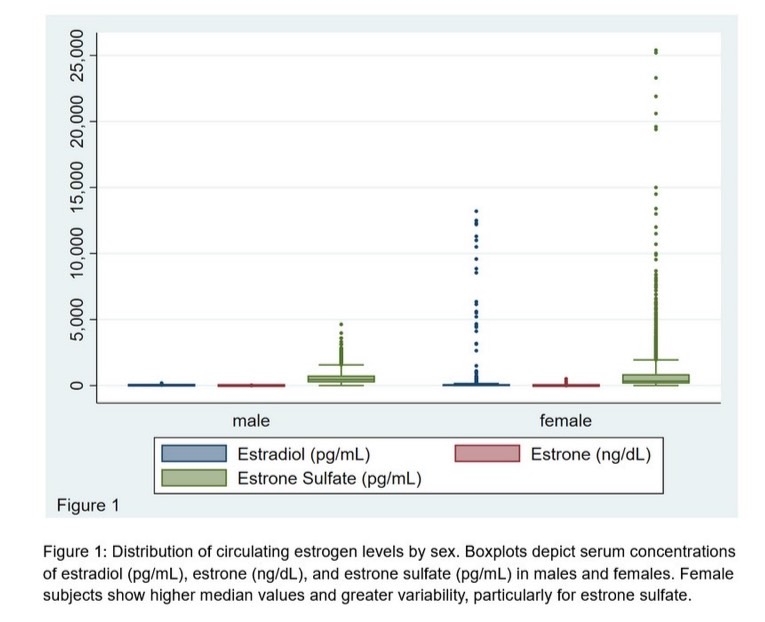
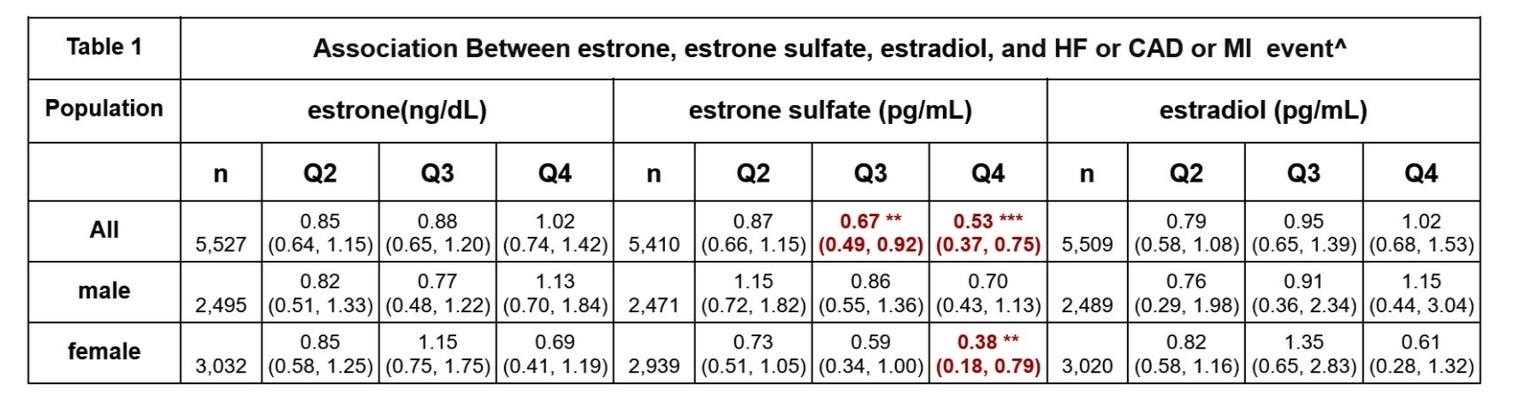
We conducted a cross-sectional analysis of 5,527 participants (2,495 males and 3,032 females) from NHANES with available serum hormone data. Subjects were stratified into quartiles (Q1–Q4) by levels of estrone (ng/dL), estrone sulfate (pg/mL), and estradiol (pg/mL). Multivariate logistic regression was performed to examine the association of each hormone with risk of HF, CAD, or MI, adjusting for age, sex, race, BMI, smoking, diabetes, dyslipidemia, and hypertension.
Results:
Higher estrone sulfate levels were associated with significantly reduced odds of cardiovascular events. In the overall cohort, Q3 and Q4 estrone sulfate levels were associated with lower risk: OR 0.67 (95% CI: 0.49–0.92) and OR 0.53 (95% CI: 0.37–0.75), respectively. Among females, Q4 estrone sulfate showed an even stronger protective effect (OR 0.38, 95% CI: 0.18–0.79). No consistent associations were found between estrone or estradiol levels and cardiovascular outcomes across groups, though the trends varied by sex.
Conclusions:
Estrone sulfate was independently associated with lower risk of HF, CAD, or MI, especially among women, highlighting its potential cardioprotective role. These findings suggest that estrone sulfate may be a more relevant biomarker than estradiol in cardiovascular risk stratification, warranting further mechanistic studies.
  • Kulthamrongsri, Narathorn  ( UHIMRP at Queen's medical center , Honolulu , Hawaii , United States )
  • Kulthamrongsri, Kritpong  ( Faculty of Medicine, Chulalongkorn University , Bangkok , Thailand )
  • Srikulmontri, Thitiphan  ( Albert Einstein Medical Center , Philadelphia , Pennsylvania , United States )
  • Nuchpramool, Prachawanee  ( Ramathibodi Hospital, Mahidol University , Bangkok , Thailand )
  • Yinadsawaphan, Thanaboon  ( St. Elizabeth Medical , Boston , Massachusetts , United States )
  • Lorlowhakarn, Koravich  ( St. Elizabeth Medical , Boston , Massachusetts , United States )
  • Thiravetyan, Ben  ( TTUHSC , Lubbock , Texas , United States )
  • Puchongmar, Chanokporn  ( TTUHSC , Lubbock , Texas , United States )
  • Wattanachayakul, Phuuwadith  ( Albert Einstein Medical Center , Philadelphia , Pennsylvania , United States )
  • Suenghataiphorn, Thanathip  ( Griffin hospital Residency Program , Derby , Connecticut , United States )
  • Deepan, Natee  ( Faculty of Medicine, Chulalongkorn University , Bangkok , Thailand )
  • Author Disclosures:
    Narathorn Kulthamrongsri: DO NOT have relevant financial relationships | Kritpong Kulthamrongsri: No Answer | Thitiphan Srikulmontri: No Answer | Prachawanee Nuchpramool: DO NOT have relevant financial relationships | Thanaboon Yinadsawaphan: DO NOT have relevant financial relationships | Koravich Lorlowhakarn: DO NOT have relevant financial relationships | Ben Thiravetyan: DO NOT have relevant financial relationships | Chanokporn Puchongmar: No Answer | Phuuwadith Wattanachayakul: No Answer | Thanathip Suenghataiphorn: DO NOT have relevant financial relationships | Natee Deepan: No Answer
Meeting Info:

Scientific Sessions 2025

2025

New Orleans, Louisiana

Session Info:

CKM Syndrome Care and Outcomes Among Women and Young Adults

Saturday, 11/08/2025 , 12:15PM - 01:30PM

Moderated Digital Poster Session

More abstracts on this topic:
A Non-odorant Olfactory Receptor Ligand Depolymerizes the Platelet Actin Cytoskeleton to Prevent Thrombosis

Aggarwal Anu, Godwin Matthew, Ali Mariya, Jennings Courtney, Rajasekar Bhairavi, Scalise Alliefair, Stauffer Shaun, Mccrae Keith, Mcintyre Thomas, Cameron Scott, Wang Nancy, Josyula Vara Prasad, Yang Moua, Young Shim, Kennedy Quinn, Samuel Reina, Sangwan Naseer, Guntupalli Suman

Deciphering the drivers of cardiac sex differences in the ObscurinΔIg58/59 mouse model

Brong Annie, Grogan Alyssa, Kontrogianni-konstantopoulos Aikaterini

More abstracts from these authors:
Association between Age at Menopause and Age at Onset of Myocardial Infarction: An Analysis of NHANES Data from 2017-2020

Kulthamrongsri Narathorn, Saowapa Sakditad, Danpanichkul Pojsakorn, Ongsupankul Sorawit, Sripusanapan Adivitch, Wareesawetsuwan Nicha, Lorlowhakarn Koravich, Deepan Natee, Mohpichai Nopavit, Siritongtaworn Phatsawut, Tantisattamo Ekamol, Suriyathumrongkul Napat, Wanichwecharungruang Nisha, Nuchpramool Prachawanee, Kulthamrongsri Kritpong, Siramongkholkarn Smuch, Kookanok Chutawat, Yinadsawaphan Thanaboon, Wattanachayakul Phuuwadith

Circulating Androgen Precursors and Cardiovascular Risk: Insights From NHANES 2017-2023

Kulthamrongsri Narathorn, Kulthamrongsri Kritpong, Srikulmontri Thitiphan, Nuchpramool Prachawanee, Yinadsawaphan Thanaboon, Suenghataiphorn Thanathip, Lorlowhakarn Koravich, Thiravetyan Ben, Puchongmart Chanokporn, Wattanachayakul Phuuwadith, Ngaohirunpat Sorawis

You have to be authorized to contact abstract author. Please, Login
Not Available