
Logo

American Heart Association

  21
  0


Final ID: MP26

Evidence of Cerebral Vascular Stunning Following Ischemic Stroke Revealed by Myogenic Oscillatory Activity in Rats

Abstract Body (Do not enter title and authors here): Introduction:
Cerebral blood flow (CBF) signals contain physiological information about the dynamics of the heart, brain, and their interaction during ischemic stroke. Traditional frequency-based analyses may miss critical dynamic changes due to inter-subject variability. We hypothesize that a time-frequency approach can extract more detailed information from CBF’s physiological frequency bands to better detect stroke-induced cerebral hemodynamic changes. This study applies empirical mode decomposition (EMD) and the Hilbert transform to extract dynamic-specific features from CBF signals in a rat stroke model.
Methods:
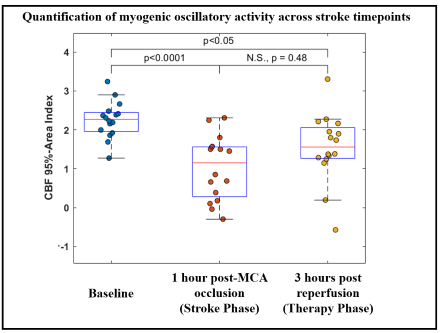
Sixteen rats underwent transient right middle cerebral artery (MCA) occlusion, with CBF recorded continuously from the right cortex. 5-minute CBF recordings were analyzed at three timepoints: baseline, 1 hour post-MCA occlusion, and 3 hours post-reperfusion. EMD decomposed each signal into 13 intrinsic mode functions (IMFs), with instantaneous frequencies extracted via the Hilbert transform. IMFs were then recombined into five physiological bands: cardiac (~2–5 Hz), respiratory (~0.4-2 Hz), myogenic (~0.15-0.4 Hz), sympathetic (~0.04-0.15 Hz), and endothelial (~0.0095-0.04 Hz). The Hilbert transform was then applied to each band to compute a 95% area metric (CBF 95%-Area Index) from the analytic signal’s complex-plane trajectory. Statistical tests compared physiological states across timepoints. P-value < 0.05 was considered significant.
Results:
The myogenic band (~0.15-0.4 Hz), associated with vascular smooth muscle activity, showed a significant reduction in the 95% area metric from baseline to occlusion (p<0.0001), and from baseline to reperfusion (p<0.05). No significant change between occlusion and reperfusion, suggesting persistent suppression of myogenic vasomotion during early reperfusion. Other bands showed minor or nonsignificant changes.
Conclusion:
Persistent myogenic oscillatory suppression during early reperfusion suggests a form of cerebral vascular stunning, analogous to stunned myocardium, where contractile function remains impaired despite restored perfusion. This may represent post-ischemic vascular dysfunction in the brain. Alternatively, it may reflect a microvascular no-reflow phenomenon within the cerebral circulation. Frequency-resolved CBF analysis offers a noninvasive approach to detect reperfusion-related vascular dysfunction, with the potential to guide acute stroke therapies and improve cerebrovascular outcomes.
  • Li, Jiajun  ( University of Southern California , Los Angeles , California , United States )
  • Alavi, Rashid  ( Caltech , Los Angeles , California , United States )
  • Dai, Wangde  ( Huntington Medical Research Institu , Pasadena , California , United States )
  • Carreno, Juan  ( HMRI , Pasadena , California , United States )
  • Kloner, Robert  ( Huntington Medical Research Inst. , Pasadena , California , United States )
  • Pahlevan, Niema  ( University of Southern California , Los Angeles , California , United States )
  • Author Disclosures:
    Jiajun Li: DO NOT have relevant financial relationships | Rashid Alavi: DO NOT have relevant financial relationships | Wangde Dai: DO NOT have relevant financial relationships | Juan Carreno: DO NOT have relevant financial relationships | Robert Kloner: DO have relevant financial relationships ; Consultant:Hoskinson Health Clinic:Active (exists now) | Niema Pahlevan: DO have relevant financial relationships ; Consultant:Avicena LLC (Ventric Health):Active (exists now) ; Ownership Interest:Avicena LLC (Ventric Health):Active (exists now)
Meeting Info:

Scientific Sessions 2025

2025

New Orleans, Louisiana

Session Info:

Stroke Mortality, Mechanisms, and Disparities: Trends, Timing, and Technologies

Saturday, 11/08/2025 , 01:45PM - 02:55PM

Moderated Digital Poster Session

More abstracts on this topic:
Active Decompression during Automated Head-up Cardiopulmonary Resuscitation

Pourzand Pouria, Metzger Anja, Moore Johanna, Suresh Mithun, Salverda Bayert, Hai Hamza, Kaizer Alexander, Duval Sue, Bachista Kerry, Lurie Keith

Agreement of Doppler Flow Velocity Reserve With PET Flow Reserve in Angina Without Obstructive Coronaries

Ismayl Mahmoud, Raphael Claire, Prasad Abhiram, Chareonthaitawee Panithaya, Bois John

More abstracts from these authors:
Post-Ischemic Administration of Empagliflozin Reduces Cerebral Infarction but Not Edema in a Rat Ischemic Stroke Model

Dai Wangde, Alavi Rashid, Li Jiajun, Carreno Juan, Pahlevan Niema, Arakaki Xianghong, Kloner Robert

Empagliflozin dramatically reduced stroke size and cerebral edema in a rat model

Dai Wangde, Carreno Juan, Pahlevan Niema, Alavi Rashid, Kloner Robert

You have to be authorized to contact abstract author. Please, Login
Not Available