
Sex Differences in Myocardial Oxygen Supply-Demand Balance After Chronic Nicotine-Free E-Cigarette Exposure
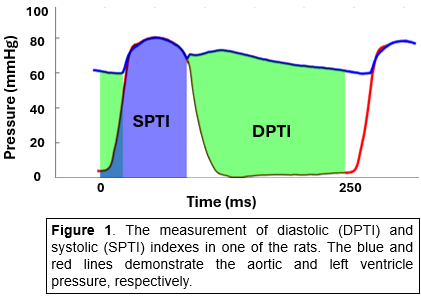
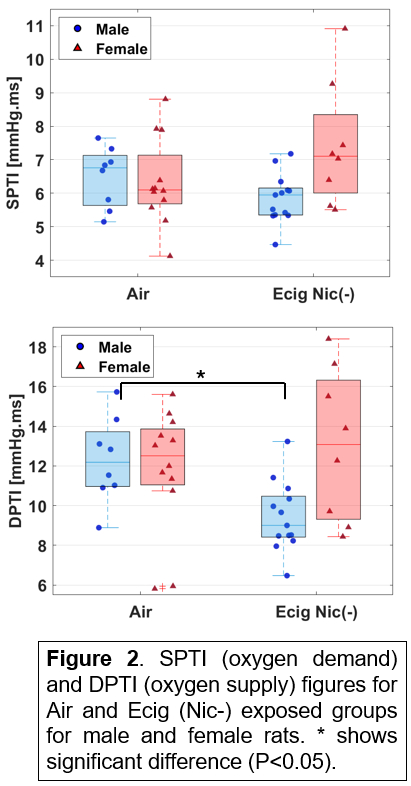
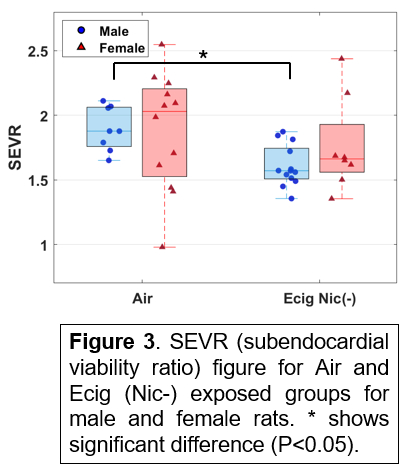
Abstract Body (Do not enter title and authors here): Introduction: Myocardial ischemia results from an imbalance between oxygen supply and demand, typically affecting the subendocardium. The diastolic pressure time index (DPTI) and systolic pressure time index (SPTI) are well-established surrogates for myocardial oxygen supply and demand, respectively. Their ratio (DPTI: SPTI), the subendocardial viability ratio (SEVR), serves as an indicator of subendocardial perfusion adequacy. Methods: A total of 41 young, healthy adult male and female Sprague Dawley rats (n=20 female; weight 187–273 g) were randomized and exposed to: 1) purified air (n=20) and 2) electronic cigarette vapor without nicotine (EC NIC(-), n=21). Rats were exposed by nose-only inhalation for 4-5 hours/day, 4 days/week, for a total of 8 weeks (puff frequency=1 puff/min, puff duration=2 seconds, at a flow rate of 1.67 L/min). For EC(-), a third-generation mod-type vaporizer (VaporFi VEX 150 TC mod, with Volt Tank) was used with a tobacco-flavored e-liquid containing a 50/50 volume ratio of propylene glycol and vegetable glycerin (PG/VG). After 8 weeks of exposure, the rats were anesthetized and catheterized to measure invasive aortic and left ventricular pressure waveforms. These waveforms were used to quantify SPTI, DPTI, and SEVR (Fig. 1). Results: Exposure to EC NIC(-) resulted in a significant change in myocardial oxygen supply in male rats (p<0.05) but not in females (Fig. 2). As there was no significant change in oxygen demand in either sex, male rats showed a significant reduction in the supply: demand ratio (SEVR) compared to air-exposed controls (Fig. 3). Conclusion: Our results suggest that chronic exposure to nicotine-free EC vapor alters myocardial oxygen dynamics in a sex-specific manner. Male rats exhibited impaired subendocardial perfusion following EC NIC(-) exposure, suggesting heightened vulnerability to ischemic imbalance. We propose these effects may be driven by sex-specific cardiac responses to components in the PG/VG base and flavoring agents, which can induce mild oxidative stress and vascular dysfunction, disrupting myocardial oxygen balance differently in males and females.
Rafiei, Deniz
(
University of Southern California
, Los Angeles , California , United States )
Alavi, Rashid
(
Caltech
, Los Angeles , California , United States )
Dai, Wangde
(
Huntington Medical Research Institu
, Pasadena , California , United States )
Herman, David
(
University California, Irvine
, Irvine , California , United States )
Kleinman, Michael
(
University of California, Irvine
, Irvine , California , United States )
Kloner, Robert
(
Huntington Medical Research Inst.
, Pasadena , California , United States )
Pahlevan, Niema
(
University of Southern California
, Los Angeles , California , United States )
Author Disclosures:
Deniz Rafiei:DO NOT have relevant financial relationships
| Rashid Alavi:DO NOT have relevant financial relationships
| Wangde Dai:DO NOT have relevant financial relationships
| David Herman:DO NOT have relevant financial relationships
| Michael Kleinman:DO NOT have relevant financial relationships
| Robert Kloner:DO have relevant financial relationships
;
Consultant:Hoskinson Health Clinic:Active (exists now)
| Niema Pahlevan:DO have relevant financial relationships
;
Consultant:Avicena LLC (Ventric Health):Active (exists now)
; Ownership Interest:Avicena LLC (Ventric Health):Active (exists now)