Psychosocial and Clinical Factors Explain Discordance Between Self-rated Health and Cardiovascular Risk
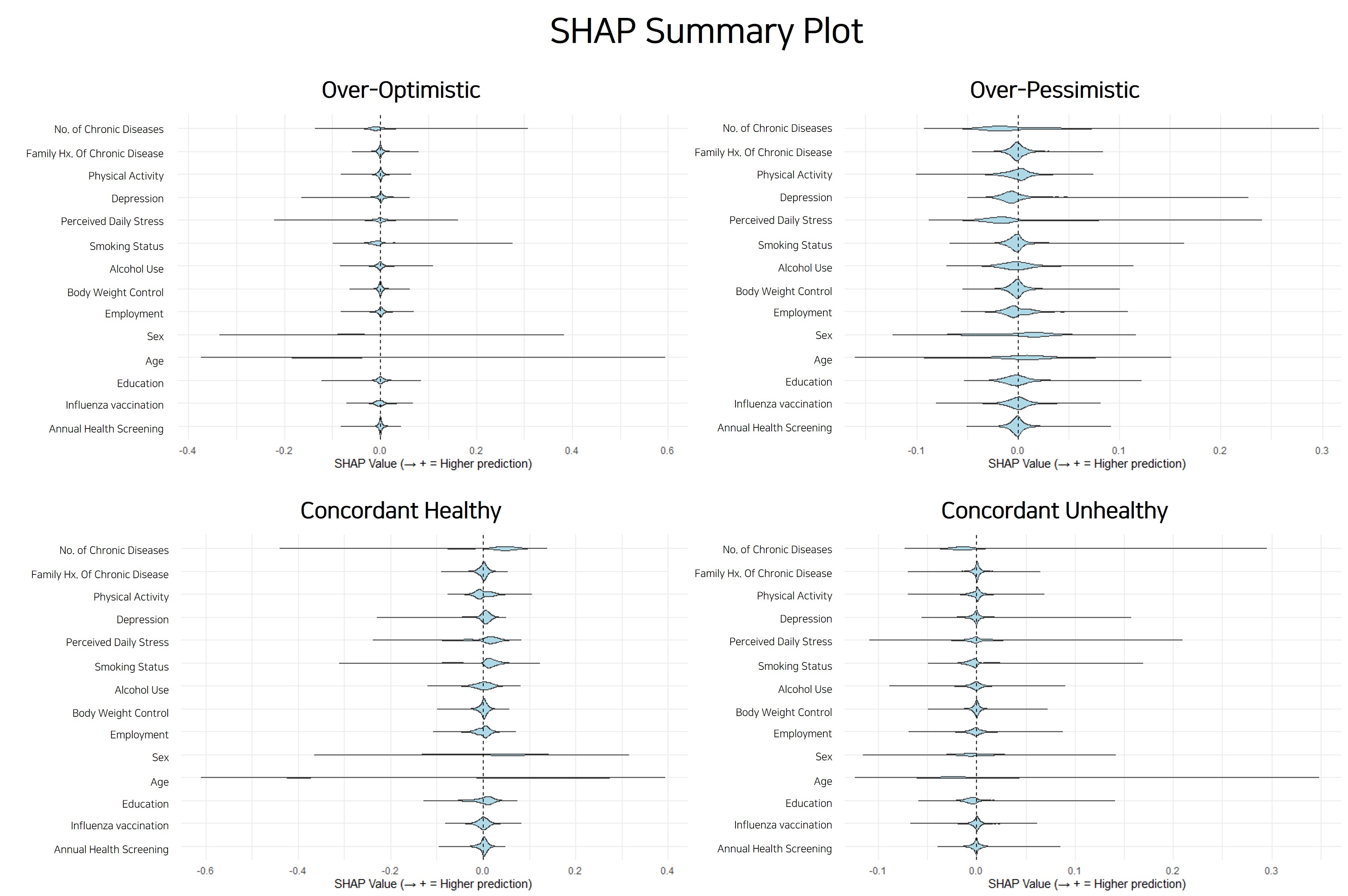
Abstract Body (Do not enter title and authors here): Background: Self-rated health (SRH) is a widely used, valid and cost-efficient indicator of an individual’s overall health status. Its alignment with objective cardiovascular disease (CVD) risk measures, such as the Framingham Risk Score (FRS), is often inconsistent. Identifying the discordance between SRH and FRS can help detect individuals who either underestimate or overestimate their health status. Understanding the characteristics of these discordant groups is essential for improving health communication and targeted interventions. This study aimed to identify predictors of discordance between SRH and the FRS using machine learning and explainable artificial intelligence. Methods: The 2021–2023 Korea National Health and Nutrition Examination Survey (KNHANES) was used, including adults aged 19 and older. Participants were classified into four groups based on SRH (good vs. poor) and FRS (low vs. high risk): Concordant Healthy, Concordant Unhealthy, Over-optimistic, and Over-pessimistic. A Random Forest model was applied to predict group classification based on sociodemographic, behavioral, and psychological characteristics. SHAP (SHapley Additive exPlanations) analysis was conducted to interpret the direction and magnitude of feature contributions to group predictions. Results: Among 9,012 individuals, the most important predictors identified by the Random Forest model included age, sex, number of chronic diseases, smoking status, perceived daily stress, and education. In the Over-optimistic group (high FRS, good SRH), older age, male sex contributed most to discordance. In the Over-pessimistic group (low FRS, poor SRH), higher perceived daily stress and depression, and increased number of chronic diseases were most influential contributors. Concordant Healthy individuals (low FRS, good SRH) were younger and had fewer chronic diseases, whereas Concordant Unhealthy group (high FRS, poor SRH) was older and had multiple comorbidities, higher daily stress and depression levels. Conclusion: This study identified distinct psychosocial and clinical profiles of individuals whose perceived health misaligns with objective cardiovascular risk. Older, less-educated males were more likely to overrate their health, while individuals with poor mental health and multiple comorbidities tended to underestimate it. Understanding discordance between perceived and actual cardiovascular risk can enhance personalized risk communication and prevention strategies.
Park, Sooyoung
(
Yonsei University
, Seoul , Korea (the Republic of) )
Lee, Juhee
(
Yonsei University
, Seoul , Korea (the Republic of) )
Author Disclosures:
Sooyoung Park:DO NOT have relevant financial relationships
| JuHee Lee:DO NOT have relevant financial relationships