
Logo

American Heart Association

  19
  0


Final ID: Su4039

X-Chromosome-Wide Association Study Identifies Novel Heart Failure Risk Loci with Sex- and Subtype-Specific Effects

Abstract Body (Do not enter title and authors here): Background/Aims: Heart failure (HF) is a leading cause of cardiovascular morbidity and mortality, with notable sex differences. Although the lifetime risk of HF is similar between sexes, HF with preserved ejection fraction (HFpEF) is more common in women, while HF with reduced ejection fraction (HFrEF) predominantly affects men. While genome-wide association studies have identified over 50 loci associated with HF and its subtypes, previous work has focused on autosomes, leaving the X chromosome underexplored despite its biological relevance and clear sex differences in HF. This study presents the first sex-stratified X-chromosome-wide association study (XWAS) of unclassified HF, HFrEF and HFpEF in a multi-ancestry cohort from the Million Veteran Program (MVP).
Methods: We analyzed X-chromosome genotype data from 658,582 MVP participants (91.6% male) across four ancestries: European (72.1%), African American (19.5%), Hispanic (7.5%), and Asian (0.9%). Genotyping was performed using Axiom Biobank Array. Sex- and ancestry- stratified XWAS was conducted using XWAS 3.0 using logistical regression models adjusting for age and the top 10 principal components. Multi-ancestry results were meta-analyzed separately for male and females using GWAMA, incorporating a random-effects model to account for heterogeneity across ancestries. Statistical significance was defined using Bonferroni correction.
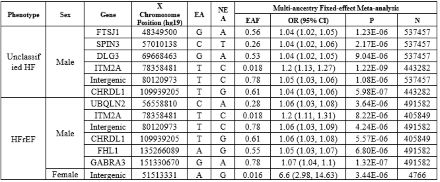
Results: In unclassified HF, a total of 6 loci were identified in males. For HFrEF, 6 loci were identified in males and 1 in females, while no significant loci were identified for HFpEF. (Table 1). Notably, the genomic loci harboring CHRDL1 and ITM2A were significantly associated with both unclassified HF and HFrEF, but only in males. One intergenic locus identified in females with HFrEF indicates a possible female-specific genetic contribution to HF risk. These findings reflect sex-specific genetic pathways potentially involved in cardiac remodeling and immune regulation in HF and its major sub-types. The smaller number of loci identified in females compared to males may be attributable to the predominantly male composition of the MVP cohort.
Conclusions: These results emphasize the need to include the X chromosome in HF genetic studies. The discovery of variants with sex- and subtype-specific effects underscores the role of X-linked genes in HF pathophysiology and supports precision medicine approaches tailored by sex and HF subtype.
  • Ren, Junling  ( VA , Providence , Rhode Island , United States )
  • Liu, Chang  ( Emory University , Johns Creek , Georgia , United States )
  • Hui, Qin  ( Emory University , Atlanta , Georgia , United States )
  • Rasooly, Danielle  ( Veterans Affairs Boston Healthcare , Boston , Massachusetts , United States )
  • Rahafrooz, Maryam  ( Brown University , Wayland , Massachusetts , United States )
  • Pereira, Alexandre  ( BWH , Rochester , Minnesota , United States )
  • Phillips, Lawrence  ( Atlanta VA Medical Center , Decatur , Georgia , United States )
  • Sun, Yan  ( Emory University , Atlanta , Georgia , United States )
  • Joseph, Jacob  ( VA PROVIDENCE HEALTHCARE, BROWN U. , Providence , Rhode Island , United States )
  • Author Disclosures:
    Junling Ren: DO NOT have relevant financial relationships | Chang Liu: DO NOT have relevant financial relationships | Qin Hui: DO NOT have relevant financial relationships | Danielle Rasooly: DO NOT have relevant financial relationships | Maryam Rahafrooz: DO NOT have relevant financial relationships | Alexandre Pereira: No Answer | Lawrence Phillips: DO have relevant financial relationships ; Ownership Interest:Diasyst, Inc.:Active (exists now) ; Research Funding (PI or named investigator):Kowa:Past (completed) ; Research Funding (PI or named investigator):Pfizer:Past (completed) ; Research Funding (PI or named investigator):GSK:Past (completed) ; Research Funding (PI or named investigator):Boehringer-Ingelheim:Active (exists now) ; Research Funding (PI or named investigator):Janssen:Active (exists now) | Yan Sun: DO NOT have relevant financial relationships | Jacob Joseph: DO have relevant financial relationships ; Research Funding (PI or named investigator):Alnylam:Past (completed) ; Research Funding (PI or named investigator):Empallo:Active (exists now)
Meeting Info:

Scientific Sessions 2025

2025

New Orleans, Louisiana

Session Info:

Detecting cardiomyopathy and Heart Failure

Sunday, 11/09/2025 , 03:15PM - 04:15PM

Abstract Poster Board Session

More abstracts on this topic:
Accelerated Pacing Reverses Ventricular Stiffening in a Rodent Model of Diastolic Dysfunction

Kabir Raihan, Hancock Emmaleigh, Wetzel Melinda, Shrier Julia, Palmer Bradley, Habel Nicole, Caporizzo Matthew

3-Mercaptopyruvate Sulfurtransferase is a Critical Regulator of Branched-Chain Amino Acid Catabolism in Cardiometabolic HFpEF

Li Zhen, Doiron Jake, Xia Huijing, Lapenna Kyle, Sharp Thomas, Yu Xiaoman, Nagahara Noriyuki, Goodchild Traci, Lefer David

More abstracts from these authors:
Understanding Diabetic Cardiomyopathy: Clinical Insights from a Case-Control Analysis

Rahafrooz Maryam, Sun Yan, Pereira Alexandre, Gaziano John Michael, Wilson Peter, Phillips Lawrence, Joseph Jacob

Epigenetic Factors Predict Incident Heart Failure with Preserved Ejection Fraction

Sun Yan, Linchangco Gregorio, Hui Qin, Rahafrooz Maryam, Gaziano J Michael, Wilson Peter, Phillips Lawrence, Joseph Jacob

You have to be authorized to contact abstract author. Please, Login
Not Available