Quality of Amiodarone Monitoring in a Veterans Affairs Healthcare System
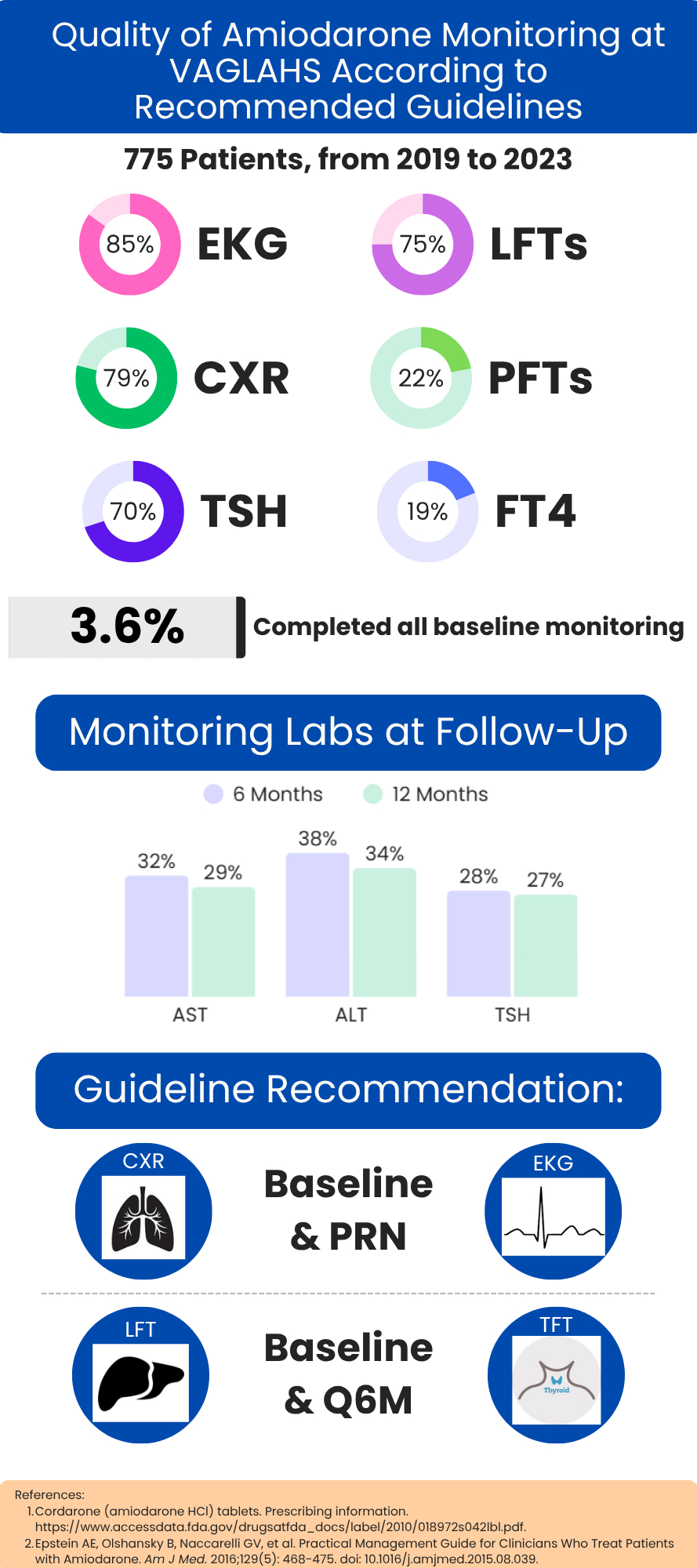
Abstract Body (Do not enter title and authors here): Background: Amiodarone is widely utilized for managing atrial and ventricular arrhythmias, but is associated with pulmonary, liver, and thyroid toxicities. Previous studies demonstrated limited adherence to guidelines for amiodarone monitoring. Research Question: To evaluate the quality of amiodarone monitoring and identify factors influencing its quality within the VA Greater Los Angeles Healthcare System (VAGLAHS). Methods: This retrospective cohort study included Veterans ≥18 years with new amiodarone prescriptions between January 1, 2019 and July 31, 2023; hospice patients were excluded. Quality of monitoring outcomes included baseline pulmonary function tests (PFTs), chest X-ray (CXR), liver function tests (LFTs), thyroid function tests (TFTs; thyroid stimulating hormone (TSH) and free T4 (FT4)), and electrocardiogram (EKG), as well as LFTs and TSH at 6 months and 12 months after initiation. Logistic regression was used to identify characteristics associated with quality of monitoring, with potential variables chosen based on clinical judgment. Results: Of 775 patients, 79% completed CXRs, 22% PFTs, 87% ALT, 75% AST, 70% TSH, 19% FT4, and 85% EKGs at baseline with 3.6% completing all baseline tests. Variables associated with baseline LFT monitoring included inpatient initiation (OR 3.30; 95%CI 2.21-4.93; P<0.0001), concomitant DOAC use (OR 2.65; 95%CI 1.79-3.93; P<0.0001), liver disease (OR 1.95; 95%CI 10.7-3.57; P=0.03), Black race (OR 1.61; 95%CI 1.00-2.56; P=0.05), age (OR 1.02; 95%CI 1.00-1.04; P=0.02) and VA initiation (OR 0.61; 95%CI 0.42-0.89; P=0.01). For baseline TFT monitoring, VA initiation was a positive factor (OR 1.60; 95%CI 1.07-2.40; P=0.02). At 6 months, 38%, 32%, and 28% had ALT, AST, and TSH evaluated respectively, with 34%, 29%, and 27% evaluated at 12 months. No medical visit at 6 or 12-months was associated with less LFT monitoring (6-month OR 0.09; 95%CI 0.03-0.28; P<0.0001, 12-months OR 0.16; 95%CI 0.05-0.51; P=0.002) and less TSH monitoring (6-months OR 0.13; 95%CI 0.04-0.40; P=0.0005, 12-months OR 0.21; 95%CI 0.06-0.77; P=0.02). A cardiology visit at 12 months (OR 2.32; 95%CI 1.25-4.31; P=0.008) was associated with TSH monitoring. Conclusion: While a majority received CXR, LFTs and TSH monitoring at baseline, only a minority completed all baseline testing and monitoring was suboptimal at follow up. Future studies should investigate both reasons for lack of amiodarone monitoring and potential interventions for improvement.
Wang, Anna
(
VA Greater Los Angeles - UCLA
, Los Angeles , California , United States )
Ahn, Joy
(
VA Greater Los Angeles - UCLA
, Los Angeles , California , United States )
Morimoto, Cherie
(
VA Greater Los Angeles - UCLA
, Los Angeles , California , United States )
Yuge, Dora
(
VA Greater Los Angeles - UCLA
, Los Angeles , California , United States )
Han, Janet
(
VA Greater Los Angeles - UCLA
, Los Angeles , California , United States )
Jackevicius, Cynthia
(
WESTERN UNIVERSITY
, Pomona , California , United States )
Author Disclosures:
Anna Wang:DO NOT have relevant financial relationships
| Joy Ahn:DO NOT have relevant financial relationships
| Cherie Morimoto:DO NOT have relevant financial relationships
| Dora Yuge:DO NOT have relevant financial relationships
| Janet Han:DO have relevant financial relationships
;
Consultant:Medtronic:Past (completed)
; Consultant:Abbott:Past (completed)
; Consultant:iRhythm:Past (completed)
| Cynthia Jackevicius:DO NOT have relevant financial relationships