
Logo

American Heart Association

  21
  0


Final ID: Mo3046

Artificial Intelligence ECG Model To Reduce False-Positive STEMI Alerts in the Emergency Department

Abstract Body (Do not enter title and authors here): Introduction: Current STEMI alert pathways triggered in the emergency department often result in high false-positive rates and frequent cancellations by cardiology. AI-based ECG analysis may improve diagnostic accuracy and resource use in suspected occlusive myocardial infarction (OMI).

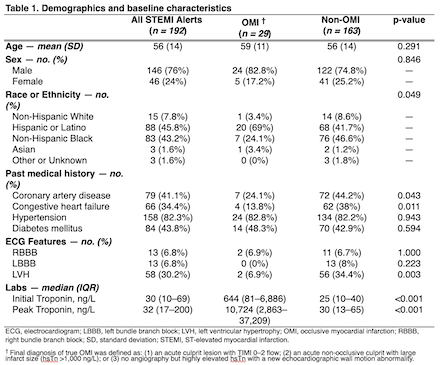
Objective: To evaluate the predictive performance of an AI deep learning ECG algorithm in identifying OMI among ED-triggered STEMI Alerts (SAs), including subgroup analysis in common STEMI mimic patterns of LVH and LBBB.

Methods: We retrospectively analyzed ED-triggered SAs in adult patients at a large, urban, tertiary academic medical center from January 1 to October 31, 2024. Alerts were activated by ED physicians and assessed by cardiologists for emergent catheterization lab activation (CLA). Cases initiated by EMS or post-cardiac arrest were excluded. Pre-alert ECGs were analyzed by the Queen of Hearts (QoH) AI model and classified as OMI or non-OMI. True OMI was defined by either (1) an acute culprit lesion with TIMI 0–2 flow, (2) an acute non-occlusive culprit with large infarct size (hsTn >1000 ng/L), or (3) no angiography but highly elevated hsTn with a new echocardiographic wall motion abnormality. QoH model performance was compared to standard clinical interpretation, including cardiologist-determined CLA.

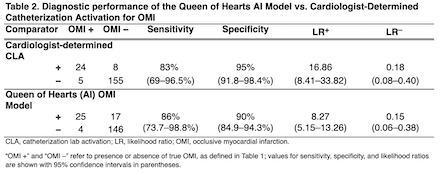
Results: Of the 192 SAs, 29 were true OMIs, reflecting an 85% false-positive rate. Emergent CLA was performed in 32 cases, with 24 confirmed OMIs (Sn 83%, Sp 95%). Five OMIs occurred among the 160 cancelled alerts. The QoH model identified 42 cases as OMI, correctly detecting 25 of 29 (Sn 86%, Sp 89%), including 3 of the 5 missed by cardiology. Among 58 SAs with LVH, QoH identified both true OMIs (Sn 100%, Sp 95%). None of the 13 LBBB cases were OMI (Sp 92%).

Conclusion: The QoH AI model has the potential to substantially reduce false-positive ED-triggered STEMI alerts and exhibited diagnostic performance comparable to cardiologist-determined CLA. Notably, QoH identified OMI cases missed by standard clinical evaluation and was highly accurate in patients with LVH—a common STEMI mimic in this population. These findings support the potential of AI-assisted ECG interpretation to enhance triage accuracy and optimize resource utilization in acute cardiac care.
  • Davis, Adam  ( Baylor College of Medicine , Houston , Texas , United States )
  • Mesbah, Heba  ( Baylor College of Medicine , Friendswood , Texas , United States )
  • Boone, Stephen  ( Baylor College of Medicine , Friendswood , Texas , United States )
  • Author Disclosures:
    Adam Davis: DO NOT have relevant financial relationships | Heba Mesbah: No Answer | Stephen Boone: DO NOT have relevant financial relationships
Meeting Info:

Scientific Sessions 2025

2025

New Orleans, Louisiana

Session Info:

AI, Advanced Imaging & Rapid Diagnostics in ACS

Monday, 11/10/2025 , 10:30AM - 11:30AM

Abstract Poster Board Session

More abstracts on this topic:
Alpha-Delta Ratio as an Acute Marker of Intracerebral Hemorrhage on Sub-galeal EEG

Cummins Daniel, Bose Javin, Kalagara Roshini, Waziri Allen, Dangayach Neha, Kellner Christopher

A large-scale multi-view deep learning-based assessment of left ventricular ejection fraction in echocardiography

Jing Linyuan, Metser Gil, Mawson Thomas, Tat Emily, Jiang Nona, Duffy Eamon, Hahn Rebecca, Homma Shunichi, Haggerty Christopher, Poterucha Timothy, Elias Pierre, Long Aaron, Vanmaanen David, Rocha Daniel, Hartzel Dustin, Kelsey Christopher, Ruhl Jeffrey, Beecy Ashley, Elnabawi Youssef

You have to be authorized to contact abstract author. Please, Login
Not Available