
Rhythmic feeding behavior modifies the circadian phase in the autonomic regulation of heart rate in mice
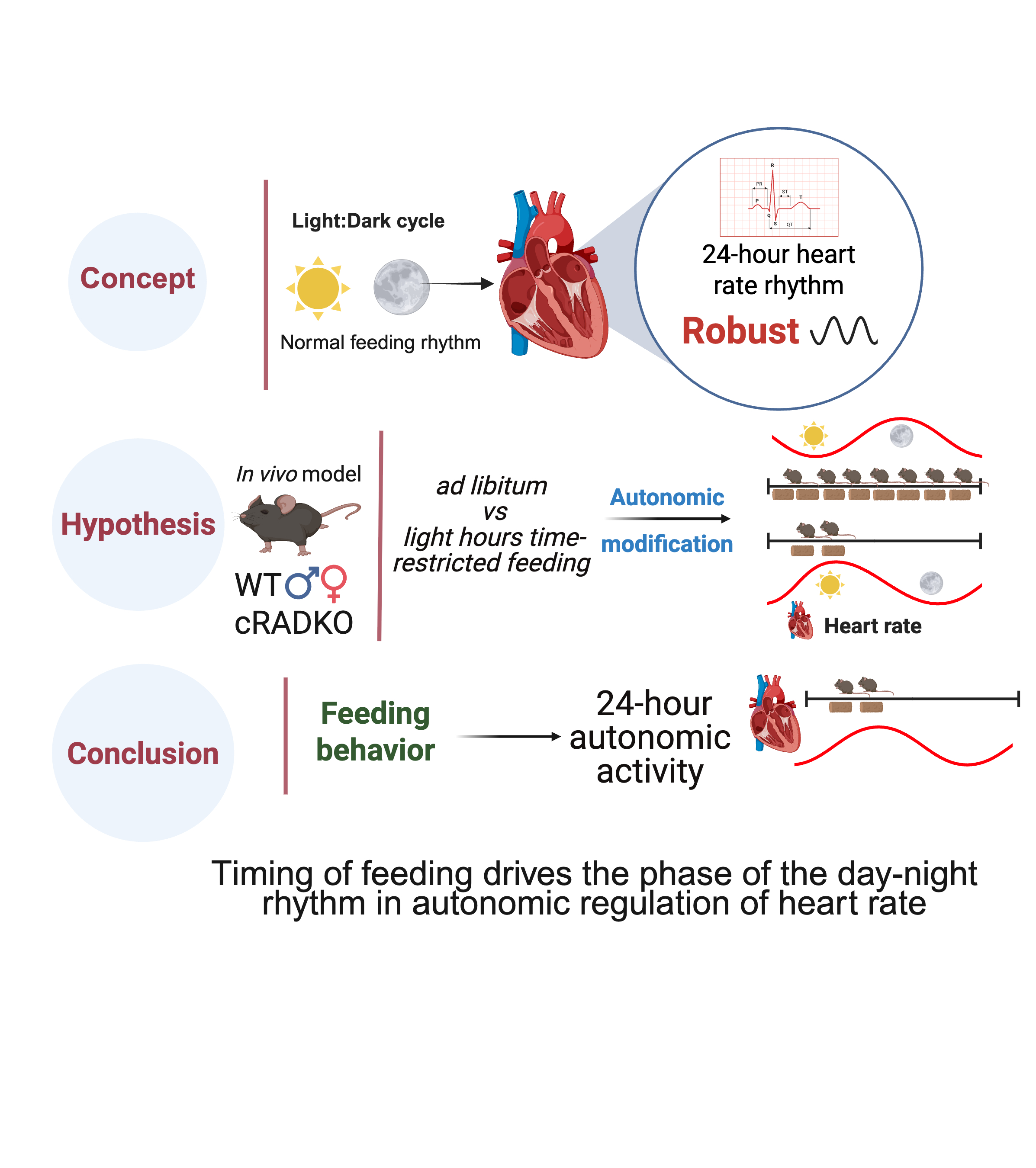
Abstract Body (Do not enter title and authors here): Background: Eating during the appropriate time of day can mitigate changes in autonomic cardiovascular risk factors. The goal of this study is to determine the mechanism(s) that connect the timing of feeding to changes in the autonomic regulation of heart rate (HR) in mice. Hypothesis: The timing of feeding behavior modifies autonomic input to the heart to mask circadian rhythms in the HR. Methodology: Wild-type (WT) and inducible cardiomyocyte-specific knockout of the RRAD gene (cRADKO) mice were implanted with telemetry devices to continuously record HR using electrocardiography, core body temperature (Tb), and activity. The cRADKO mice were used to test the role of autonomic regulation, because the cardiac response to β-adrenergic stimulation relies on Rad disinhibition of voltage-gated calcium channels. WT mice were housed in 12-hour light: 12-hour dark cycles (LD) with ad libitum food (ALF) access at room temperature were exposed to thermoneutrality. Mice were subjected to light cycle time-restricted feeding (TRF) for 6 days, followed by constant darkness (DD) for 3 days, and returned to ALF for 3 days under DD. The change in HR associated with autonomic nervous system regulation (ΔHR) was quantified across the 24-hour cycle by subtracting the experimentally measured HR and the intrinsic HR (HR measured after autonomic inhibition and adjusted for Tb). Results: Housing mice (n=6/sex) in thermoneutrality decreased HR in mice. Mice with ALF access housed in LD had 24-hour rhythms in HR, Tb, and activity that all peaked in phase alignment during the dark cycle. One day after starting light cycle TRF, the onset of the 24-hour rhythm in HR and ΔHR (but not activity) shifted by 8-10 hours to align with food access during the light cycle (p<0.0001; ALF vs TRF). Switching TRF mice from LD to DD did not alter the onset of the day-night rhythms in HR, ΔHR, or activity. Returning the TRF mice housed in DD to ALF access re-aligned the onset of the HR and ΔHR rhythms with activity rhythms. Repeating control and cRADKO mice (n=5-6/group) showed similar results with light cycle TRF as WT mice. The day-night HR rhythm in cRADKO was 25% larger compared to control (p<0.05), suggesting the realignment of HR is largely mediated by the vagal input. Conclusions: The data show that the timing of feeding behavior in mice drives the phase of the day-night rhythm in autonomic regulation of HR, and TRF can mask the circadian rhythm in the autonomic regulation of HR.
Prabhat, Abhilash
( University of Kentucky
, Lexington
, Kentucky
, United States
)
Stumpf, Isabel
( University of Kentucky
, Lexington
, Kentucky
, United States
)
Ehlman, Allison
( University of Kentucky
, Lexington
, Kentucky
, United States
)
Stalcup, Rebecca
( University of Kentucky
, Lexington
, Kentucky
, United States
)
Seward, Tanya
( University of Kentucky
, Lexington
, Kentucky
, United States
)
Satin, Jonathan
( University of Kentucky
, Lexington
, Kentucky
, United States
)
Schroder, Elizabeth
( University of Kentucky
, Lexington
, Kentucky
, United States
)
Delisle, Brian
( University of Kentucky
, Lexington
, Kentucky
, United States
)
Author Disclosures:
Abhilash Prabhat:DO NOT have relevant financial relationships
| Isabel Stumpf:No Answer
| Allison Ehlman:No Answer
| Rebecca Stalcup:No Answer
| Tanya Seward:No Answer
| Jonathan Satin:No Answer
| Elizabeth Schroder:DO NOT have relevant financial relationships
| Brian Delisle:DO NOT have relevant financial relationships