Asymmetric Pulmonary Artery Geometry Drives Branch-Specific Shear Stress Patterns in Repaired Tetralogy of Fallot: A Substudy of the Single Center Cardiac Magnetic Resonance Outcomes Registry – Tetralogy of Fallot
Abstract Body (Do not enter title and authors here): Introduction: In repaired tetralogy of Fallot (rToF), asymmetric remodeling of the pulmonary arteries (PA) leads to branch-specific hemodynamic changes. Geometric factors such as curvature influence wall shear stress (WSS) patterns, with distinct effects between the left (LPA) and right pulmonary arteries (RPA). Oscillatory shear index (OSI), which quantifies directional changes in WSS over the cardiac cycle, is a key marker of disturbed flow. This study investigates how curvature and other geometric factors influence hemodynamics in these two branches.
Hypothesis: We hypothesize that geometric features influence PA hemodynamics in a branch-specific manner, with curvature having a stronger association with shear-related metrics in certain regions compared to others.
Methods: Patient-specific PA models (n = 22) were reconstructed from cardiac magnetic resonance imaging, and computational fluid dynamics simulations were performed under steady and pulsatile flow conditions with patient-derived boundary conditions. Geometric parameters, including curvature and tortuosity, and hemodynamic metrics, including time-averaged WSS and OSI, were quantified. Spearman correlations assessed branch-specific relationships.
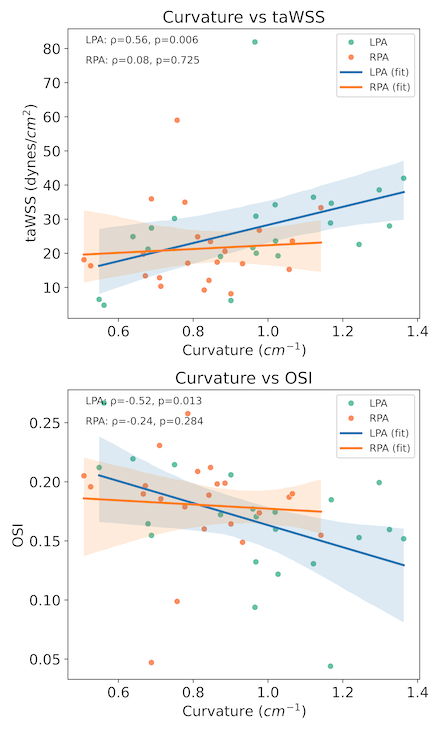
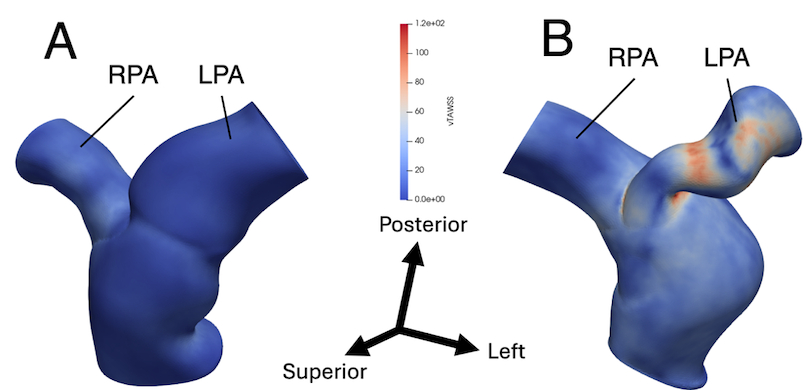
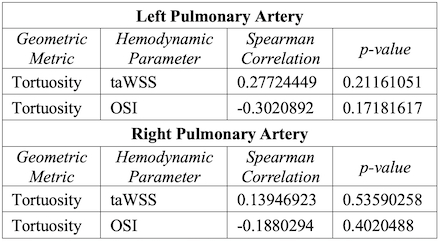
Results: In the LPA, curvature showed a strong positive correlation with time-averaged WSS (ρ = 0.56, p = 0.006) and a negative correlation with OSI (ρ = -0.52, p = 0.013), indicating that higher curvature segments exhibit more unidirectional, high-shear flow (Figures 1 and 2). In contrast, RPA curvature did not correlate significantly with any of the measured hemodynamic variables (all p > 0.28). The LPA curvature was significantly greater than the RPA curvature (p = 0.015). Tortuosity did not show significant correlations with hemodynamics in either branch (p > 0.17), suggesting that curvature is the dominant geometric modulator of wall shear stress (Table 1).
Conclusions: The LPA’s curvature-dependent hemodynamics characterized by significant time-averaged WSS and OSI patterns contrast with the RPA’s lack of such correlations. Anatomically, the RPA’s straighter anatomy minimizes flow disruption whereas the LPA curvature increases flow disruption. This study’s results align with prior studies showing sharper angulation in the LPA post-repair, promoting flow acceleration. Clinically, these findings highlight the importance of branch-specific geometric and hemodynamic assessments in rToF follow-up.
Bhattacharya, Anindro
(
University of Pennsylvania
, Philadelphia , Pennsylvania , United States )
Thompson, Elizabeth
(
University of Pennsylvania
, Philadelphia , Pennsylvania , United States )
Hu, Fengling
(
University of Pennsylvania
, Philadelphia , Pennsylvania , United States )
Shinohara, Russell
(
University of Pennsylvania
, Philadelphia , Pennsylvania , United States )
Perdikaris, Paris
(
University of Pennsylvania
, Philadelphia , Pennsylvania , United States )
Whitehead, Kevin
(
CHILDRENS HOSPITAL OF PHILADELPHIA
, Philadelphia , Pennsylvania , United States )
Goldmuntz, Elizabeth
(
CHILDRENS HOSPITAL OF PHILADELPHIA
, Philadelphia , Pennsylvania , United States )
Fogel, Mark
(
CHILDRENS HOSPITAL OF PHILADELPHIA
, Philadelphia , Pennsylvania , United States )
Witschey, Walter
(
University of Pennsylvania
, Philadelphia , Pennsylvania , United States )
Author Disclosures:
Anindro Bhattacharya:DO NOT have relevant financial relationships
| Elizabeth Thompson:DO NOT have relevant financial relationships
| Fengling Hu:DO NOT have relevant financial relationships
| Russell Shinohara:DO have relevant financial relationships
;
Consultant:octave bioscience:Past (completed)
| Paris Perdikaris:DO NOT have relevant financial relationships
| Kevin Whitehead:DO NOT have relevant financial relationships
| Elizabeth Goldmuntz:No Answer
| Mark Fogel:DO have relevant financial relationships
;
Research Funding (PI or named investigator):NIH:Active (exists now)
; Research Funding (PI or named investigator):Friedrich's Ataxia Foundation:Past (completed)
; Consultant:Law firm:Past (completed)
; Research Funding (PI or named investigator):Additional Ventures:Active (exists now)
; Research Funding (PI or named investigator):CMP Pharma:Active (exists now)
| Walter Witschey:No Answer