Logo

American Heart Association

  22
  0


Final ID: Su2024

Endurance Exercise Modifies Organ-Specific Proteomic Aging Scores: Insights from the Heritage Family Study

Abstract Body (Do not enter title and authors here): Introduction: Plasma proteomics has been used to identify organ-specific aging signatures related to health and disease. It is unknown whether regular exercise can modulate predicted organ aging.
Research Question: To examine whether proteomic aging signatures are modified by endurance exercise training (ET).
Methods: We measured 4,979 plasma proteins (SomaScan assay) in the HERITAGE Family Study (N=657 adults) before and after 20 weeks of ET. Organ age was estimated for 11 major organs using different panels of proteins and age gap was calculated as the difference between predicted age and the LOWESS regression estimate of the population mean. Accelerated and decelerated aging were defined as an age gap value ≥ or < 2 SD from the mean, respectively. Paired t-tests examined changes in predicted organ age after ET.
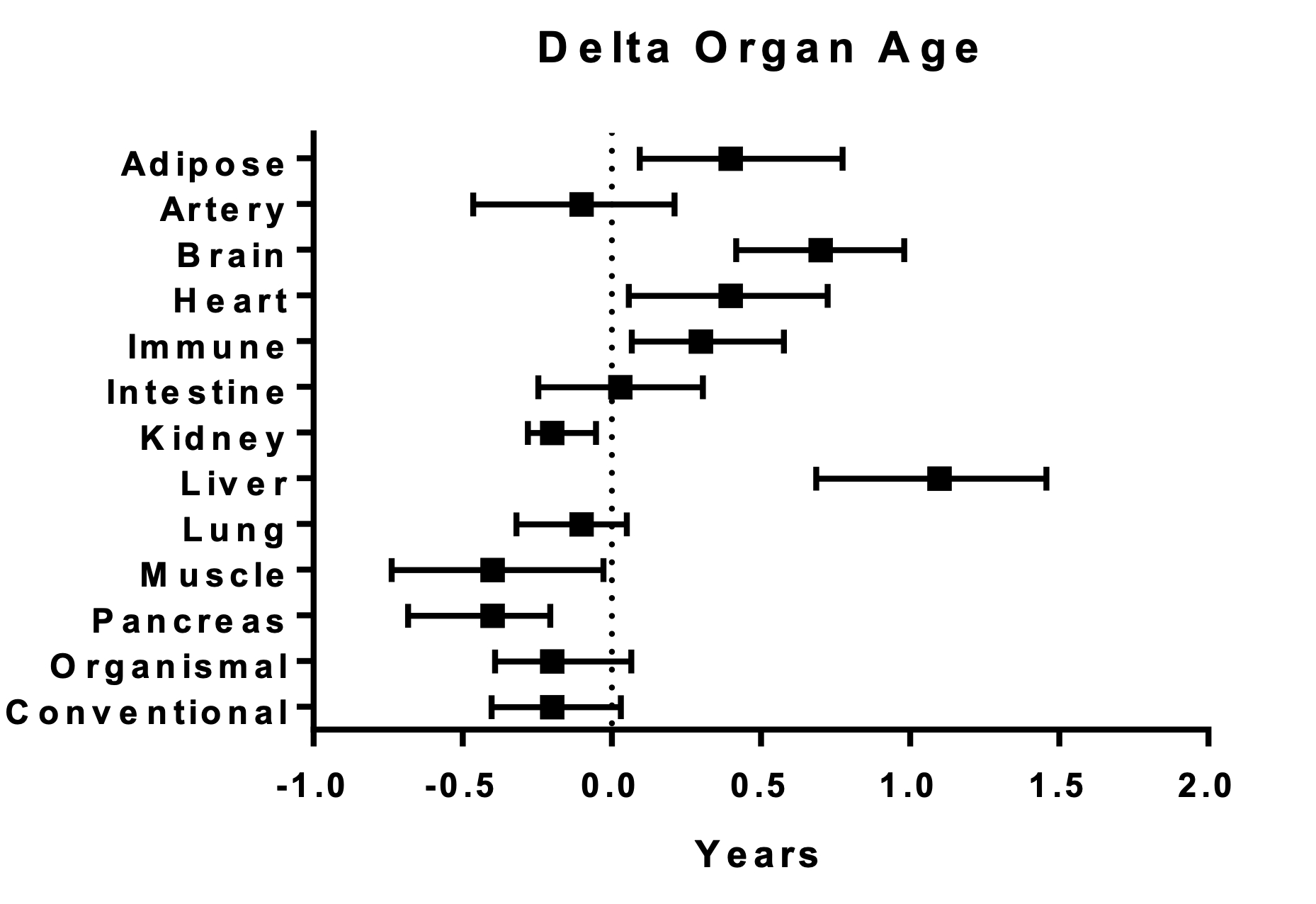
Results: The mean (SD) age of the study was 34.4 (13.5) years, and 55.1% were female. We found low-to-moderate correlations between predicted organ age and chronological age for 9 of 11 traits with the strongest correlations found in the conventional age score (r=0.81, p=2.1E-155), which included all proteins on the platform, and organismal age score, which incorporated organ-nonspecific proteins (r = 0.77, p=3.5E-132). Organismal age score was highly associated with several cardiometabolic traits including VO2max (r=-0.44, p=1.3E-37), body fat percentage (r=0.35, p=1.6E-21), and waist circumference (r=0.29, p=3.2E-13) after adjusting for sex and race; these associations were significant after adjustment for chronological age. We found 8 of the 11 organ age signatures changed (p<0.05) with ET (Figure 1), with kidney, muscle, and pancreas the only organs to decrease age, while adipose, brain, heart, immune, and liver ages increased. Among the 23% of participants with accelerated and 15% with decelerated organ aging at baseline, 74% had fewer accelerated or decelerated organ ages after ET (Figure 2).
Conclusions: We found that organ age signatures replicated in the HERITAGE Family Study and were modified by ET in both positive and negative directions. These changes suggest that individuals with extreme aging tended to regress toward the mean, whereby those with accelerated aging decreased and those with decelerated aging increased organ aging.
  • Herzig, Matthew  ( Beth Israel Deaconess Medical Cente , Boston , Massachusetts , United States )
  • Clish, Clary  ( Broad Institute of MIT and Harvard , Cambridge , Massachusetts , United States )
  • Ghosh, Sujoy  ( PENNINGTON BIOMEDICAL RESEARCH CTR , Baton Rouge , Louisiana , United States )
  • Saha, Enakshi  ( University of South Carolina , Columbia , South Carolina , United States )
  • Bouchard, Claude  ( PENNINGTON BIOMEDICAL RESEARCH CTR , Baton Rouge , Louisiana , United States )
  • Gerszten, Robert  ( Beth Israel Deaconess Medical Ctr , Boston , Massachusetts , United States )
  • Robbins, Jeremy  ( Beth Israel Deaconess Medical Cente , Boston , Massachusetts , United States )
  • Sarzynski, Mark  ( University of South Carolina , Columbia , South Carolina , United States )
  • Dev, Prasun  ( University of South Carolina , Columbia , South Carolina , United States )
  • Jacobs, Kiani  ( University of South Carolina , Columbia , South Carolina , United States )
  • Leszczynski, Eric  ( University of South Carolina , Columbia , South Carolina , United States )
  • Barber, Jacob  ( Beth Israel Deaconess , Jamaica Plain , Massachusetts , United States )
  • Rao, Prashant  ( Beth Israel Deaconess Medical Cente , Boston , Massachusetts , United States )
  • Mi, Michael  ( Beth Israel Deaconess Medical Ctr , Boston , Massachusetts , United States )
  • Valakos, Matthew  ( University of South Carolina , Columbia , South Carolina , United States )
  • Mcbride, Margaret  ( University of South Carolina School of Medicine , Columbia , South Carolina , United States )
  • Author Disclosures:
    Matthew Herzig: DO NOT have relevant financial relationships | Clary Clish: DO NOT have relevant financial relationships | SUJOY GHOSH: DO NOT have relevant financial relationships | Enakshi Saha: DO NOT have relevant financial relationships | Claude Bouchard: DO NOT have relevant financial relationships | Robert Gerszten: No Answer | Jeremy Robbins: DO have relevant financial relationships ; Consultant:Edwards Lifesciences:Past (completed) ; Consultant:Abbott Laboratories:Past (completed) | Mark Sarzynski: DO NOT have relevant financial relationships | Prasun Dev: No Answer | Kiani Jacobs: DO NOT have relevant financial relationships | Eric Leszczynski: DO NOT have relevant financial relationships | Jacob Barber: No Answer | Prashant Rao: DO NOT have relevant financial relationships | Michael Mi: DO NOT have relevant financial relationships | Matthew Valakos: No Answer | Margaret McBride: DO NOT have relevant financial relationships
Meeting Info:

Scientific Sessions 2025

2025

New Orleans, Louisiana

Session Info:
More abstracts on this topic:
ESC-AF, A Plasma Protein-Based Prediction Model for Atrial Fibrillation Recurrence After Ablation: A Multi-Omic Mendelian Randomization and Prospective Observational Study.

Sha Zimo, Wu Liqun, Zhou Taojie, Dai Yang, Bao Yangyang, Zhou Liping, Yu Lilei, Jiang Hong, Jin Qi, Hou Tianzhichao

Blood protein mediators of association between smoking and abdominal aortic aneurysm: exploration integrating human proteomic and genomic data

Yuan Shuai, Khodursky Samuel, Geng Jiawei, Sharma Pranav, Spin Joshua, Tsao Philip, Levin Michael, Damrauer Scott

More abstracts from these authors:
Sex Differences in the Plasma Metabolome Before and After Exercise Training

Leszczynski Eric, Clish Clary, Robbins Jeremy, Gerszten Robert, Sarzynski Mark, Barber Jacob, Rao Prashant, Jacobs Kiani, Mi Michael, Dev Prasun, Schwartz Charles, Ghosh Sujoy, Bouchard Claude

Plasma Proteomic Signatures Of Organ Aging Are Not Responsive To Exercise Training: HERITAGE Family Study

Herzig Matthew, Clish Clary, Bouchard Claude, Gerszten Robert, Robbins Jeremy, Sarzynski Mark, Dev Prasun, Jacobs Kiani, Leszczynski Eric, Barber Jacob, Rao Prashant, Mi Michael, Valakos Matthew, Ghosh Sujoy

You have to be authorized to contact abstract author. Please, Login
Not Available