Logo

American Heart Association

  21
  0


Final ID: Su3079

Interhospital Transfer versus Direct Admission for Percutaneous Coronary Intervention in Patients with Acute ST-Segment Elevation Myocardial Infarction: A Systematic Review and Meta-analysis

Abstract Body (Do not enter title and authors here): Background: Timely reperfusion with primary percutaneous coronary intervention (PCI) is critical for patients with ST-segment elevation myocardial infarction (STEMI). However, whether interhospital transfer delays impact clinical outcomes compared with direct admission remains uncertain.
Methods: We conducted a systematic review and meta-analysis of studies comparing interhospital transfer versus direct admission for primary PCI in STEMI patients. Searches were performed in PubMed, EMBASE, Scopus, and Web of Science. The primary outcome was in-hospital mortality. Secondary outcomes included post-discharge mortality (30 days, 6 months, 12 months), major adverse cardiovascular events (MACE), stroke, bleeding, target vessel revascularization, heart failure hospitalization, left ventricular ejection fraction (LVEF), and reperfusion time metrics.
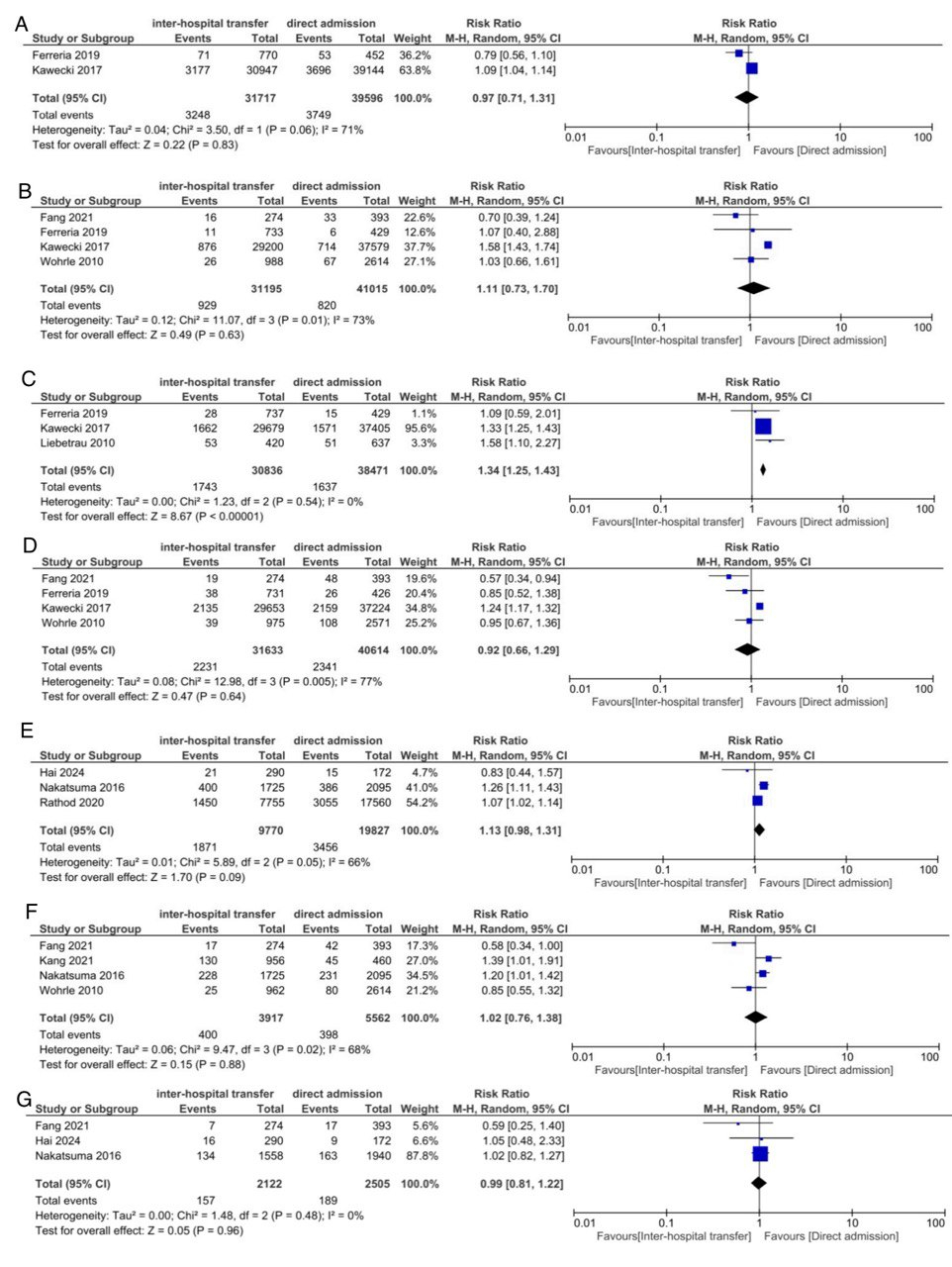
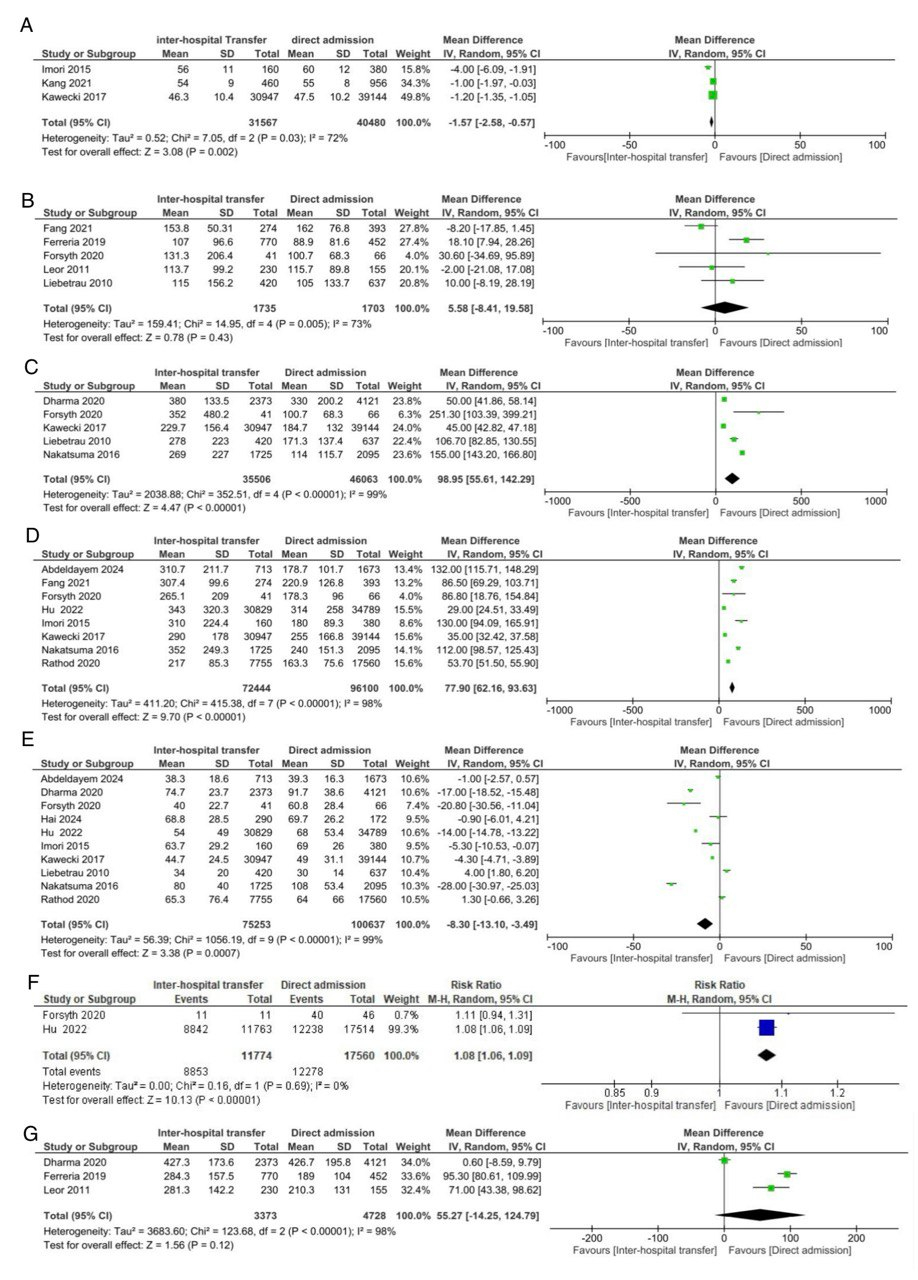
Results: Sixteen studies (n = 165,084) were included, comprising ten retrospective cohorts and six prospective cohorts. In-hospital mortality was lower in the transfer group (RR, 0.82; 95% CI, 0.69–0.96) with absolute risk reduction is 7 fewer per 1000, while 6-month post-discharge mortality was lower in the direct admission group (RR, 1.34; 95% CI, 1.25–1.43) and the absolute risk is 14 more deaths per 1000 in the transfer group. No significant differences were found in MACE, stroke, bleeding, heart failure hospitalization, or total all-cause death. Transferred patients had a slightly lower LVEF (mean difference −1.57%; 95% CI, −2.58 to −0.57). Direct admission was associated with shorter symptom-to-balloon and total ischemic times, while door-to-balloon time was slightly shorter in transferred patients.
Conclusion: In STEMI patients treated with primary PCI, interhospital transfer was not associated with worse clinical outcomes despite longer delays to reperfusion. These findings highlight the critical role of coordinated STEMI networks in mitigating time-dependent risk and delivering equitable care across pathways.
  • Zahran, Anwar  ( An-Najah National University , Nablus , Palestine, State of )
  • Khayat, Nadeem  ( An-Najah National University , Nablus , Palestine, State of )
  • Mohammad, Ahmad  ( Hurley Medical Center-MSU , Grand Blanc , Michigan , United States )
  • Elgendy, Mohamed  ( Tanta Unversity , Tanta , Egypt )
  • Milhem, Fathi  ( An-Najah National University , Nablus , Palestine, State of )
  • Amer, Saja  ( An-Najah National University , Nablus , Palestine, State of )
  • Bdair, Mohammad  ( An-Najah National University , Nablus , Palestine, State of )
  • Shubietah, Abdalhakim  ( Advocate Illinois Masonic Med Ctr , Chicago , Illinois , United States )
  • Shweliya, Mohammedsadeq A.  ( University of Baghdad College of Medicine , Baghdad , Iraq )
  • Hamzah, Khadeeja  ( Baghdad University AIkindy College , Baghdad , Iraq )
  • Besharieh, Firas  ( An-Najah National University , Nablus , Palestine, State of )
  • Hajjeh, Orabi  ( An-Najah National University , Nablus , Palestine, State of )
  • Author Disclosures:
    Anwar Zahran: DO NOT have relevant financial relationships | Nadeem Khayat: DO NOT have relevant financial relationships | Ahmad Mohammad: DO NOT have relevant financial relationships | Mohamed Elgendy: DO NOT have relevant financial relationships | Fathi Milhem: DO NOT have relevant financial relationships | Saja Amer: DO NOT have relevant financial relationships | Mohammad Bdair: DO NOT have relevant financial relationships | Abdalhakim Shubietah: DO NOT have relevant financial relationships | Mohammedsadeq A. Shweliya: DO NOT have relevant financial relationships | khadeeja Hamzah: DO NOT have relevant financial relationships | Firas Besharieh: DO NOT have relevant financial relationships | Orabi Hajjeh: No Answer
Meeting Info:

Scientific Sessions 2025

2025

New Orleans, Louisiana

Session Info:

Surgical vs Percutaneous Revascularization: Outcomes & Special Populations

Sunday, 11/09/2025 , 11:30AM - 12:30PM

Abstract Poster Board Session

More abstracts on this topic:
Assessing Coronary Artery Disease Severity: Leveraging Inflammatory Markers As a Prognostic Indicators

Turnbull Scott, Dugal Jasmine, Gill Randeep, Wang Shawn, Cross Chad, Mubder Mohamad

All Magnesium-Based Bioresorbable Scaffolds in patients with CAD: A Proportional Meta Analysis

Dar Areej, Abu Ajamieh Kamal, Abdullah Muhammad, Khalid Ghina, Kamel Mohammed, Dar Muhammad Shayaan

More abstracts from these authors:
Genicular Artery Embolization for Knee Osteoarthritis: A Systematic Review of Sham-Controlled Randomized Trials

Mohammad Ahmad, Hamdan Yazan, Z. Ayaseh Qutayba, Hajjeh Orabi, Younas Ayesha, Shehadeh Waseem, Zaitoun Anwar, Milhem Fathi, Takhman Muhammad, Elgendy Mohamed, Abu Zahra Anas, Saife Sarah, Saife Sakeena, Bdair Mohammad, Abu-khazneh Omar

Safety and Efficacy of the Aldosterone Synthase Inhibitor Osilodrostat in Primary Hypertension: A Retrospective Cohort Analysis

Emara Ahmed, Abuawwad Mohammad, Tawba Maysam, Patel Jalpan, Shubietah Abdalhakim, Elgendy Mohamed, Milhem Fathi, Awashra Ameer, Abed Alhaleem Mohammad, Bdair Mohammad, Alqadi Mohammad, Nazir Abubakar

You have to be authorized to contact abstract author. Please, Login
Not Available