
Logo

American Heart Association

  26
  0


Final ID: Mo3099

Use of an Administratively Derived Elder Risk Assessment Score and Long Term Mortality in Older Adults Undergoing Aortic Valve Replacement

Abstract Body (Do not enter title and authors here): Background: Older adults with severe aortic stenosis (AS) are at high risk of mortality unless treated by aortic valve replacement (AVR). The Society of Thoracic Surgery (STS) score is primarily used clinically to determine mortality risk from surgical AVR. Due to geriatric comorbidities unique to older adults, traditional methods of risk stratification with STS may have significant shortcomings. Administratively derived risk scores that have prognostic significance in the geriatric population may prove valuable.
Methods: We reviewed patients at our hospital system with AS undergoing AVR (surgical and transcatheter) and administratively derived an Elder Risk Assessment (ERA) score from the health record. The ERA score is a composite of age, marital status, number of hospitalized days in previous 2 years, and comorbidities (diabetes, coronary artery disease (CAD), heart failure, stroke, pulmonary disease, cancer, and dementia). Kaplan-Meier method was used to estimate survival by ERA score tertile. Cox regression was used to determine association between ERA and survival after accounting for STS predicted risk.
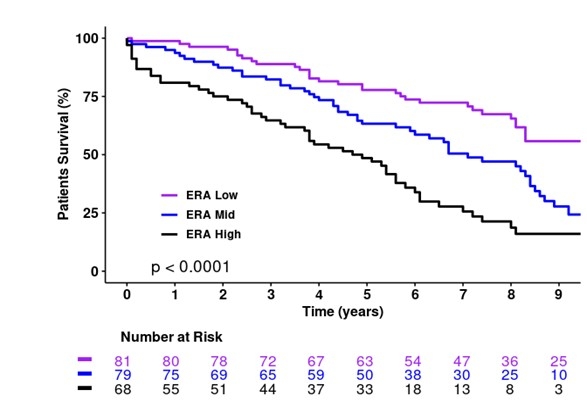
Results: There were a total of 228 patients that underwent AVR (TAVR: 59 (26.1 %); SAVR 167 (73.9%) and had ERA scores derived. The average age was 79.6 (SD 7.6) years) and there were 93 (40.8%) women. Patients were stratified by ERA score tertiles: low (≤6), mid (6-13), or high (≥14). Over a mean follow up of 5.8 (SD 3.1) years, lower ERA scores were associated with better long-term survival (p<0.001). After accounting for age, sex, and STS score, mid ERA (HR 1.61; 95% CI 1.00-2.59; p<0.001) and high (HR 2.90; 95% CI 1.79-4.69; p<0.001) were associated with mortality (reference: low ERA). For every 10-point increase in the ERA, there was a 2-fold increase in adjusted mortality risk (HR 2.14; 95% CI 1.58-2.90; p<0.001).
Conclusions: Older adults undergoing AVR for severe AS have specific geriatric comorbidities that may be better characterized using the ERA score. This administratively derived score was independently associated with survival after accounting for the widely used STS risk score.
  • Laenger, Jessica  ( Mayo Clinic Florida , Jacksonville , Florida , United States )
  • Meier, Tristan  ( MAYO CLINIC COLLEGE MEDICINE , Rochester , Minnesota , United States )
  • Ma, Yaohua  ( Mayo Clinic Florida , Jacksonville , Florida , United States )
  • El Sabbagh, Abdallah  ( Mayo Clinic , Jacksonville , Florida , United States )
  • Pellikka, Patricia  ( MAYO CLINIC COLLEGE MEDICINE , Rochester , Minnesota , United States )
  • Takahashi, Paul  ( Mayo Clinic , Jacksonville , Florida , United States )
  • Gharacholou, Shahyar  ( Mayo Clinic Florida , Jacksonville , Florida , United States )
  • Author Disclosures:
    Jessica Laenger: DO have relevant financial relationships ; Individual Stocks/Stock Options:Dexcom:Active (exists now) ; Individual Stocks/Stock Options:Merck:Active (exists now) | Tristan Meier: DO NOT have relevant financial relationships | Yaohua Ma: No Answer | Abdallah El Sabbagh: No Answer | Patricia Pellikka: DO have relevant financial relationships ; Research Funding (PI or named investigator):Edwards Lifesciences:Past (completed) ; Royalties/Patent Beneficiary:UpToDate:Active (exists now) ; Advisor:Alnylam:Active (exists now) ; Advisor:Astellas:Past (completed) ; Research Funding (PI or named investigator):Ultromics:Active (exists now) | Paul Takahashi: No Answer | Shahyar Gharacholou: DO NOT have relevant financial relationships
Meeting Info:

Scientific Sessions 2025

2025

New Orleans, Louisiana

Session Info:

Innovations in Aortic Valve Intervention: Surgery, TAVR, and What’s Next 1

Monday, 11/10/2025 , 10:30AM - 11:30AM

Abstract Poster Board Session

More abstracts on this topic:
A Machine Learning Readmission Risk Prediction Model for Cardiac Disease

Bailey Angela, Wang Wei, Shannon Clarence, Huling Jared, Tignanelli Christopher

Aortic Valve Calcification Density Performs Better Compared to Absolute Aortic Valve Calcification in Aortic Stenosis Risk Stratification

Ahmad Syed, Zeb Irfan, Watson Hangyu, Awad Maan, Patel Kunal, Nassar Sameh, Thyagaturu Harshith, Balla Sudarshan, Kawsara Mohammad, Daggubati Ramesh

You have to be authorized to contact abstract author. Please, Login
Not Available