New Technological Adoption of Robotics into Healthcare Systems: Healthcare Provider Perspectives
Abstract Body (Do not enter title and authors here): Background While the implementation of robotics into daily healthcare task has the potential to revolutionize healthcare, the integration of robotics into routine clinical practice remains a challenge. We conducted a targeted survey to explore healthcare workers’ preferences and attitudes towards the integration of robotics into healthcare operations.
Methods We launched a prospective web-based survey over three months consisting of 16 questions in the English language, to hospital-based clinical and allied health workers. To understand and collect respondents’ preferences towards the implementation of robotics in healthcare, including safety, user-friendliness, autonomy, and accuracy as well as preferred robotic functions. Lickert scale responses were transformed into -1, 0 and 1 to facilitate further analysis.
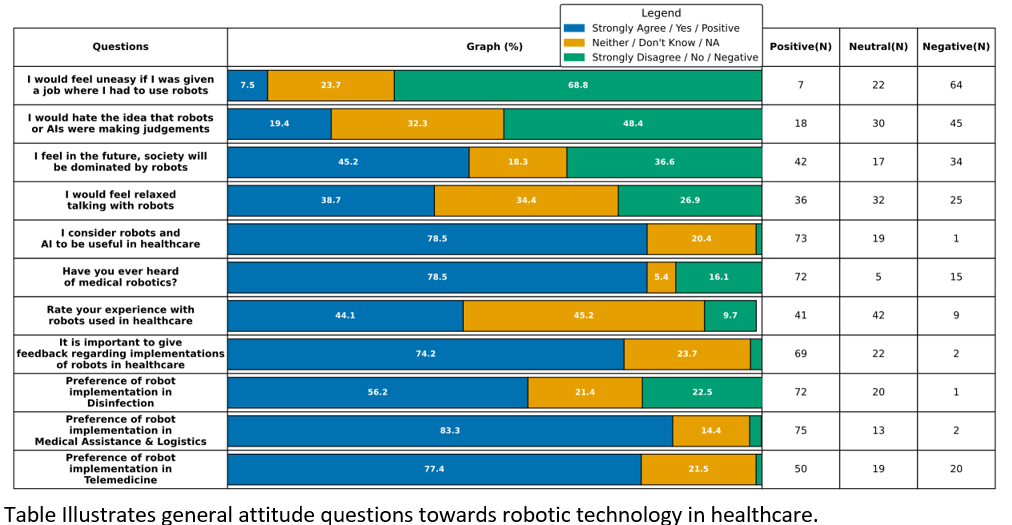
Results A total of n=106 healthcare workers participated in the survey; complete data analysis for n=93 respondents was done. While the majority of respondents (78.50%, N=93) were aware of robotics in healthcare, half of the respondents (55.09%, n=93) have had no interaction with robots during their practice. Two-thirds (68.81%, N=93) of the respondents expressed that they will be comfortable in performing tasks where robots are involved. A third expressed that they would “hate the idea that robots or artificial intelligence were making judgments about things,” while the rest were unsure or disagreed. The majority expressed a preference for robotics in disinfection (77.42%, n=93), medical assistance and logistics (83.33%, n=93) and telemedicine (56.18%, n=93). Safety and accuracy ranked highly for disinfection, medical assistance and logistics. User-friendliness and accuracy ranked highly for telemedicine. A positive association between educational level and desired robotic features was observed. There were positive correlations between the respondents’ education level and preferences of features for robots implemented for disinfection (r=0.231, p=0.026), medical assistance and logistics (r=0.265, p=0.01) and telemedicine (r=0.270, p=0.0009) and specific preference for trustworthiness (r=0.265, p=0.01) for telemedicine, and provision of alerts (r=0.229, p=0.027) for medical assistance and logistics.
Conclusion The current lack of exposure to robots in healthcare highlights a key gap in technological adoption and also in workplace and cultural acceptance. Addressing this through a targeted deployment that addresses these perspectives might be helpful.
Tan, Kieran
(
National Heart Centre Singapore
, Singapore , Singapore )
Seah, Teck Soon
(
National Heart Centre Singapore
, Singapore , Singapore )
Loh, Johnathan
(
National Heart Center Singapore
, Singapore , Singapore )
Wong, Jie Jun
(
National Heart Centre Singapore
, Singapore , Singapore )
Tan, Yong Jin
(
National Heart Centre Singapore
, Singapore , Singapore )
Teo, Loon Yee
(
National Heart Centre Singapore
, Singapore , Singapore )
Koh, Angela
(
National Heart Centre Singapore
, Singapore , Singapore )
Author Disclosures:
Kieran Tan:DO NOT have relevant financial relationships
| Teck Soon Seah:DO NOT have relevant financial relationships
| Johnathan Loh:No Answer
| JIE JUN WONG:No Answer
| Yong Jin Tan:No Answer
| Loon Yee Teo:No Answer
| Angela Koh:DO NOT have relevant financial relationships
Wong Jie Jun, Tan Ru, Kovalik Jean Paul, Koh Angela, Gao Fei, Tan Glades, Loh Johnathan, Teo Loon Yee, Ewe See Hooi, Wee Hai Ning, Chua Kee Voon, Ching Jianhong