Logo

American Heart Association

  19
  0


Final ID: MP199

The Role of Venous Excess Ultrasound (VExUS) in Predicting AKI and Diuresis in Acute Decompensated Heart Failure

Abstract Body (Do not enter title and authors here): Introduction:
Venous Excess Ultrasound (VExUS), a novel Doppler-based scoring system to evaluate venous congestion, may provide insight into how and when to diurese patients with acute decompensated heart failure (ADHF). The current study evaluates the potential utility of VExUS as a bedside tool to diagnose, monitor, and guide diuresis among patients with ADHF and cardiorenal acute kidney injury (AKI).

Hypothesis:
VExUS can be used to predict presence or absence of AKI, in addition to guiding diuretic therapy.

Methods:
In this observational study we prospectively enrolled patients in the emergency department (ED) of a tertiary medical center with a presumptive diagnosis of ADHF. Patients underwent standardized VExUS scanning prior to administration of initial dose of loop diuretic, on hospital days 1-3, and on discharge. VExUS scans were graded on a scale of 0 (no congestion) to 3 (severe congestion) by providers experienced in VExUS scoring.

Results:
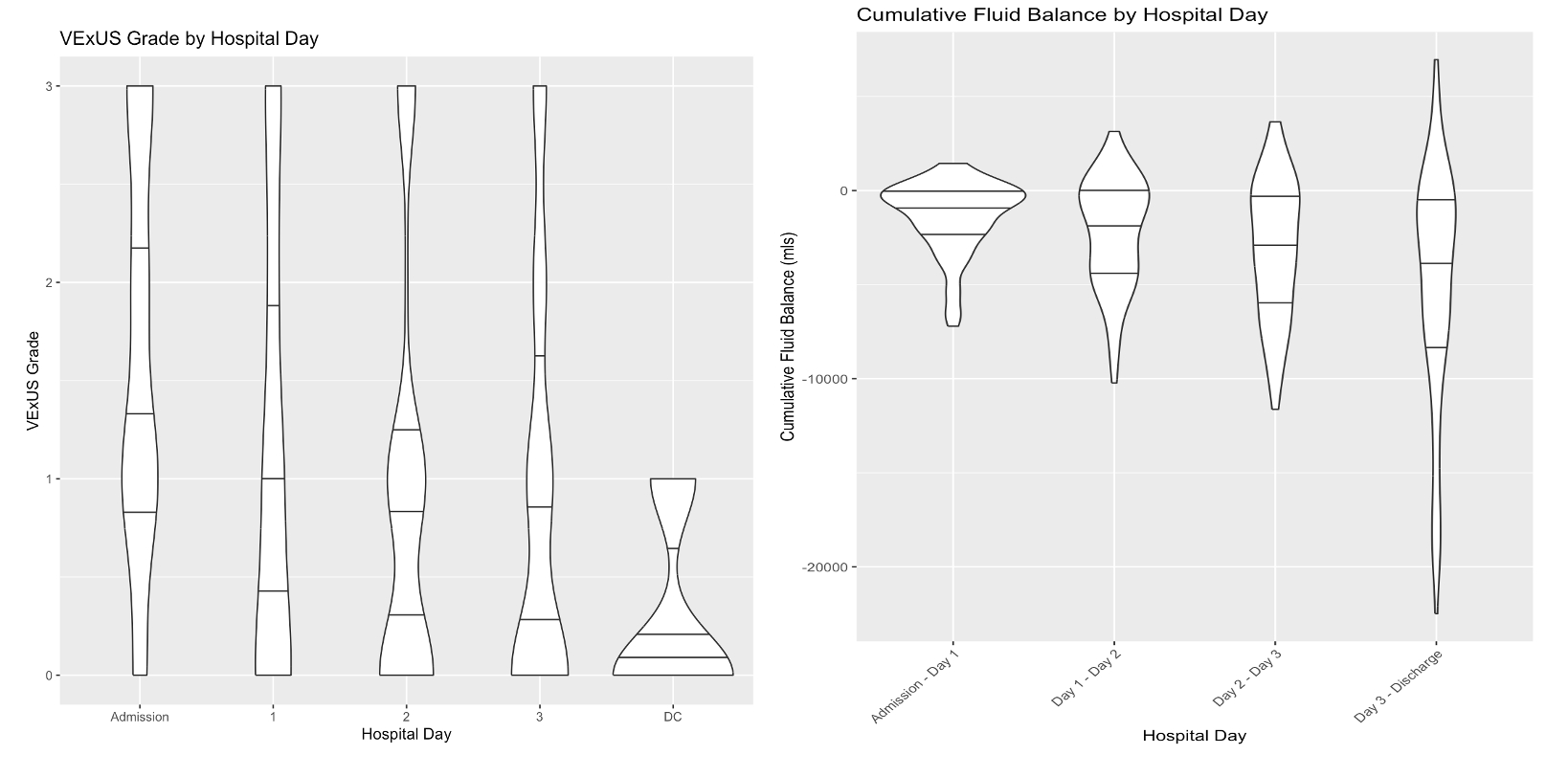
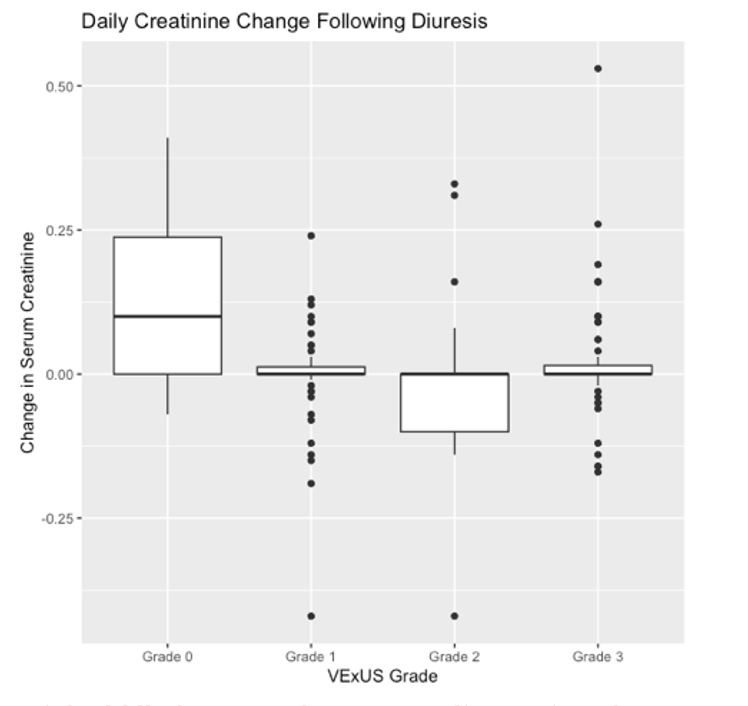
VExUS Grade demonstrated a statistically significant linear decrease over time as patients underwent diuresis (p = <0.001). This change was significantly associated with change in fluid balance (p = 0.005). After adjusting for age, sex, and Charlson Comorbidity Index (CCI), admission VExUS grade was associated with the presence of acute kidney injury on admission, per KDIGO criteria(p = 0.01).41 Among patients presenting with volume overload and elevated creatinine that underwent diuresis, there was a significant indirect association between elevated VExUS grade and subsequent change in serum creatinine (p <0.001).

Conclusion:
These results suggest that VExUS may be an accurate and dynamic indicator of venous congestion. Furthermore, it may be able to guide diuresis in patients with AKI of uncertain etiology. The fact that a low VExUS grade predicted an increase in creatinine following diuresis is a promising sign that Doppler assessment of hemodynamics can provide bedside providers with valuable insight to help them decide when to diurese patients with AKI of uncertain etiology, thereby limiting iatrogenic AKI when trying to decongest patients.
  • Teran, Santiago  ( University of Colorado Anschutz , Denver , Colorado , United States )
  • Mantha, Aditya  ( University of Colorado , Aurora , Colorado , United States )
  • Siegel, Gabriel  ( Denver Health , Denver , Colorado , United States )
  • Thayapran, Kisha  ( University of Colorado , Aurora , Colorado , United States )
  • Riscinti, Matthew  ( Denver Health , Denver , Colorado , United States )
  • Gill, Ed  ( University of Colorado Anschutz , Denver , Colorado , United States )
  • Douglas, Ivor  ( Denver Health , Denver , Colorado , United States )
  • Longino, August  ( Denver Health , Denver , Colorado , United States )
  • Author Disclosures:
    Santiago Teran: DO NOT have relevant financial relationships | Aditya Mantha: DO NOT have relevant financial relationships | Gabriel Siegel: No Answer | Kisha Thayapran: DO NOT have relevant financial relationships | Matthew Riscinti: DO have relevant financial relationships ; Consultant:Exo Works:Past (completed) | Ed Gill: No Answer | Ivor Douglas: No Answer | August Longino: No Answer
Meeting Info:

Scientific Sessions 2025

2025

New Orleans, Louisiana

Session Info:

Heart Failure and Cardiomyopathies: Disease Management

Saturday, 11/08/2025 , 03:15PM - 04:05PM

Moderated Digital Poster Session

More abstracts on this topic:
Can IVUS Predict Aortic Remodeling?
The Role of Flap Mobility in Type B Aortic Dissection With TEVAR

Kameda Yuika, Samejima Yusuke, Nemoto Naohiko, Anzai Hitoshi

Association of Pre-operative Neutrophil to Lymphocyte Ratio (NLR) and Post-operative AKI in Patients Undergoing CABG: A Meta-Analysis

Patel Bhavin, Lapsiwala Boney, Jariwala Prayag, Suresh Aditya, Vanani Samir, Patel Shaurya, Rajani Aayushi, Desai Rupak

More abstracts from these authors:
You have to be authorized to contact abstract author. Please, Login
Not Available