Incidence and Predictors of Atrial Fibrillation after Heart Transplantation
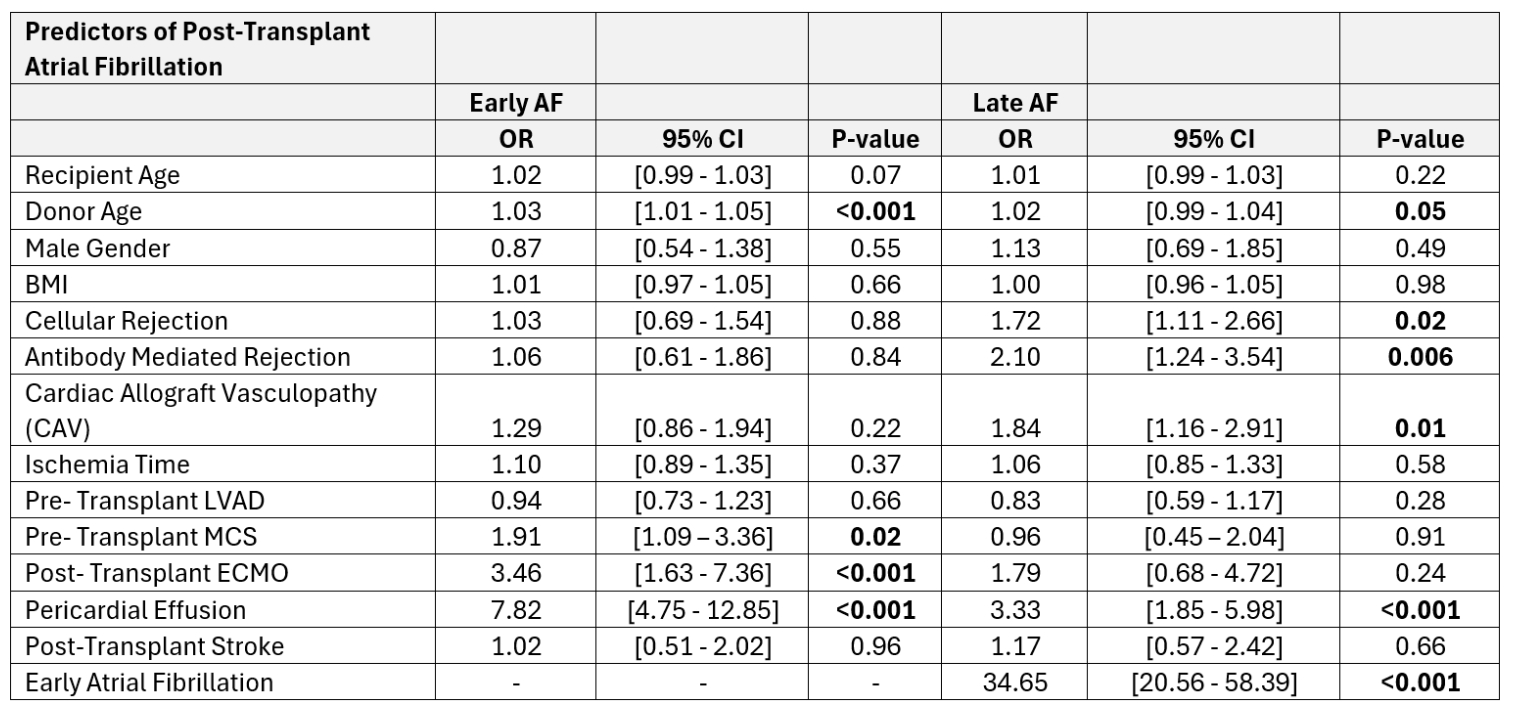
Abstract Body (Do not enter title and authors here): Background: Atrial fibrillation (AF) has been associated with increased morbidity and mortality in patients after heart transplantation (HT); however, little is known about the incidence and risk factors of post-HT AF. Research Question: The aim of this study is to better understand the incidence and predictors of early and late onset atrial fibrillation after HT. Methods: A single center, retrospective study of patients who underwent HT at a large-volume transplant center between January 1, 2005 – September 30, 2024. Incidence of AF was categorized as either early post-HT AF or late AF (new or recurrence of AF >60 days from transplant date). Relevant clinical and echocardiographic data from both recipient and donor were collected. Univariate and multivariable logistic regression models were performed to determine the predictors of early and late AF. Results: A total of 1,072 HT patients (52.5 ± 0.6 years; 75% male) were included. During follow-up, 110 patients developed early AF (11%) and 88 patients developed late AF (8%). Compared with patients whom were free of AF, AF patients were older (54.6 ± 1.0 vs. 52.3 ± 0.4, years; p=0.03), had advanced donor age (37.0 ± 1.3 vs. 32.4 ± 0.4, years; p<0.001), increased pre-transplant MCS use (38% vs. 29%; p=0.02), increased post-transplant ECMO use (9% vs. 3%; p=0.001), and significant pericardial effusions (27% vs. <1%; p<0.001). Predictors of early AF included advanced donor age (OR 1.03, 95% CI [1.01 - 1.05]; p<0.0001), pre-transplant MCS use (OR 1.91, 95% CI [1.09 – 3.36]; p=0.02), post-transplant ECMO use (OR 3.46, 95% CI [1.63 - 7.36]; p<0.001), and significant pericardial effusion (OR 7.82, 95% CI [4.75 - 12.85]; p<0.001). Predictors of late AF included advanced donor age (OR 1.02, 95% CI [0.99 - 1.04]; p=0.05), cellular rejection (OR 1.72, 95% CI [1.11 - 2.66]; p=0.02), antibody mediated rejection (2.10, 95% CI [1.24 - 3.54]; p=0.006), cardiac allograft vasculopathy (OR 1.84, 95% CI [1.16 - 2.91]: p=0.01), significant pericardial effusion (OR 3.33, 95% CI [1.85 - 5.98], p<0.001) and early AF (OR 34.7, 95% CI [20.6 - 58.4]; p<0.001). These predictors remained robust after adjustment for traditional AF risk factors. Conclusions: Development of AF post-HT is not uncommon. Early AF is more common with advanced donor age, pre- and post-transplant MCS use and significant pericardial effusion. Additionally, late AF development was highly associated with various forms of rejection and early AF.
Elnabawi, Youssef
(
Columbia University Medical Center
, New York , New York , United States )
Lee, Charlotte
(
Columbia University Medical Center
, New York , New York , United States )
Clerkin, Kevin
(
Columbia University Medical Center
, New York , New York , United States )
Defilippis, Ersilia
(
Columbia University Medical Center
, New York , New York , United States )
Yarmohammadi, Hirad
(
Columbia University Medical Center
, New York , New York , United States )
Author Disclosures:
Youssef Elnabawi:DO NOT have relevant financial relationships
| Charlotte Lee:No Answer
| Kevin Clerkin:No Answer
| Ersilia DeFilippis:DO have relevant financial relationships
;
Speaker:AstraZeneca:Active (exists now)
| Hirad Yarmohammadi:DO have relevant financial relationships
;
Consultant:Biotronik:Past (completed)
; Speaker:Zoll:Past (completed)