
Distinct Lipodomic Signatures Identify Imaging-Defined Vulnerable Coronary Plaques in Patients with Myocardial Infarction
Abstract Body (Do not enter title and authors here): Background: Non-invasive identification of high-risk coronary atherosclerosis remains a major clinical challenge. Lipidomics offers a promising tool to uncover metabolic signatures associated with plaque vulnerability and improve early risk assessment.
Aim: To investigate the relationship between circulating lipid metabolites and imaging-derived characteristics of vulnerable coronary plaques.
Method: In the multicentre PROSPECT II trial, 898 patients with recent myocardial infarction underwent three-vessel near-infrared spectroscopy and intravascular ultrasound (NIRS-IVUS) imaging after revascularization. Non-flow limiting plaques were assessed for lipid core burden index (LCBI) and plaque burden (PB). Plasma samples were analyzed for 424 lipid metabolites using untargeted mass spectrometry. Associations between lipids and the three imaging outcomes; Pan-coronary PB, Pan-coronary lipid and High-risk vulnerable plaque (maxLCBI4mm ≥324.7 + PB ≥70%) were evaluated using multivariable models. The Benjamini-Hochberg procedure was applied to control the false discovery rate (FDR) and findings were validated in the SCAPIS cohort using the outcomes Segment Involvement Score (SIS) and Coronary Artery Calcium Score (CACS).
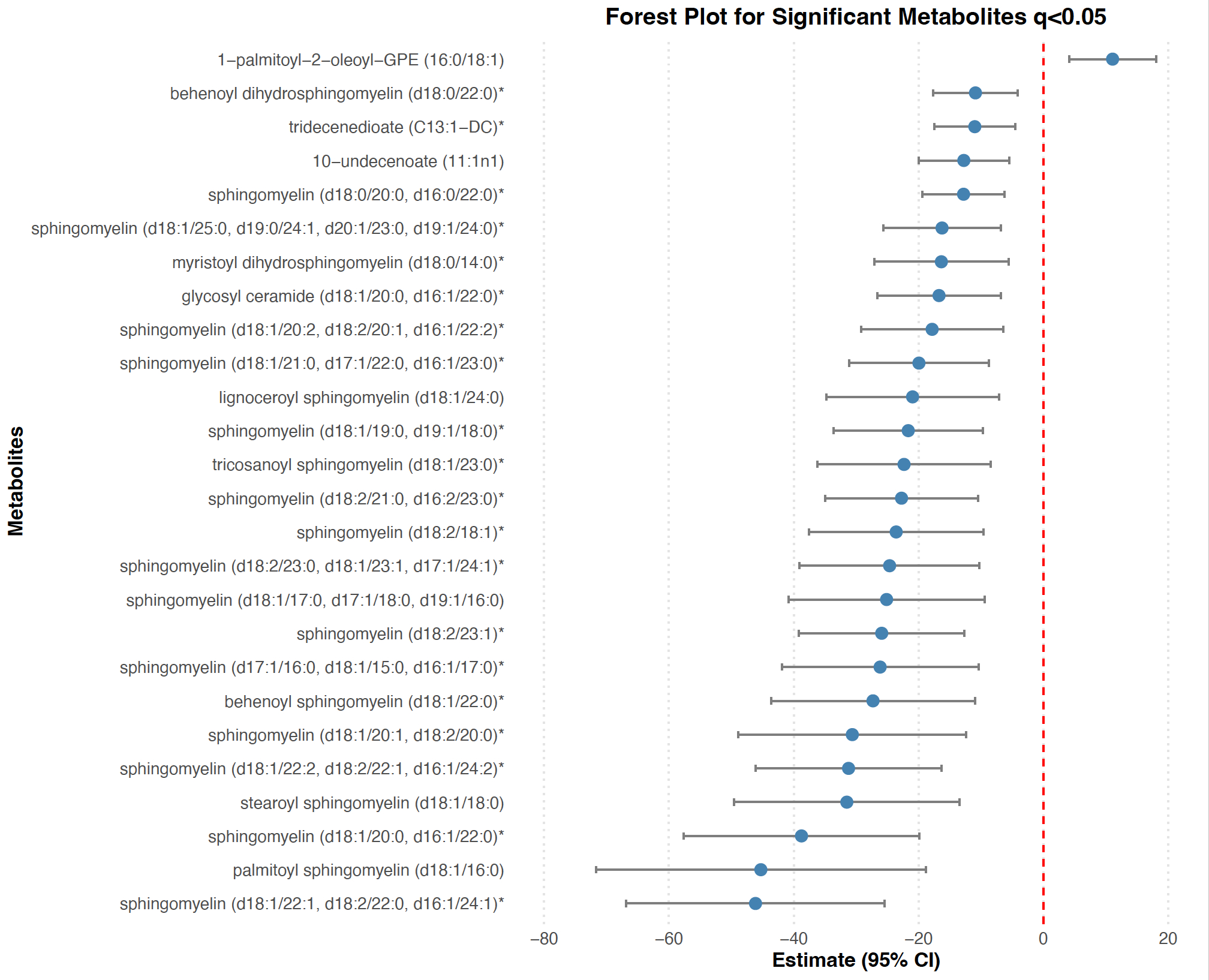
Results: Sphingomyelins demonstrated robust and consistent inverse associations with all three imaging-defined plaque characteristics, with the strongest signal observed for Pan-coronary lipid, which remained statistically significant after FDR adjustment ( q < 0,05). In contrast, 1-palmitoyl-2-oleoyl-GPE (16:0/18:1), a phosphatidylethanolamine, showed strong positive associations across all plaque metrics, remaining significant after multiple testing for Pan-coronary lipid. These results were replicated in the SCAPIS cohort where similar trends were observed.
Conclusion: Lower circulating levels of sphingomyelins are linked to greater lipid core and plaque burden, suggesting a protective or regulatory role in plaque stability. Conversely, elevated levels of 1-palmitoyl-2-oleoyl-GPE (16:0/18:1) may reflect or contribute to a pro-atherogenic lipid environment. These distinct lipid signatures may aid in early, non-invasive identification of vulnerable coronary plaques and offer insight into lipid-driven mechanisms of plaque destabilization.
Sharma, Tania
(
Lund University
, Lund , Sweden )
Maehara, Akiko
(
New York -Presbyterian Hospital and Columbia University Irving Medical Center
, New York , New York , United States )
Maeng, Michael
(
Aarhus University Hospital
, Aarhus , Denmark )
Kjøller-hansen, Lars
(
Zealand university hospital
, Roskilde , Denmark )
Engstrøm, Thomas
(
Rigshospitalet, University of Copenhagen
, Copenhagen , Denmark )
Ben-yehuda, Ori
(
University of California, San Diego
, San Diego , California , United States )
Matsumura, Mitsuaki
(
Cardiovascular Research Foundation, New York
, New York , New York , United States )
Frobert, Ole
(
Orebro University Hospital
, Orebro , Sweden )
Persson, Jonas
(
Karolinska Institutet, Danderyd
, Stockholm , Sweden )