Logo

American Heart Association

  16
  0


Final ID: MP855

Rare Variants in Cardiomyopathy and Channelopathy Genes are Associated with Severe Ventricular Arrhythmias in Mitral Valve Prolapse

Abstract Body (Do not enter title and authors here): Introduction:
Mitral valve prolapse (MVP) is a common valvular disorder associated, in a minority of cases, with severe arrhythmic events including sudden cardiac arrest/death (SCA/SCD). Traditional imaging parameters of arrhythmic risk such as bileaflet prolapse, mitral annular disjunction (MAD), and late gadolinium enhancement by cardiac MRI are not found in all SCA survivors, suggesting an alternative arrhythmogenic mechanism. Recently, the presence of a genetic myopathy and/or channelopathy has been suggested in MVP, albeit only in case reports or cross-sectional investigations. Hence, the utility of genetic testing in MVP remains uncertain.

Hypothesis:
Testing for cardiomyopathy/channelopathy (CC) variants in a large MVP cohort will identify a subset with pathogenic/likely pathogenic (P/LP) variants associated with an increased risk of severe arrhythmic events longitudinally.

Methods:
We prospectively recruited MVPs at the University of California, San Francisco between 2017 and 2024. 196/220 patients underwent whole exome sequencing. Variants of interest were rare (<0.1% frequency), protein-coding, nonsynonymous variants in genes present on a selected clinical Arrhythmia and Cardiomyopathy panel. P/LP classification was assigned with an automated algorithm (Franklin). Severe arrhythmic events were defined as SCA/SCD or sustained ventricular arrhythmias requiring an implantable cardioverter defibrillator (ICD) or ablation. We assessed the risk of severe arrhythmic outcomes in MVPs with and without CC P/LP variants using both adjusted logistic regression and survival analyses.

Results:
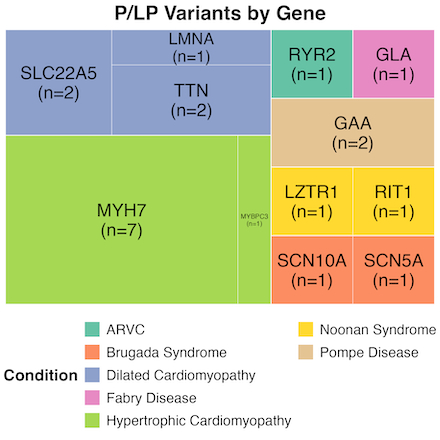
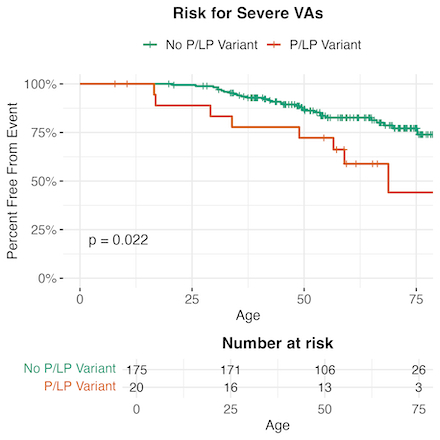
We included 196 MVPs, of which 187 (95%) had CC variants and 20 (10%) were P/LP (Figure 1). None of the MVPs in our study demonstrated channelopathy or overt cardiomyopathy. However, P/LP variants were significantly associated with severe arrhythmic events after adjusting for age, sex, bileaflet involvement, and MAD (Odds Ratio: 3.1, p=0.03). Time to event analysis confirmed that MVPs with P/LP variants were at significantly increased risk for severe arrhythmic events starting at birth (Figure 2).

Conclusions:
Occult P/LP variants associated with cardiomyopathy or channelopathy independently increase the risk of severe arrhythmic events in MVP. Genetic testing should be investigated as a novel arrhythmic risk stratification tool for MVP, especially for cases that may not yet demonstrate an arrhythmic phenotype but may need closer clinical follow-up.
  • Jhawar, Rohit  ( UCSF , San Francisco , California , United States )
  • Cristin, Luca  ( UCSF , San Francisco , California , United States )
  • Small, Aeron  ( Brigham and Women's Hospital , Boston , Massachusetts , United States )
  • Bibby, Dwight  ( UCSF , San Francisco , California , United States )
  • Rich, Amy  ( UCSF , San Francisco , California , United States )
  • Tastet, Lionel  ( Laval University , Quebec City , Quebec , Canada )
  • Delling, Francesca  ( UCSF , San Francisco , California , United States )
  • Author Disclosures:
    Rohit Jhawar: DO NOT have relevant financial relationships | Luca Cristin: No Answer | Aeron Small: No Answer | Dwight Bibby: No Answer | AMY RICH: DO NOT have relevant financial relationships | Lionel Tastet: No Answer | Francesca Delling: DO NOT have relevant financial relationships
Meeting Info:

Scientific Sessions 2025

2025

New Orleans, Louisiana

Session Info:
More abstracts on this topic:
Association of Race with Disease Expression and Clinical Outcomes among Patients with Mitral Valve Prolapse

Desai Aishwary, Shalaby Alaa, Estes Nathan, Saba Samir, Jain Sandeep, Bhonsale Aditya, Thoma Floyd, Naniwadekar Aditi, Singla Virginia, Wong Timothy, Kancharla Krishna, Mulukutla Suresh, Katz William, Voigt Andrew

Caught Between a Clot and a Bleed: Using Transcranial Doppler Microemboli Monitoring to Determine Anticoagulation Management in a Stroke Patient with Mitral Valve Thrombus and Intracranial Hemorrhage

Vo Phuong Uyen, Slabic Andrew, Bower Matthew, Hepburn Madihah

More abstracts from these authors:
Atrial Fibrillation in Valvular Heart Disease: Assessing the Impact of Genetics in the UK Biobank

Cristin Luca, Tang Janet, Tastet Lionel, Marcus Gregory, Delling Francesca

Defining the Role of Ablation Therapies and ICD in Arrythmic Mitral Valve Prolapse

Miller Marc, Sabbag Avi, Delling Francesca

You have to be authorized to contact abstract author. Please, Login
Not Available