
Logo

American Heart Association

  15
  0


Final ID: 4366146

Adenine accumulation in Endothelial Cells Induces Cardiotoxicity in Type 2 Diabetes

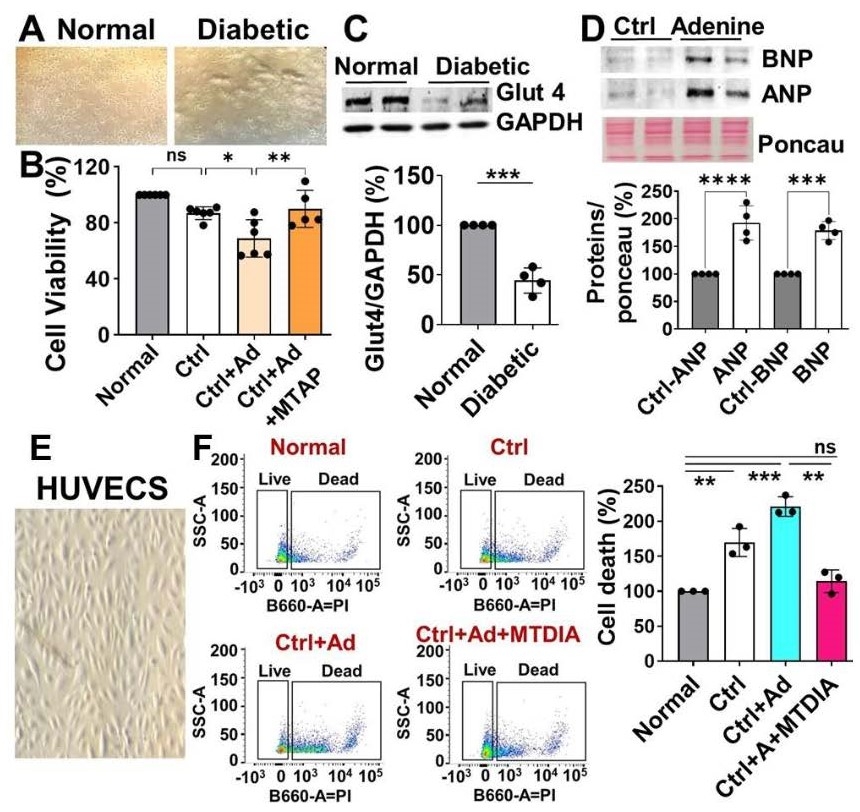
Abstract Body (Do not enter title and authors here): People living with T2DM are twice as likely to develop and die from cardiovascular disease, such as heart attacks, and heart failure (HF). HF is a clinical syndrome characterized by a constellation of symptoms that are caused by a structural and/or functional cardiac abnormality. The objective of this study is to define the mechanism by which adenine accumulation in heart contributes to HF in T2DM. Human heart tissues were analyzed by spatial metabolomics to assess adenine localization across hearts from non-diabetic and diabetic patients. Multi-modal analysis was performed using auto-fluorescence (AF) to localize coronary blood vessels and overlay with H&E imaging of serial sections. H9c2 cardiomyoblasts and HUVEC cells were cultured in DPBS media supplemented with glucose (30 mM)+insulin (1 nM) for 48 h. Cells were cultured in a 5% CO2/95% humidified air atmosphere at 37 oC and at passage 4 and 8 (70-80% confluence) and treated with adenine (20 μM, 2 g/kg in vivo) or vehicle for 1h hours. Using SMART2 study, human hearts, and mouse model, after adjustment for clinical risk factors, urine adenine/creatinine ratio (UAdCR) was associated with overall incident HF. Spatial metabolomics indicated that adenine accumulation was increased in coronary artery blood vessels of diabetic human and mouse hearts (Fig. 1). Adenine treatment exacerbated the reduction in cell viability, and increased cell death (Fig. 2). Moreover, adenine administration in mice and in vitro, altered the removal of damaged mitochondria (mitophagy), and significantly decreased mitochondrial inner membrane protein (Mic60) levels. This finding was supported by the increased number of damaged mitochondria observed in human diabetic tissues with HF, and suggests alteration of cardiac bioenergetics. All these effects were reversed by the inhibitor of adenine production (MTDIA), confirming that adenine induces deleterious effects in diabetic cells. MTDIA blocked adenine accumulation in the diabetic heart (Fig. 3), and restored cardiac dysfunction, but MTDIA did not affect blood glucose and body weight. These results indicate that endogenous adenine, as reflected by the UAdCR, can predict the incidence of HF in T2DM individuals and adenine accumulation in the heart contributes to diabetes-induced HF.
  • Nasiripour, Somayyeh  ( University of Texas Health San Anto , San Antonio , Texas , United States )
  • Khan, Muhammad S.  ( UTHSCSA , San Antonio , Texas , United States )
  • Tamayo, Ian  ( UT Health San Antonio , San Antonio , Texas , United States )
  • Sharma, Kumar  ( University of Texas Health San Anto , San Antonio , Texas , United States )
  • Bopassa, Jean Chrisostome  ( University of Texas Health San Anto , San Antonio , Texas , United States )
  • Author Disclosures:
    somayyeh Nasiripour: No Answer | Muhammad S. Khan: No Answer | Ian Tamayo: No Answer | Kumar Sharma: No Answer | Jean Chrisostome Bopassa: DO NOT have relevant financial relationships
Meeting Info:

Scientific Sessions 2025

2025

New Orleans, Louisiana

Session Info:

Kenneth Bloch Memorial Lecture in Vascular Biology

Monday, 11/10/2025 , 08:00AM - 09:15AM

Abstract Oral Session

More abstracts on this topic:
Cardiac Mitochondrial Dysfunction Impairs Mitochondrial Complex Activities And Induces UPRmt Stress Responses In The Cortex And Hippocampus

Muthu Sakthijothi, Tran Zinnia, Karelina Kate, Velayutham Murugesan, Meadows Ethan, Hollander John, Sundararajan Venkatesh

Anatomical Variations in Coronary Arteries and Implications in Spontaneous Coronary Artery Dissection

Gabaldon Badiola Alvaro, Kir Devika, Tweet Marysia, Donisan Teodora, Alfonso Fernando, Prasad Abhiram, Gulati Rajiv

More abstracts from these authors:
The importance of adenine in the formation of coronary artery calcification and development of ischemic cardiomyopathy

Tamayo Ian, Gruslova Aleksandra, Feldman Marc, Trevino Esmeralda, Bedi Kenneth, Margulies Kenneth, Lee Hak Joo, Bopassa Jean Chrisostome, Sharma Kumar

Comparative metabolic signatures of arterial calcification in human cadaver coronary arteries and a porcine model via MALDI mass spectrometry

Gruslova Aleksandra, Zhang Shiqi, Tamayo Ian, Feldman Marc, Sharma Kumar

You have to be authorized to contact abstract author. Please, Login
Not Available