Neighborhood Socioeconomic Deprivation Relates to Epigenetic Modification of the LPA gene and Potential Increase in Circulating Plasma Lp(a) Levels in African Americans: A Pilot Study
Abstract Body (Do not enter title and authors here): Background: Lp(a) has gained increased attention as a significant risk factor for cardiovascular disease (CVD), and its plasma levels are up to 3-fold higher in African Americans (AAs) likely contributing to the heightened CVD risk. While it is widely acknowledged that Lp(a) levels are largely determined by genetics, the potential impact of epigenetic alterations and a connection to adverse social determinants of health (SDoH) is unknown. Adverse SDoH are known to accelerate CVD risk, partially through epigenetic changes of the genome. In this pilot study, we aim to investigate a potential connection between socioeconomic status (SES) measures of SDoH, methylation levels within the Lp(a) gene, and circulating plasma Lp(a) levels in AAs.
Methods: Sixty AAs (93.3% female, mean age: 61 years, mean BMI 33.7kg/m^2) at moderate CVD risk and living in under-resourced neighborhoods within the Washington DC area, were recruited to the NIH. Baseline sociodemographics were collected, including individual-level SES and census tract-based neighborhood socioeconomic deprivation (NSD). Methylating patterns determined by DNA methylation analysis on the Lp(a) gene (LPA) were detected utilizing the Illumina technique. Lp(a) plasma levels were measured using ELISA. We conducted a multivariable regression analysis with adjustment for ASCVD 10-year risk score and BMI to explore associations between NSD, methylation levels on LPA, and Lp(a) plasma levels.
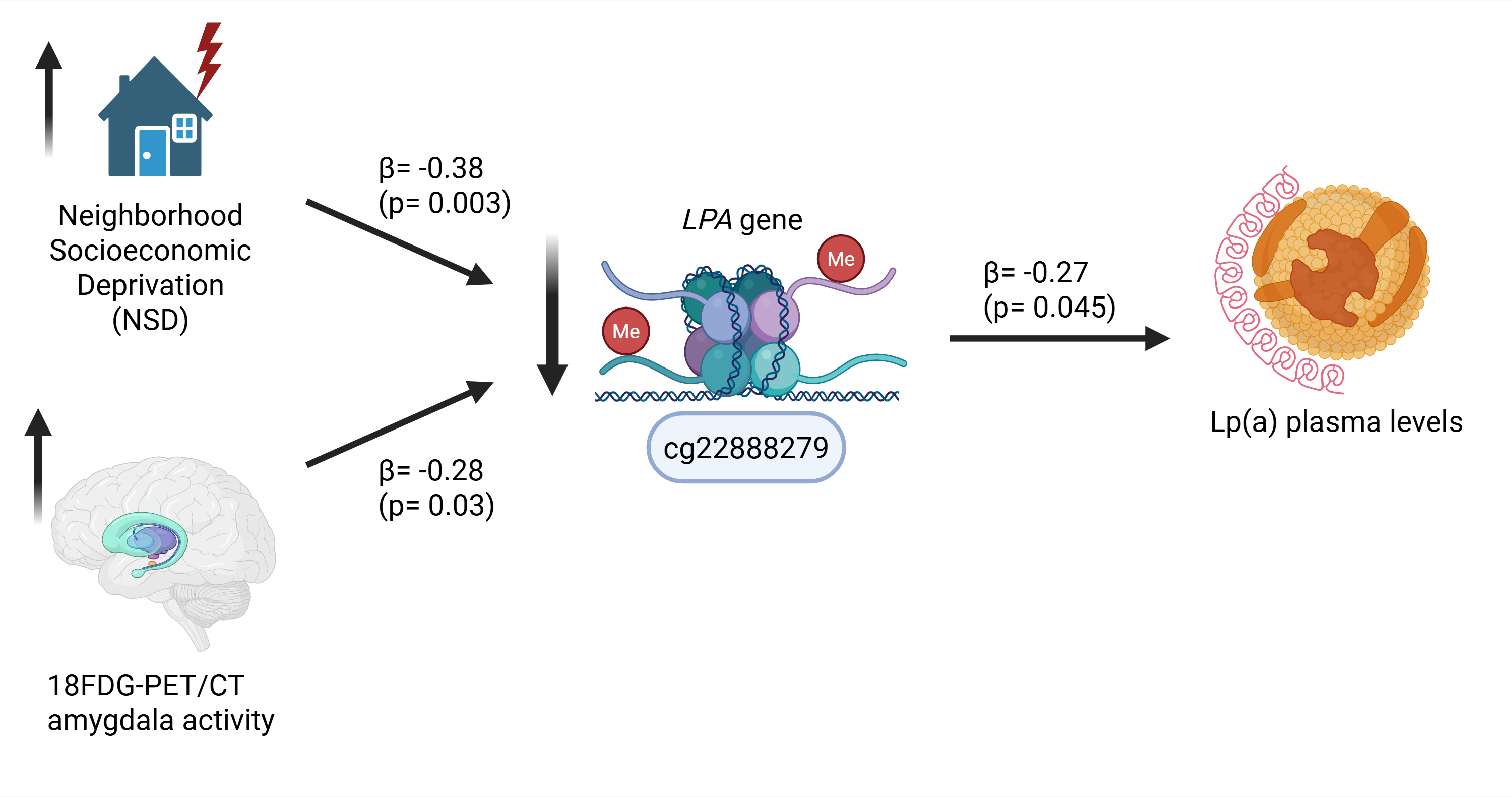
Results: We examined 20 LPA methylation sites. Four sites were significantly associated with circulating Lp(a) levels. None of these four methylation sites was significantly associated with SES. However, two methylation sites associated negatively with NSD (cg17028067 b= -0.27, p=0.04; cg22888279 b= -0.38, p=0.003). Neither SES nor NSD were directly associated with Lp(a) plasma levels. In a final step, we determined if either cg17028067 or cg22888279 would associate with 18FDG-PET/CT-measured amygdala activity, a pathophysiological measure of chronic stress. Amygdala activity was negatively associated with LPA-cg22888279 (b= -0.28, p = 0.03) (Figure).
Conclusion: Our data highlight the importance of chronic stress-related epigenetic modification of the LPA gene, especially in the cg22888279 locus, to increasing plasma Lp(a) levels, potentially further accelerating CVD development and progression in AAs.
Baumer, Yvonne
( National Institutes of Health
, Bethesda
, Maryland
, United States
)
Powell-wiley, Tiffany
( National Institutes of Health
, Bethesda
, Maryland
, United States
)
Pang, Alina
( Weill Cornell Medicine
, New York
, New York
, United States
)
Saurabh, Abhinav
( National Institutes of Health
, Bethesda
, Maryland
, United States
)
Mendelsohn, Laurel
( National Institutes of Health
, Bethesda
, Maryland
, United States
)
Mitchell, Valerie
( National Institutes of Health
, Bethesda
, Maryland
, United States
)
Collins, Billy
( U.S. Public Health Service
, Porter
, Texas
, United States
)
Andrews, Marcus
( National Institutes of Health
, Bethesda
, Maryland
, United States
)
Remaley, Alan
( National Institutes of Health
, Bethesda
, Maryland
, United States
)
Corley, Michael
( Weill Cornell Medicine
, New York
, New York
, United States
)
Author Disclosures:
Yvonne Baumer:DO NOT have relevant financial relationships
| Tiffany Powell-Wiley:DO NOT have relevant financial relationships
| Alina Pang:No Answer
| Abhinav Saurabh:No Answer
| Laurel Mendelsohn:DO NOT have relevant financial relationships
| Valerie Mitchell:No Answer
| Billy Collins:DO NOT have relevant financial relationships
| Marcus Andrews:No Answer
| Alan Remaley:No Answer
| Michael Corley:DO NOT have relevant financial relationships