
Logo

American Heart Association

  14
  0


Final ID: MP2082

Healthcare Providers Conceptions of Chest Pain Differ from the Lay Public

Abstract Body (Do not enter title and authors here): Introduction. Chest pain is the most common symptom of ACS. The term chest pain is an umbrella term, and patients often describe chest symptoms using other terms leading them to deny chest pain. A mismatch between healthcare professionals’ and the lay public’s conceptions of chest pain may lead to ineffective assessment or triage for chest symptoms leading to delayed diagnosis and treatment.
Research question. How does the conception of chest pain differ between healthcare professionals and the lay public?
Methods. Participants from across the U.S. were recruited online for the lay public sample. Healthcare professionals were recruited from a large multi-facility healthcare system in the Midwest. Participants completed an online survey that included basic demographic questions and the Chest Pain Conception Questionnaire. Descriptive statistics were used to characterize chest pain in both samples while Chi-square and Mann-Whitney U tests were used to compare the samples.
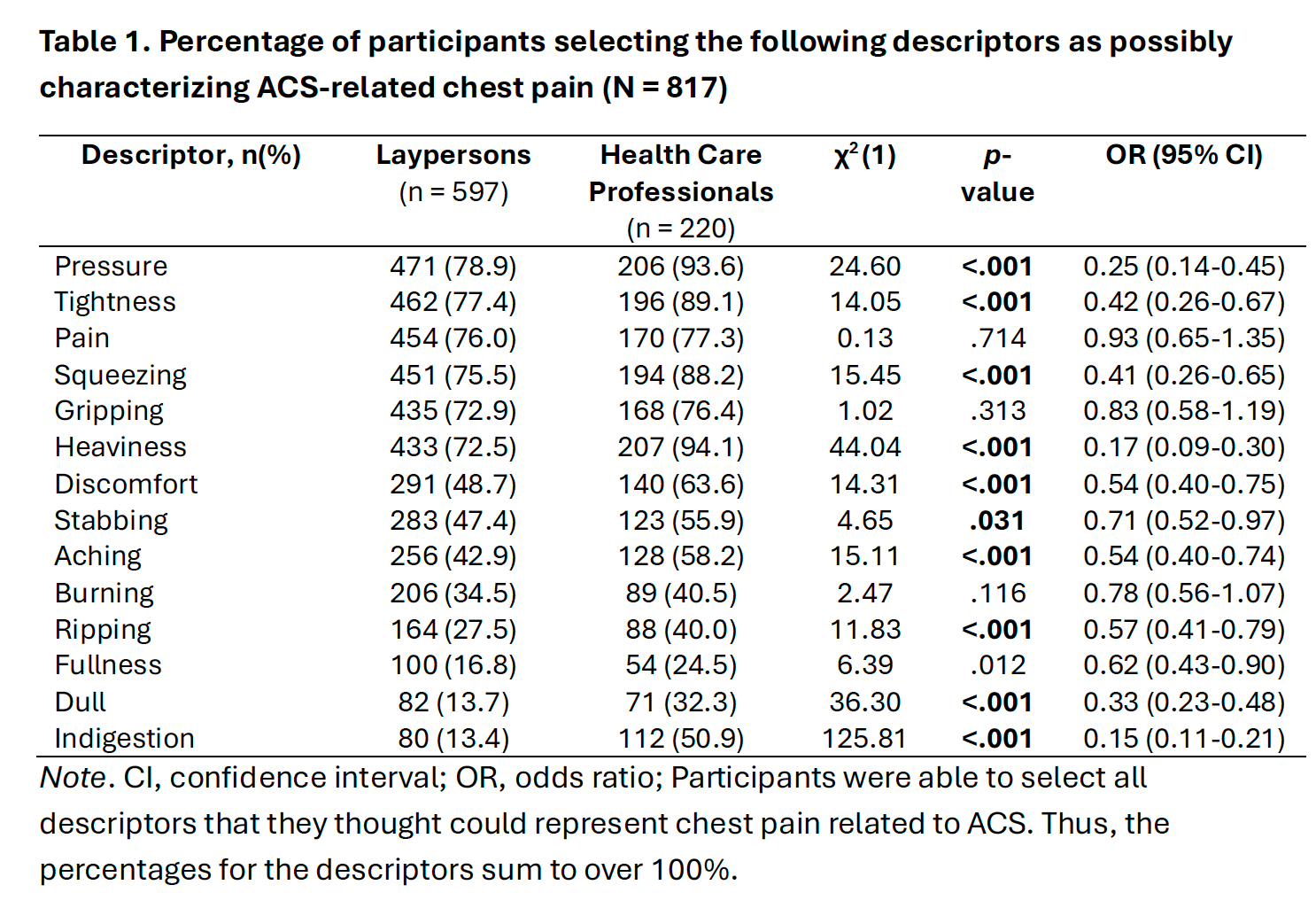
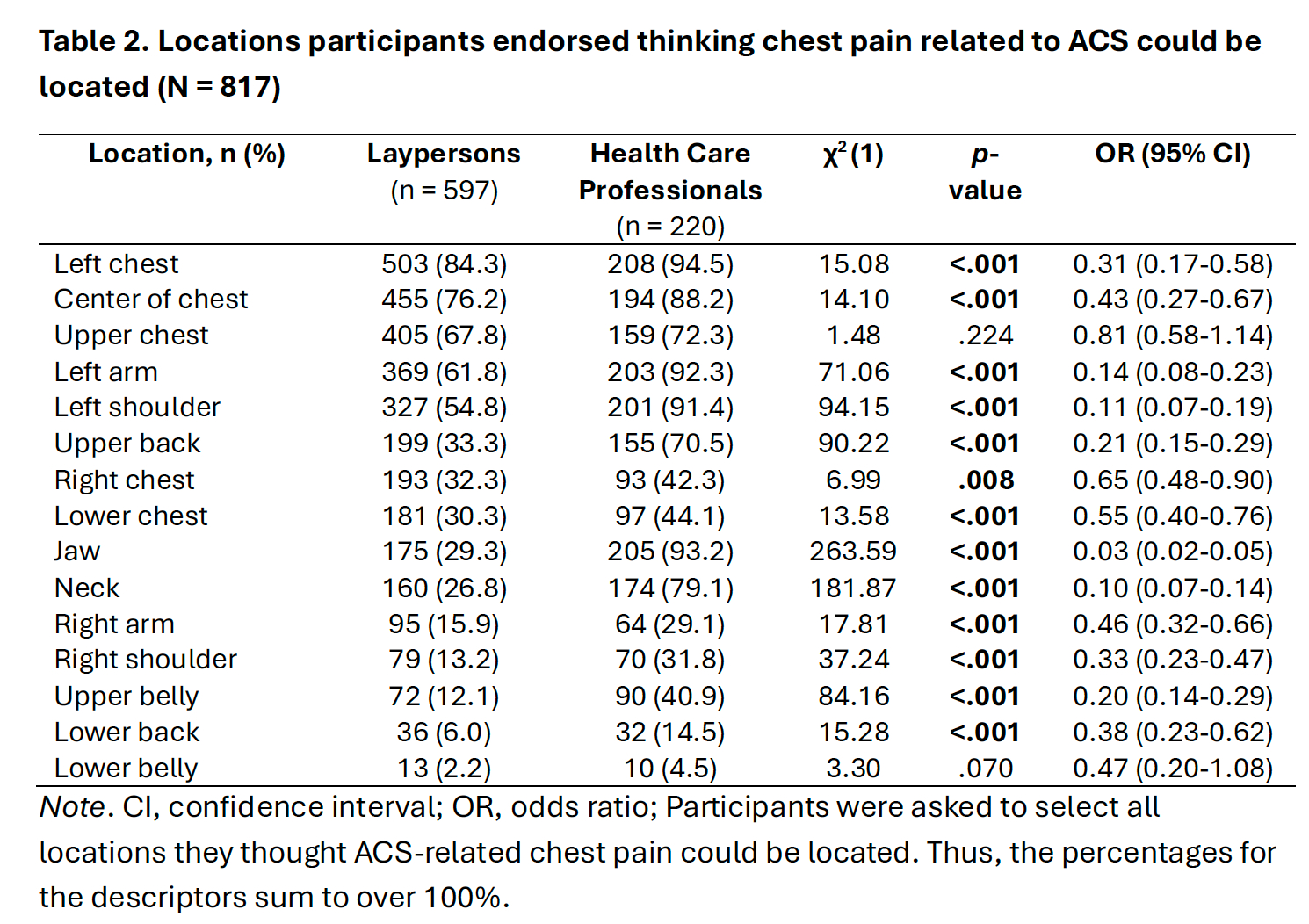
Results. In the lay public sample, participants (N=597) were primarily female (59.6%) and non-Hispanic White (57.8%) with an average age of 54.0 years (SD 11.5). A total of 220 healthcare professionals participated. Healthcare providers were primarily female (92.3%) and the majority were 25-44 years of age. Healthcare professionals were more likely to select a wider variety of chest pain descriptors than the lay public with over 50% of healthcare professionals choosing 9 possible descriptors while over 50% of the lay public endorsed only 6 (Table 1). They were also more likely to select a wider variety of locations than the lay public (Table 2). Healthcare professionals were more likely than the lay public to report that ACS-related chest pain occurs ‘sometimes’ or ‘often’ with rest (p<.001) and activity (p<.001). The lay public was more likely to believe that chest pain would be intense (47.4%) or very intense (37.9%) and bother them ‘a lot’ (41.4%) or ‘a great deal’ (44.1%) though most healthcare professionals did endorse that chest pain would be intense (50.5%) with fewer selecting very intense (25.0%).
Conclusion. Significant differences were identified in the chest pain conceptions between healthcare professionals and the lay public. These findings highlight the need for education that targets misconceptions so that health care professionals and the lay public conceive of term chest pain in similar ways, supporting more accurate assessment/triage, diagnosis, and rapid management.
  • Eckhardt, Ann  ( University of Texas at Arlington , Arlington , Texas , United States )
  • Blakeman, Elizabeth  ( Memorial Health , Springfield , Illinois , United States )
  • Blanchetti, Nancy  ( Memorial Health , Springfield , Illinois , United States )
  • Deters, Edith Christine  ( Memorial Health , Springfield , Illinois , United States )
  • Kim, Myoungjin  ( Illinois State University , Chatham , Illinois , United States )
  • Whitaker, Tiffany  ( Memorial Health , Springfield , Illinois , United States )
  • Yoder, Debora  ( Memorial Health , Springfield , Illinois , United States )
  • Blakeman, John  ( Illinois State University , Chatham , Illinois , United States )
  • Author Disclosures:
    Ann Eckhardt: DO NOT have relevant financial relationships | Elizabeth Blakeman: DO NOT have relevant financial relationships | NANCY Blanchetti: DO NOT have relevant financial relationships | Edith Christine Deters: No Answer | MyoungJin Kim: DO NOT have relevant financial relationships | Tiffany Whitaker: DO NOT have relevant financial relationships | Debora Yoder: No Answer | John Blakeman: DO have relevant financial relationships ; Individual Stocks/Stock Options:Roche:Active (exists now)
Meeting Info:

Scientific Sessions 2025

2025

New Orleans, Louisiana

Session Info:

ACS Across the Spectrum: Innovations in Diagnosis, Delays, and Diverse Patient Experiences

Monday, 11/10/2025 , 01:45PM - 02:55PM

Moderated Digital Poster Session

More abstracts on this topic:
Accuracy Of Stroke Prediction Using The Predicting Risk Of CVD Events Equation Among Diverse Adults Of The Northern Manhattan Study

Mesa Robert, Veledar Emir, Levin Bonnie, Agudelo Christian, Elfassy Tali, Gardener Hannah, Rundek Tatjana, Brown Scott, Yang Eugene, Elkind Mitchell, Gutierrez Jose, Besser Lilah, Gutierrez Carolina

Advanced maternal age and association with major adverse cardiovascular events from NHANES from 1999 to 2018

Mehta Adhya, Honigberg Michael, Kennedy Jamie, Spitz Jared, Sharma Garima, Agboola Olayinka, Satti Danish Iltaf, Harrington Colleen, Scott Nandita, Sarma Amy, Saad Antonio, Sullivan Scott, Epps Kelly

More abstracts from these authors:
You have to be authorized to contact abstract author. Please, Login
Not Available