
Predictive Value of Patent False Lumen Extent for Postoperative Hypoxia in Acute Type A Aortic Dissection
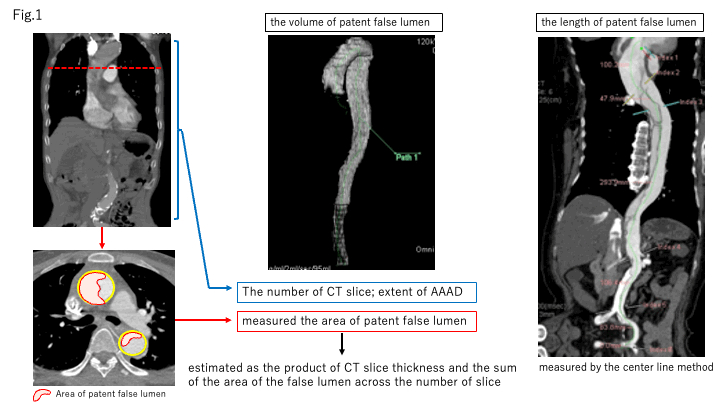
Abstract Body (Do not enter title and authors here): Background: Acute type A aortic dissection (AAAD) is frequently complicated by severe respiratory failure due to acute lung injury, contributing to postoperative mortality. This study investigated the association between the extent of the patent false lumen and postoperative hypoxia in patients with AAAD. Methods: We retrospectively analyzed 143 patients with AAAD who had a patent false lumen and underwent surgical repair within 24 hours of diagnosis. Severe hypoxia was defined as PaO2/FiO2 (PF) ratio <200 during postoperative endotracheal intubation. The volume of the patent false lumen was calculated as the product of CT slice thickness and the summed area of the false lumen across all axial slices. Additionally, the length of the aorta with a patent false lumen was measured using centerline analysis (Fig 1). Results: Severe hypoxia occurred in 66% of patients. Compared to those without oxygenation impairment, patients with hypoxia had significantly longer ICU stays, prolonged mechanical ventilation, and lower minimum PF ratios (all p<0.05). The hypoxia group also showed significantly greater false lumen length and volume (p<0.01). In contrast, no significant differences were found in smoking history, surgical procedure, or operative time between the two groups. Receiver operating characteristic (ROC) curve analysis demonstrated that both the length and volume of the patent false lumen had modest predictive ability for postoperative hypoxia, with areas under the curve (AUC) of 0.68 and 0.70, respectively. The optimal cut-off value for length was 439mm (sensitivity 66%, specificity 65%), and for volume, 185 cm3 (sensitivity 60%, specificity 59%). Conclusions: The extent of the patent false lumen was identified as a risk factor for postoperative hypoxia in AAAD. Greater intimal disruption was associated with postoperative respiratory complications. Preoperative assessment of false lumen morphology may assist in identifying high-risk patients and guiding appropriate respiratory management.
Kameda, Yuika
( Ota Memorial Hospital
, Gunma
, Japan
)
Samejima, Yusuke
( Ota Memorial Hospital
, Gunma
, Japan
)
Nemoto, Naohiko
( Ota Memorial Hospital
, Gunma
, Japan
)
Anzai, Hitoshi
( Ota Memorial Hospital
, Gunma
, Japan
)
Author Disclosures:
Yuika Kameda:DO NOT have relevant financial relationships
| Yusuke Samejima:No Answer
| Naohiko Nemoto:DO NOT have relevant financial relationships
| Hitoshi Anzai:No Answer