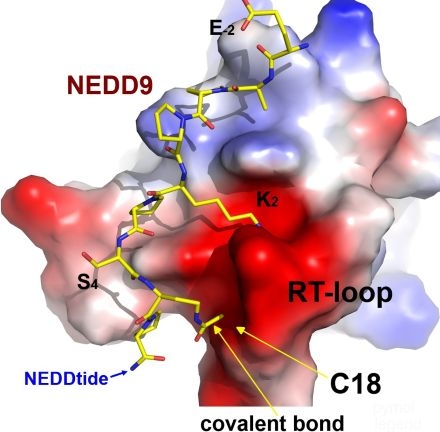
Abstract Body (Do not enter title and authors here): Introduction Knockout of the gene encoding SH3-domain protein NEDD9 mitigates endothelial dysfunction, vascular fibrosis and pulmonary arterial hypertension (PAH) in vivo, suggesting NEDD9 may be a therapeutic target in PAH. However, SH3 domains express flat and shallow surfaces that lack small molecule binding pockets, and, thus, are considered “undruggable”. Hypothesis We hypothesized that a peptidyl approach leveraging the focal adhesion kinase (FAK) consensus motif, PxKPxR, which modulates NEDD9 protein-protein docking, with a warhead targeting the redox sensitive cysteine at position 18 on the flexible RT loop promotes target engagement and specificity to NEDD9. Methods NEDD9-targeting peptides (NEDDtides) containing PxKPxR were modified with bromoacetamide as a covalent warhead, or thalidomide to engage the E3 ligase system. Crystallography and various in vitro chemical assays were used to profile NEDDtide-NEDD9 interactions, and biological effects were tested in cultured human pulmonary artery endothelial cells (HPAECs). Results Isothermal titration calorimetry confirmed binding of a NEDDtide to NEDD9 SH3 domain (KD=4 μM). Compared to vehicle (V) control, transfection of HPAECs for 10 min with NEDDtide conjugated to thalidomide induced dose-dependent degradation of NEDD9 protein that was not observed for SH3 protein GBR2, which lacks an PxKPxR consensus motif (2.4±0.3 vs. 1.1±0.1 vs. 2.0±0.1 arb. units, P<0.001). To optimize potency and target specificity, we modified the NEDDtide with a reactive bromoacetamide residue. Crystallography confirmed a structural basis of interactions and covalent bond between warhead and Cys18 in NEDDtide-NEDD9 complex (Figure). Fluorescence polarization demonstrated strong affinity of the covalent peptide for the NEDD9-SH3 (IC50=4 μM). Further, incubation with a 10-fold excess of peptide led to complete labeling of NEDD9-SH3 assessed by mass spectrometry. Compared to V-treated cells, HPAECs transfection with the covalent peptide decreased cell migration by wound assay (422±35 vs. 192±30 µm, P<0.001). Conclusion We developed a novel FAK peptidomimetic to engage the SH3 protein NEDD9. NEDDtide modification with a bromoacetamide warhead showed strong affinity to, and specificity for, NEDD9-SH3, and affected HPAEC phenotype whereas thalidomide-modified NEDDtide degraded NEDD9. This technology advances therapeutics targeting SH3 proteins with implications for diseases characterized by endothelial dysfunction including PAH.
Saha, Progyaparamita
(
University of Maryland
, Baltimore , Maryland , United States )
Seo, Hyuk-soo
(
Dana-Farber Cancer Institute
, Boston , Massachusetts , United States )
Daum, Jacqueline
(
University of Maryland, Baltimore
, Baltimore , Maryland , United States )
Dhe-paganon, Sirano
(
Dana-Farber Cancer Institute
, Boston , Massachusetts , United States )
Maron, Bradley
(
University of Maryland, Baltimore
, Baltimore , Maryland , United States )
Samokhin, Andriy
(
University of Maryland, Baltimore
, Baltimore , Maryland , United States )
Author Disclosures:
Progyaparamita Saha:No Answer
| Hyuk-Soo Seo:No Answer
| Jacqueline Daum:DO NOT have relevant financial relationships
| Sirano Dhe-Paganon:No AnswerAndriy Samokhin:DO NOT have relevant financial relationships