Logo

American Heart Association

  14
  0


Final ID: MP1913

Reduced Medial Prefrontal Cortex Hemodynamics and Peak Oxygen Consumption in Patients with Takotsubo Syndrome

Abstract Body (Do not enter title and authors here): Introduction:
Preliminary data suggest that patients with takotsubo syndrome (TTS) have altered activation of stress-related brain regions. The medial prefrontal cortex (mPFC) plays a central role in processing stress-related information and initiating the associated cardiovascular response. The aim of this study is to determine whether changes in mPFC hemodynamics are present in patients with TTS during the acute hospitalization compared to in recovery, and whether mPFC hemodynamics correlate with cardiac function and peak oxygen consumption (peak VO2), a measure of cardiorespiratory fitness and a strong predictor of cardiovascular outcomes.
Methods:
Medial prefrontal cortex (mPFC) hemodynamics were evaluated non-invasively with near-infrared spectroscopy in patients hospitalized with TTS and controls. TTS patients were then reassessed 90±30 days after discharge (follow-up). We assessed mPFC hemodynamics for ten minutes with the patient resting in the semi-fowler position. In follow-up, a symptom-limited cardiopulmonary exercise test was also completed to assess peak VO2. Comparisons were assessed with Wilcoxon or Mann-Whitney testing as appropriate, and correlations were made with Spearman rank testing. Data are median [IQR].
Results:
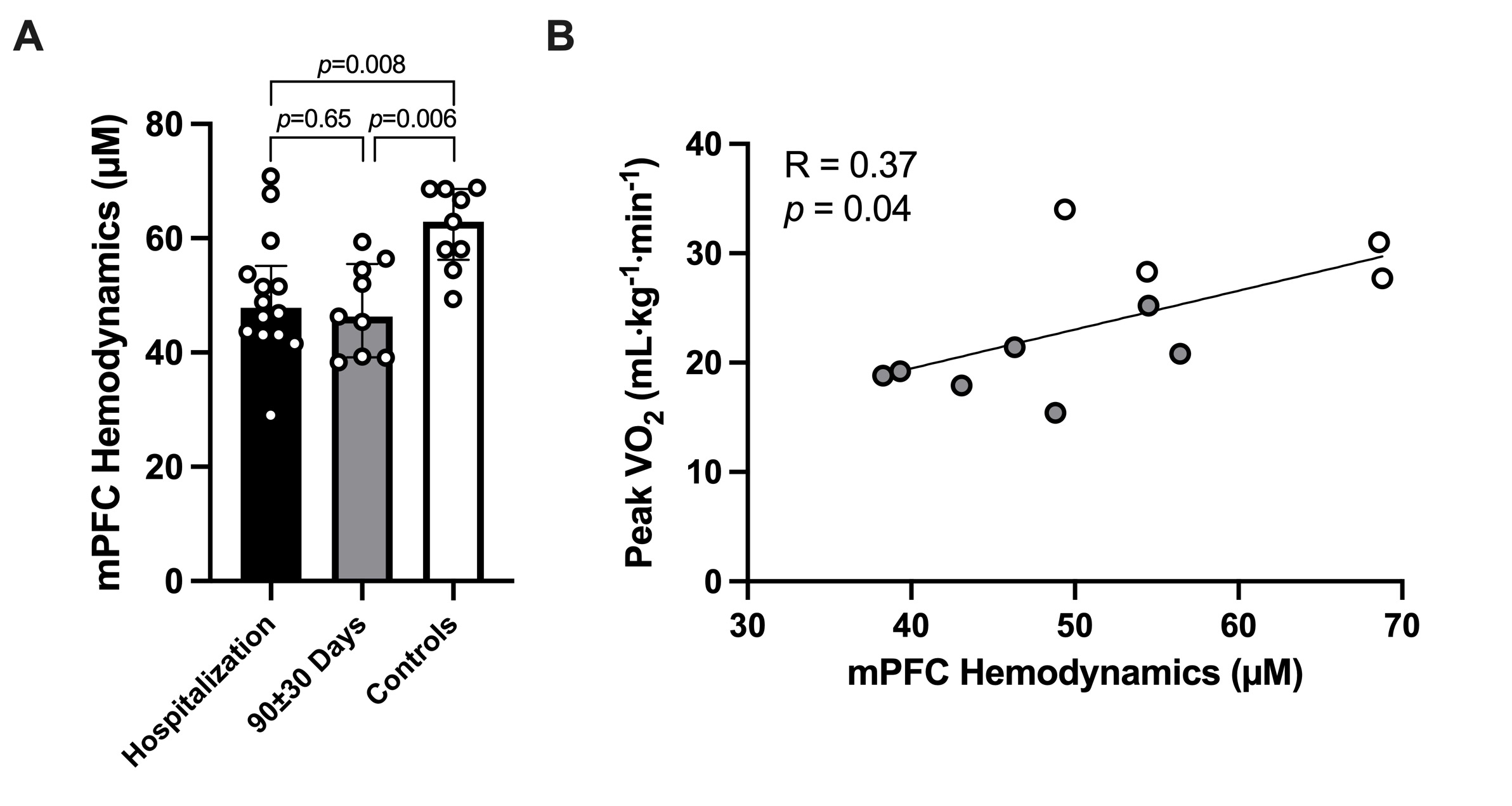
Patients with TTS (n=14) were assessed during hospitalization (LVEF: 34 [28-40] %, troponin I: 1,392 [405-2,626] ng/L, BNP: 873 [459-996] pg/mL). Controls were matched for age, sex, and LVEF to TTS patients at follow-up. We observed significantly lower mPFC hemodynamics in TTS (48 [43-53] μM) compared to controls (63 [58-69] μM; p=0.008; Fig 1A). At follow-up (n=9), cardiac function in TTS improved (LVEF: 57 [53-60] %, troponin I: 3 [3-5] ng/L, BNP: 32 [24-72] pg/mL), however, mPFC hemodynamics were not different from hospitalization (46 [39-55] μM; p=0.65) and remained significantly reduced compared to controls (p=0.004). Peak VO2 in TTS (18 [17-23] ml.kg-1.min-1) was also significantly reduced compared to controls (30 [28-32] ml.kg-1.min-1; p=0.006), and peak VO2 correlated with mPFC hemodynamics in follow-up (R=0.37; p=0.04; n=11; Fig 1B).
Conclusion:
These data suggest that in TTS, mPFC hemodynamics are reduced during hospitalization and remain reduced in follow-up. Further, peak VO2 is poor in those with TTS and positively correlates with mPFC hemodynamics. Additional research is needed to address how mPFC hemodynamics may influence cardiorespiratory fitness in TTS.
  • Hogwood, Austin  ( University of Virginia , Charlottesville , Virginia , United States )
  • Van Tassell, Benjamin  ( Virginia Commonwealth University , Richmond , Virginia , United States )
  • Canada, Justin  ( Virginia Commonwealth University , Richmond , Virginia , United States )
  • Rodriguez Miguelez, Paula  ( Virginia Commonwealth University , Richmond , Virginia , United States )
  • Abbate, Antonio  ( University of Virginia , Charlottesville , Virginia , United States )
  • Marchetta, Michele  ( University of Virginia , Charlottesville , Virginia , United States )
  • Lopez Miranda, Rocio Isabel  ( University of Virginia , Charlottesville , Virginia , United States )
  • Simovic, Tijana  ( Virginia Commonwealth University , Richmond , Virginia , United States )
  • Denicolai, Martin  ( University of Virginia , Charlottesville , Virginia , United States )
  • Bigio, Sophia  ( University of Virginia , Charlottesville , Virginia , United States )
  • Clark, Reid  ( University of Virginia , Charlottesville , Virginia , United States )
  • Golino, Michele  ( Virginia Commonwealth University , Richmond , Virginia , United States )
  • Kontos, Emily  ( Virginia Commonwealth University , Richmond , Virginia , United States )
  • Author Disclosures:
    Austin Hogwood: DO NOT have relevant financial relationships | Benjamin Van Tassell: DO NOT have relevant financial relationships | Justin Canada: DO NOT have relevant financial relationships | Paula Rodriguez Miguelez: DO NOT have relevant financial relationships | Antonio Abbate: DO have relevant financial relationships ; Consultant:Kiniksa:Active (exists now) ; Consultant:Monterosa Tx:Past (completed) ; Consultant:Novo Nordisk:Active (exists now) ; Consultant:Cardiol:Past (completed) | Michele Marchetta: DO NOT have relevant financial relationships | ROCIO ISABEL LOPEZ MIRANDA: No Answer | Tijana Simovic: DO NOT have relevant financial relationships | Martin Denicolai: DO NOT have relevant financial relationships | Sophia Bigio: DO NOT have relevant financial relationships | James Clark: DO NOT have relevant financial relationships | Michele Golino: DO NOT have relevant financial relationships | Emily Kontos: DO NOT have relevant financial relationships
Meeting Info:

Scientific Sessions 2025

2025

New Orleans, Louisiana

Session Info:

Heart-Brain Axis in Stroke, Recovery, and Cognitive Resilience

Monday, 11/10/2025 , 10:45AM - 12:00PM

Moderated Digital Poster Session

More abstracts on this topic:
A-band titin-truncating variant promotes the development of arrhythmia-induced cardiomyopathy in a novel genetically-engineered porcine model

Lee Kwonjae, Del Rio Carlos, Mcnally Elizabeth, Pfenniger Anna, Bhatnagar Ashita, Glinton Kristofor, Burrell Amy, Ober Rebecca, Mcluckie Alicia, Bishop Brian, Rogers Christopher, Geist Gail

A Comparative Study Of Social Determinants, Hypertension, And Life Essential Factors In Alabama And Colorado From The 2021 Behavioral Risk Factor Surveillance System

Chukwunyere Chibuike, Owuor Kevin

More abstracts from these authors:
Interleukin-1 Blockade in Patients With ST-Segment Elevation Myocardial Infarction Across the Spectrum of Coronary Artery Disease Complexity.

Denicolai Martin, Morello Matteo, Golino Michele, Corna Giuliana, Del Buono Marco, Agatiello Carla, Van Tassell Benjamin, Abbate Antonio

Interleukin-1 Blockade in Patients With ST-Segment-Elevation Myocardial Infarction: a Pooled Analysis of Randomized Clinical Trials of Anakinra and Goflikicept

Golino Michele, Meray Imad, Privalov Dmitry, Cremer Paul, Egorova Alina, Ponomar Ekaterina, Van Tassell Benjamin, Abbate Antonio, Marchetta Michele, Del Buono Marco Giuseppe, Trankle Cory, Canada Justin, Markley Roshanak, Grishin Sergey, Samsonov Mikhail, Pevzner Dmitriy

You have to be authorized to contact abstract author. Please, Login
Not Available