Logo

American Heart Association

  18
  0


Final ID: MP450

Spironolactone and Cardiovascular Outcomes in Dialysis Patients with Heart Failure

Abstract Body (Do not enter title and authors here): Background: Patients with end-stage renal disease (ESRD) undergoing dialysis and with concomitant heart failure (HF) experience substantial cardiovascular risks. Although mineralocorticoid receptor antagonists (MRAs) are guideline-recommended for HF management, their utilization in dialysis-dependent populations is constrained by safety concerns and a paucity of outcome data.
Objective: This study aimed to evaluate the association of spironolactone use with the risks of major adverse cardiovascular events (MACE) and all-cause mortality among dialysis patients with HF.
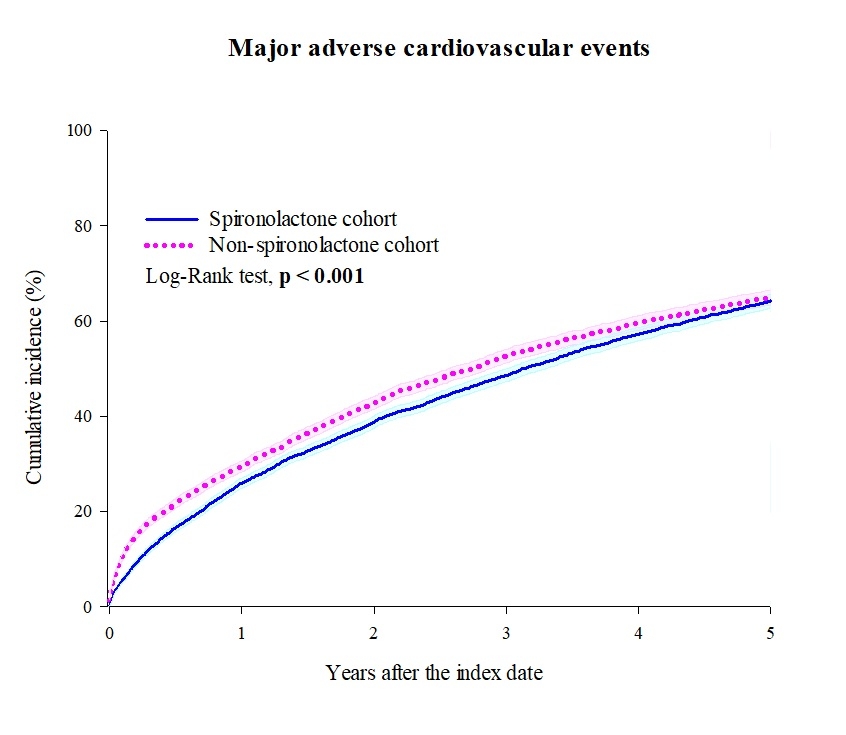
Methods: This retrospective cohort study utilized data from the TriNetX US collaborative network, encompassing over 122 million patients. We identified adult patients with ESRD undergoing dialysis and diagnosed with HF between 2015 and 2024. Spironolactone users (n=6,951) were propensity score-matched (1:1) to non-users. The primary endpoints were the 5-year incidence of MACE and all-cause mortality. Cox proportional hazards regression and Kaplan-Meier survival analysis were employed. Subgroup and sensitivity analyses were performed to assess the robustness of the findings.
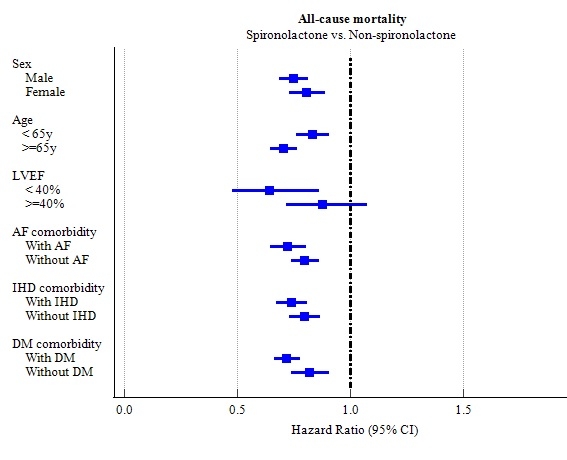
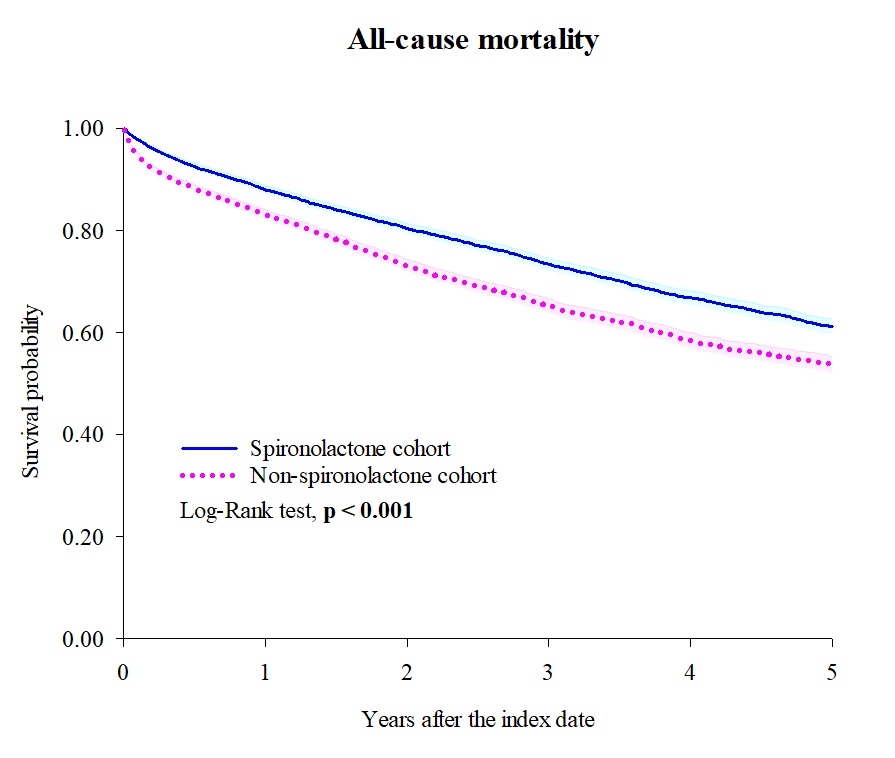
Results: Compared to non-users, spironolactone users exhibited significantly reduced risks of MACE (HR: 0.892, 95% CI: 0.850–0.937) and all-cause mortality (HR: 0.738, 95% CI: 0.694–0.786). Subgroup analyses revealed consistent reductions in mortality across various patient characteristics, including sex, age, and comorbidities such as diabetes, ischemic heart disease, and atrial fibrillation (Figure 1). Kaplan-Meier survival curves illustrated a sustained benefit throughout the follow-up period . Conversely, spironolactone use was associated with increased risks of ischemic stroke (HR: 1.157), hypotension (HR: 1.197), and hyperkalemia (HR: 1.086). Baseline left ventricular ejection fraction (LVEF) did not differ significantly between the groups (p=0.802).
Conclusion: In this cohort of dialysis patients with HF, spironolactone administration was associated with lower MACE and all-cause mortality, albeit with an increased incidence of hyperkalemia and ischemic stroke. These findings advocate for the judicious use of spironolactone in this high-risk cohort, while emphasizing the imperative for randomized controlled trials (RCTs) to confirm its efficacy and safety profile.
  • Hsiao, Buyuan  ( Taipei medical university hospital , Taipei , Taiwan )
  • Author Disclosures:
    BUYUAN HSIAO: DO NOT have relevant financial relationships
Meeting Info:

Scientific Sessions 2025

2025

New Orleans, Louisiana

Session Info:

Addressing the Cardiac-Kidney Connection: Defining Risk and Optimizing Outcomes

Saturday, 11/08/2025 , 01:45PM - 02:45PM

Moderated Digital Poster Session

More abstracts on this topic:
Association of Neutrophil-Lymphocyte Ratio with All-Cause Mortality and Cardiovascular Mortality in Patients Receiving Peritoneal Dialysis: A Systematic Review and Meta-Analysis

Mourad Denise, Damarlapally Nanush, Vempati Roopeessh, Vasudevan Srivatsa Surya, Banda Prathibha, Polamarasetty Harshavardhan, Khan Afrasayab, Mathur Gaurav, Desai Rupak

A Body Shape Index at Age 25-64 Predicts Mortality and CHD Hospitalization

Shafran Itamar, Krakauer Nir, Krakauer Jesse, Cohen Gali, Gerber Yariv

You have to be authorized to contact abstract author. Please, Login
Not Available