Identification of heart failure patients by seismocardiography; a comparison with brain natriuretic peptide
Abstract Body (Do not enter title and authors here): Background: Heart failure is a significant global health concern, with limited diagnostic tools for efficient, cost-effective, and non-invasive detection. While echocardiography is widely used due to its availability and affordability, its accuracy depends on operator skill and requires specialist training for accurate results. Brain natriuretic peptide testing, though recommended in heart failure detection, is costly, delayed, and affected by various factors. Seismocardiography is a non-invasive, low-cost method that records chest vibrations caused by the heart’s mechanical activity. It offers continuous, high-resolution monitoring and shows promise for assessing heart function and detecting heart failure.
Purpose: The primary aim is to develop a seismocardiography-based algorithm and assess its diagnostic performance in detection of heart failure with reduced ejection fraction (HFrEF) and compare it to brain natriuretic peptide in detecting HFrEF.
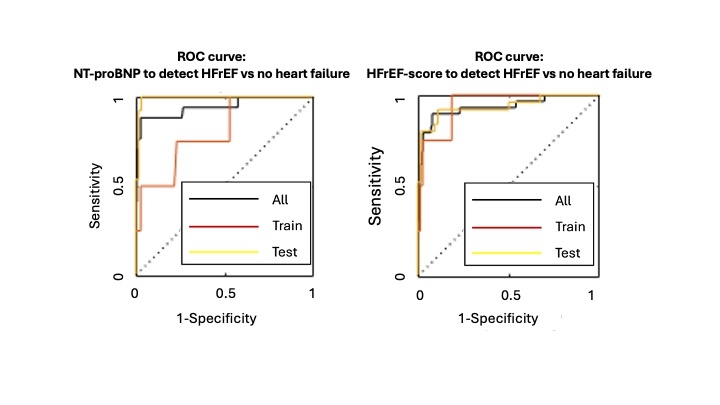
Methods: A seismocardiography-based algorithm, the "HFrEF-score," was developed using logistic regression to detect HFrEF. The algorithm was trained using logistic regression on 79 subjects (75 without heart failure, 4 with HFrEF) and evaluated on 89 subjects (64 without, 25 with HFrEF). Diagnostic accuracy was assessed using sensitivity, specificity, positive predictive value, negative predictive value, and the area under the receiver-operating characteristic curve (AUC-ROC).
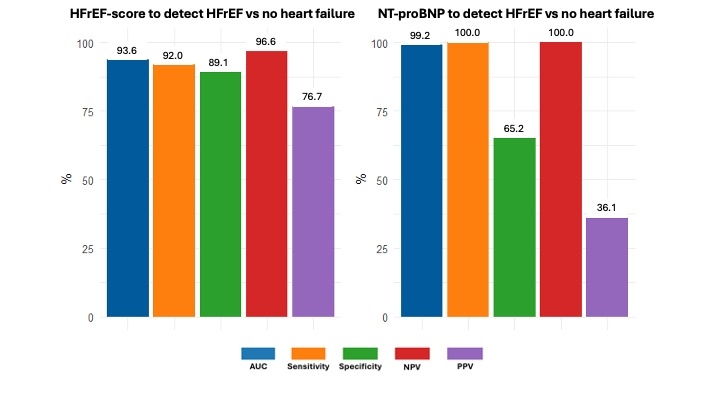
Results: The study included 199 subjects with suspected HF and 20 patients with known HFrEF. Following exclusion criteria, 208 subjects formed the final study population. The seismocardiography-based HFrEF-score achieved an AUC of 93.6%, sensitivity of 92%, specificity of 89.1%, negative predictive value of 96.6% and positive predictive value of 76.7% in detecting HFrEF vs no heart failure. Brain natriuretic peptide demonstrated high AUC of 99.2%, sensitivity of 94% and negative predictive value of 99% but lower specificity (68.6%) and positive predictive value (26.7%) compared to HFrEF-score.
Conclusions: This study demonstrates the potential of seismocardiography for identifying HFrEF. The seismocardiography-based HFrEF-score showed high diagnostic accuracy, with superior specificity and PPV compared to brain natriuretic peptide. Seismocardiography could potentially offer a cost-effective, non-invasive alternative for HFrEF detection.
Agam, Ahmad
(
Aalborg University Hospital
, Aalborg , Denmark )
Korsgaard, Emil
(
Aalborg University
, Aalborg , Denmark )
Schmidt, Samuel
(
Aalborg University
, Aalborg , Denmark )
Soegaard, Peter
(
Aalborg University Hospital
, Aalborg , Denmark )
Author Disclosures:
Ahmad Agam:DO NOT have relevant financial relationships
| Peter Soegaard:No Answer
| Emil Korsgaard:DO NOT have relevant financial relationships
| Troels Yding Haugstrup:DO NOT have relevant financial relationships
| Maria Weinkouff Pedersen:No Answer
| Kristian Kragholm:No Answer
| Massar Omar:No Answer
| Jacob Moller:DO have relevant financial relationships
;
Speaker:Johnson & Johnson Heart Recovery:Past (completed)
; Consultant:Magenta:Active (exists now)
; Consultant:Boston Scientific:Active (exists now)
; Speaker:Abbott:Past (completed)
; Research Funding (PI or named investigator):Novo Nordic Foundation:Active (exists now)
; Research Funding (PI or named investigator):Abiomed:Past (completed)
; Research Funding (PI or named investigator):Johnson & Johnson Heart Recovery:Active (exists now)
| Kasper Janus Groenn Emerek:No Answer
| Samuel Schmidt:No Answer