Logo

American Heart Association

  30
  0


Final ID: MP492

Cumulative exposure to low-density lipoprotein cholesterol levels explains the cardiovascular benefit over time in randomized clinical trials

Abstract Body (Do not enter title and authors here): Introduction
It is well-established that lowering low-density lipoprotein cholesterol (LDL-C) levels is associated with cardiovascular risk reduction, with clinical benefits increasing over time; however, previous analyses may have underestimated the real treatment effect by not accounting for yearly changes in LDL-C levels.
Research question
The aim of this study was to assess the reduction in major cardiovascular event (MCE) risk after each year of statin therapy, considering the actual LDL-C reduction achieved annually.
Methods
We included statin randomized controlled trials (RCTs) from the Cholesterol Treatment Trialists' Collaboration meta-analyses that reported the Kaplan-Meyer curve for MCE (defined as a composite of acute myocardial infarction, non-hemorrhagic stroke, cardiac death, and ischemia-driven revascularization) and LDL-C change after each year of follow-up. We used an online image-processing tool (WebPlotDigitizer 4.5) to extract trial-level data from event curves and LDL-C graphs, to estimate hazard ratios (HRs) with 95% confidence intervals (95% CI) for therapy-outcome associations and to track LDL-C changes after each year of follow-up. HRs for MCE and LDL-C measurement after each year of treatment were then scaled to a 1 mmol/L reduction. For each year of follow-up, HRs standardized for 1 mmol/L were pooled through a random-effects meta-analysis.
Results
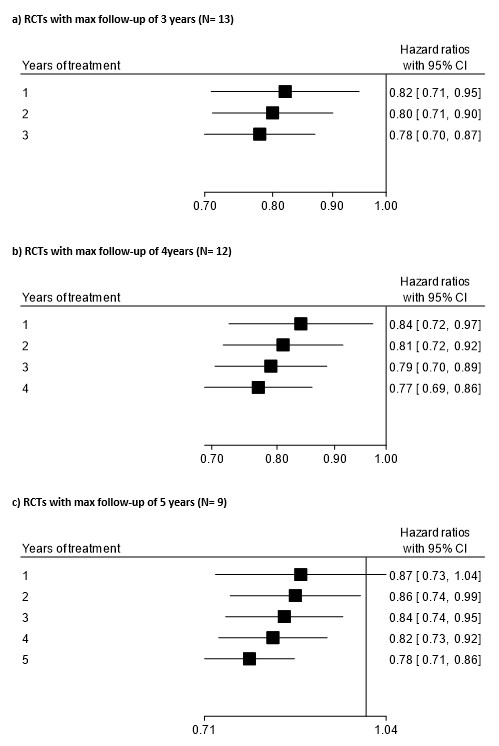
We included a total of 13 RCTs with statins enrolling 99,360 participants. A 1 mmol/L reduction in LDL-C was associated with increasing cardiovascular benefit over time, with a consistent trend across trials lasting up-to 3, 4 and 5 years (Figure). In the latter case, the pooled data from 9 RCTs with data available up to 5 years showed a risk reduction per 1 mmol/L ranging from 13% after one year (HR: 0.87; 95% CI: 0.73-1.04) to a 22% reduction after 5 years (HR: 0.78; 95% CI: 0.71-0.86).
Conclusions
Our findings reinforce the notion that prolonged exposure to lower LDL-C levels translates into greater cardiovascular risk reduction over time, even for the same reduction in LDL-C levels, thus highlighting the need for timely and persistent management of hypercholesterolemia. These insights should be integrated into clinical guidelines to further optimize long-term cardiovascular prevention strategies.
  • Galimberti, Federica  ( IRCCS MultiMedica , Sesto San Giovanni (Milan) , Italy )
  • Olmastroni, Elena  ( 1 IRCCS MultiMedica, Sesto San Giovanni (Milan), Italy 2 Epidemiology and Preventive Pharmacology Service (SEFAP), Department of Pharmacological and Biomolecular Sciences, University of Milan, Milan, Italy , Milan , Italy )
  • Casula, Manuela  ( 1 IRCCS MultiMedica, Sesto San Giovanni (Milan), Italy 2 Epidemiology and Preventive Pharmacology Service (SEFAP), Department of Pharmacological and Biomolecular Sciences, University of Milan, Milan, Italy , Milan , Italy )
  • Catapano, Alberico  ( 1 IRCCS MultiMedica, Sesto San Giovanni (Milan), Italy 2 Epidemiology and Preventive Pharmacology Service (SEFAP), Department of Pharmacological and Biomolecular Sciences, University of Milan, Milan, Italy , Milan , Italy )
  • Author Disclosures:
    Federica Galimberti: No Answer | Elena Olmastroni: DO NOT have relevant financial relationships | Manuela Casula: No Answer | Alberico Catapano: DO have relevant financial relationships ; Speaker:Amarin, Amgen, Astrazeneca, Chiesi, Daiichi Sankyo, Eli Lilly , Esperion, Ionis Pharmaceutical, Medscape, Menarini, MSD, New Amsterdam Pharma, Novartis, NovoNordisk, Regeneron, Sanofi, Ultragenyx, Viatris:Active (exists now) ; Research Funding (PI or named investigator):Chiesi, Amarin, Ultragenyx:Active (exists now) ; Advisor:Amarin, Amgen, Astrazeneca, Chiesi, Daiichi Sankyo, Eli Lilly , Esperion, Ionis Pharmaceutical, Medscape, Menarini, MSD, New Amsterdam Pharma, Novartis, NovoNordisk, Regeneron, Sanofi, Ultragenyx, Viatris:Active (exists now) ; Consultant:Amarin, Amgen, Astrazeneca, Chiesi, Daiichi Sankyo, Eli Lilly , Esperion, Ionis Pharmaceutical, Medscape, Menarini, MSD, New Amsterdam Pharma, Novartis, NovoNordisk, Regeneron, Sanofi, Ultragenyx, Viatris:Active (exists now)
Meeting Info:

Scientific Sessions 2025

2025

New Orleans, Louisiana

Session Info:

Next-Gen Therapies, Real-World Impact: Advancing Cardiovascular Outcomes Through Innovation and Insight

Saturday, 11/08/2025 , 01:45PM - 02:55PM

Moderated Digital Poster Session

More abstracts on this topic:
Aggressive LDL cholesterol lowering post ACS with triple combination therapy: Insights from the multicentric LAI-REACT study

Puri Raman, Mahajan Kunal, Agarwala Rajeev, Gupta Ashu, Batra Aditya, Khan Aziz, Vijan Vinod, Sharma Jai Bharat, Himral Surender

A 50% or Greater Reduction in LDL-Cholesterol Is Associated with Improved Long-Term Outcomes and Lower Health Care Utilization After Myocardial Infarction - a SWEDEHEART study

Reitan Christian, Watanabe Alexandre, Bash Lori, Galvain Thibaut, Arnet Urs, Jernberg Tomas

More abstracts from these authors:
Cardiologist Attitude to Lipid Control in Patients with ASCVD without Major Cardiovascular Events: Insights from the 2024 ACS EuroPath Survey

Zaman Azfar, De Caterina Raffaele, Schiele Francois, Sionis Alessandro, Catapano Alberico, Laufs Ulrich

A Nationwide Italian Network for the Clinical and Genetic Diagnosis of Familial Dyslipidemias: The LIPIGEN registry

Casula Manuela, Galimberti Federica, Olmastroni Elena, Arca Marcello, Averna Maurizio, Catapano Alberico

You have to be authorized to contact abstract author. Please, Login
Not Available