
Logo

American Heart Association

  16
  0


Final ID: MP2157

Fulminant Myocarditis and Pulmonary Tuberculosis Presenting as Inferolateral ST-elevation myocardial infarction: A Case Report

Abstract Body (Do not enter title and authors here): Background
Fulminant myocarditis can present as ST-elevation myocardial infarction (STEMI) and requires early recognition and distinct management. We report a rare case of fulminant myocarditis and pulmonary tuberculosis (TB) presenting as inferolateral STEMI, complicated by biventricular failure and cardiogenic shock.
Case
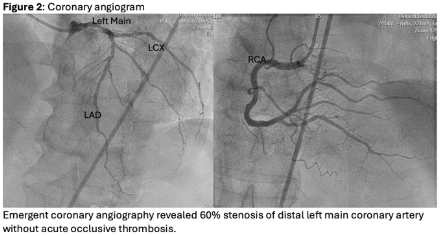
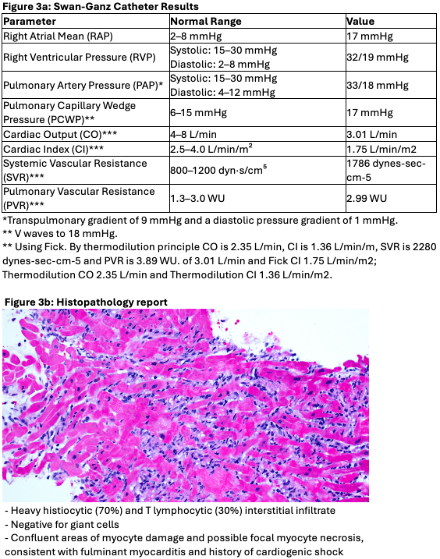
A 76-year-old male presented with 3 days of chest pain and infero-lateral ST elevations (Figure 1). Emergent cardiac catheterization revealed 70% calcified left main disease without plaque rupture or thrombus (Figure 2). IVUS confirmed stable disease. Echocardiogram showed LVEF 45%; an intra-aortic balloon pump (IABP) was placed, and surgery was deferred pending ticagrelor washout. Over the next 3 days, the patient’s condition worsened with rising troponin, LVEF decline to 10%, right ventricular failure, and complete heart block. The clinical picture was inconsistent with coronary anatomy, prompting suspicion for myocarditis. Endomyocardial biopsy and temporary pacing were performed. Due to worsening cardiogenic shock, mechanical circulatory support with Impella 5.5 was initiated. Immediately after Impella, the patient developed ventricular tachycardia and suction alarms due to right sided failure, therefore a veno-arterial Venoarterial Extracorporeal Membrane Oxygenation (ECMO) was initiated. Biopsy confirmed lymphohistiocytic myocarditis with immunophenotype supported the diagnosis of tuberculous myocarditis (Figure 3); respiratory cultures grew Mycobacterium tuberculosis. Despite treatment with corticosteroids, IVIG, inhaled nitric oxide, and antitubercular treatment, the patient failed to improve and expired.
Conclusion
This case emphasizes the need to consider myocarditis in patients presenting with STEMI-like ECGs and rapid progression to biventricular dysfunction unexplained by coronary findings. While tuberculosis in general is a slowly progressing disease, this case shows rate manifestation which presents as rapidly progressive tubercular fulminant myocarditis. Tuberculosis cases are on the rise due to global travel and immunosuppression therapy; therefore, the index of suspicion should be high. Early recognition and aggressive mechanical support with Impella and ECMO, and immunosuppressive and targeted therapies are critical in these rare presentations.
  • Atreja, Surabhi  ( UC Davis Medical Center , Sacramento , California , United States )
  • Zoghi, Shervin  ( UC Davis Medical Center , Sacramento , California , United States )
  • Ure, Andrea  ( UC Davis Medical Center , Sacramento , California , United States )
  • Jadaun, Pushkal  ( UC Davis Medical Center , Sacramento , California , United States )
  • Author Disclosures:
    Surabhi Atreja: DO NOT have relevant financial relationships | Shervin Zoghi: DO NOT have relevant financial relationships | Andrea Ure: No Answer | Pushkal Jadaun: No Answer
Meeting Info:

Scientific Sessions 2025

2025

New Orleans, Louisiana

Session Info:

From Molecules to Man and Beyond: Interesting Cases and Studies in Heart Failure

Monday, 11/10/2025 , 12:15PM - 01:30PM

Moderated Digital Poster Session

More abstracts on this topic:
A Bridge from Sweet to Sour: A Case of Recurrent Myocardial Stunning in Diabetic Ketoacidosis

Satish Vikyath, Pargaonkar Sumant, Slipczuk Leandro, Schenone Aldo, Maliha Maisha, Chi Kuan Yu, Sunil Kumar Sriram, Borkowski Pawel, Vyas Rhea, Rodriguez Szaszdi David Jose Javier, Kharawala Amrin, Seo Jiyoung

A Rare Cause of a Classic Presentation of NSTEMI: Case of 39-Year-Old Female with Hypothyroidism Induced Myocarditis

Quadri Fayz, Qazi Mariam, Teague Taylor

You have to be authorized to contact abstract author. Please, Login
Not Available