Muscle Matters: CT-Derived Skeletal Muscle Mass Is Independently Associated with Lower Cardiovascular Risk and Potentiates Exercise Benefit
Abstract Body (Do not enter title and authors here): Background: Diminished skeletal muscle mass predicts frailty and mortality, yet its independent association with major adverse cardiovascular events (MACE) and its interplay with physical activity remain poorly defined. Clarifying these relationships may refine risk stratification beyond effects of adiposity, lifestyle, and genetic factors.
Hypothesis: We hypothesized that CT-derived skeletal muscle area (SMA) shows an independent and dose-responsive inverse association with MACE risk and this protection is greater among individuals achieving guideline-recommended aerobic exercise.
Methods: We analyzed 10,312 Mass General Brigham Biobank (MGBB) participants with clinically acquired CT scans. Skeletal muscle area (SMA) and visceral adipose tissue (VAT) were quantified via validated machine-learning algorithms. Major adverse cardiovascular events (MACE) were identified through ICD codes. Covariables—key demographics, traditional cardiovascular risk factors (CVDRFs), Charlson Comorbidity Index, body mass index (BMI), residential socioeconomic status (SES: income, employment, education), lifestyle (exercise, sleep, alcohol), and a polygenic risk score (PRS) for coronary disease—were obtained from MGBB databases, electronic health records, and surveys. Multivariable Cox models with an SMA × exercise interaction yielded adjusted hazard ratios (aHRs). Dose–response was assessed using restricted cubic splines.
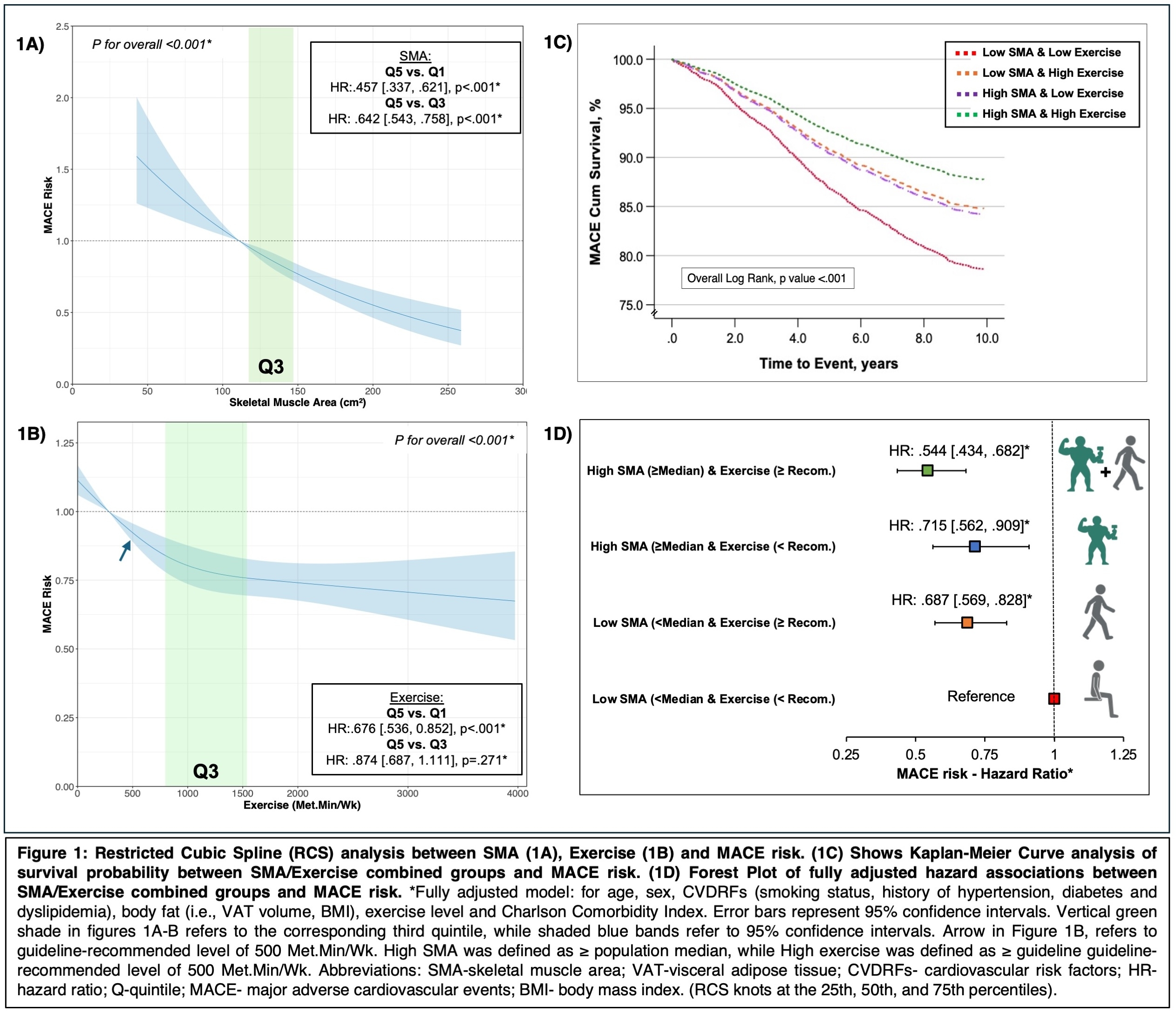
Results: Over a median 10-year follow-up, 2,648 participants (25.7%) developed MACE. Each higher SMA quintile conferred ≈20 % lower MACE risk (aHR 0.80, 95 % CI 0.76–0.84; p<0.001, Fig.1A) independent of CVDRFs, comorbidity, body fat (i.e., VAT, BMI), and exercise. Splines showed a near-linear inverse SMA–MACE relation (Q5 vs. Q3: HR: 0.64, p<0.001), while exercise benefit plateaued beyond the third quintile (Q5 vs. Q3: HR: 0.87, p=0.27; Fig.1B). Notably, individuals meeting exercise guidelines (≥500 MET.min.wk) and with above-median SMA had the lowest MACE risk (aHR 0.54, 95 % CI 0.43–0.68; interaction p = 0.033*, Fig.1C-D). These findings persisted after further adjustment for SES, PRS, sleep, and alcohol consumption. Conclusion: CT-derived SMA independently associates with lower MACE risk in a dose-responsive manner and may have synergistic associations with guideline-level exercise. Integrating skeletal muscle metrics into cardiovascular risk assessment may enhance stratification and underscore the potential value of muscle-preserving lifestyle interventions.
Abohashem, Shady
(
Harvard Medical School-Mass General
, Boston , Massachusetts , United States )
Aldosoky, Wesam
(
Massachusetts General Hospital
, Boston , Massachusetts , United States )
Saeed, Fatima
(
Massachusetts General Hospital
, Boston , Massachusetts , United States )
Abikaram, Krystel
(
Massachussetts General Hospital
, Boston , Massachusetts , United States )
Lau, Hui Chong
(
Massachusetts General Hospital
, Boston , Massachusetts , United States )
Ahmad, Taha
(
Massachusetts General Hospital
, Boston , Massachusetts , United States )
Assefa, Alula
(
Massachusetts General Hospital
, Boston , Massachusetts , United States )
Khalil, Maria
(
Massachusetts General Hospital
, Boston , Massachusetts , United States )
Filho, Ronaldo
(
Massachusetts General Hospital
, Boston , Massachusetts , United States )
Seligowski, Antonia
(
Massachusetts General Hospital
, Boston , Massachusetts , United States )
Osborne, Michael
(
Massachusetts General Hospital
, Boston , Massachusetts , United States )
Wasfy, Meagan
(
MASSACHUSETTS GENERAL HOSPITAL
, Boston , Massachusetts , United States )
Wasfy, Jason
(
MASSACHUSETTS GENERAL HOSPITAL
, Cambridge , Massachusetts , United States )
Guseh, James
(
Massachusetts General Hospital
, Boston , Massachusetts , United States )
Tawakol, Ahmed
(
Massachusetts General Hospital
, Boston , Massachusetts , United States )
Author Disclosures:
Shady Abohashem:DO NOT have relevant financial relationships
| Antonia Seligowski:No Answer
| Michael Osborne:No Answer
| Meagan Wasfy:DO NOT have relevant financial relationships
| Jason Wasfy:DO NOT have relevant financial relationships
| James Guseh:No Answer
| Ahmed Tawakol:DO have relevant financial relationships
;
Consultant:Genentech:Active (exists now)
; Research Funding (PI or named investigator):Lung Biotech:Active (exists now)
; Consultant:Tourmaline:Active (exists now)
| Wesam Aldosoky:DO NOT have relevant financial relationships
| Fatima Saeed:DO NOT have relevant financial relationships
| Krystel AbiKaram:DO NOT have relevant financial relationships
| Hui Chong Lau:No Answer
| Taha Ahmad:No Answer
| Alula Assefa:DO NOT have relevant financial relationships
| Maria Khalil:No Answer
| Ronaldo Filho:No Answer