
Logo

American Heart Association

  17
  0


Final ID: MP2213

Impact of GLP-1 Analog Use on Clinical Outcomes Following Bariatric Surgery: A Propensity-Matched Retrospective Cohort Study

Abstract Body (Do not enter title and authors here): Background:

GLP-1 receptor agonists have demonstrated cardiovascular and metabolic benefits in patients with obesity and type 2 diabetes. However, their impact on clinical outcomes following bariatric surgery remains unclear.

Objective:

To evaluate the association between post-operative GLP-1 analog use and key clinical outcomes among patients who underwent bariatric surgery.

Methods:

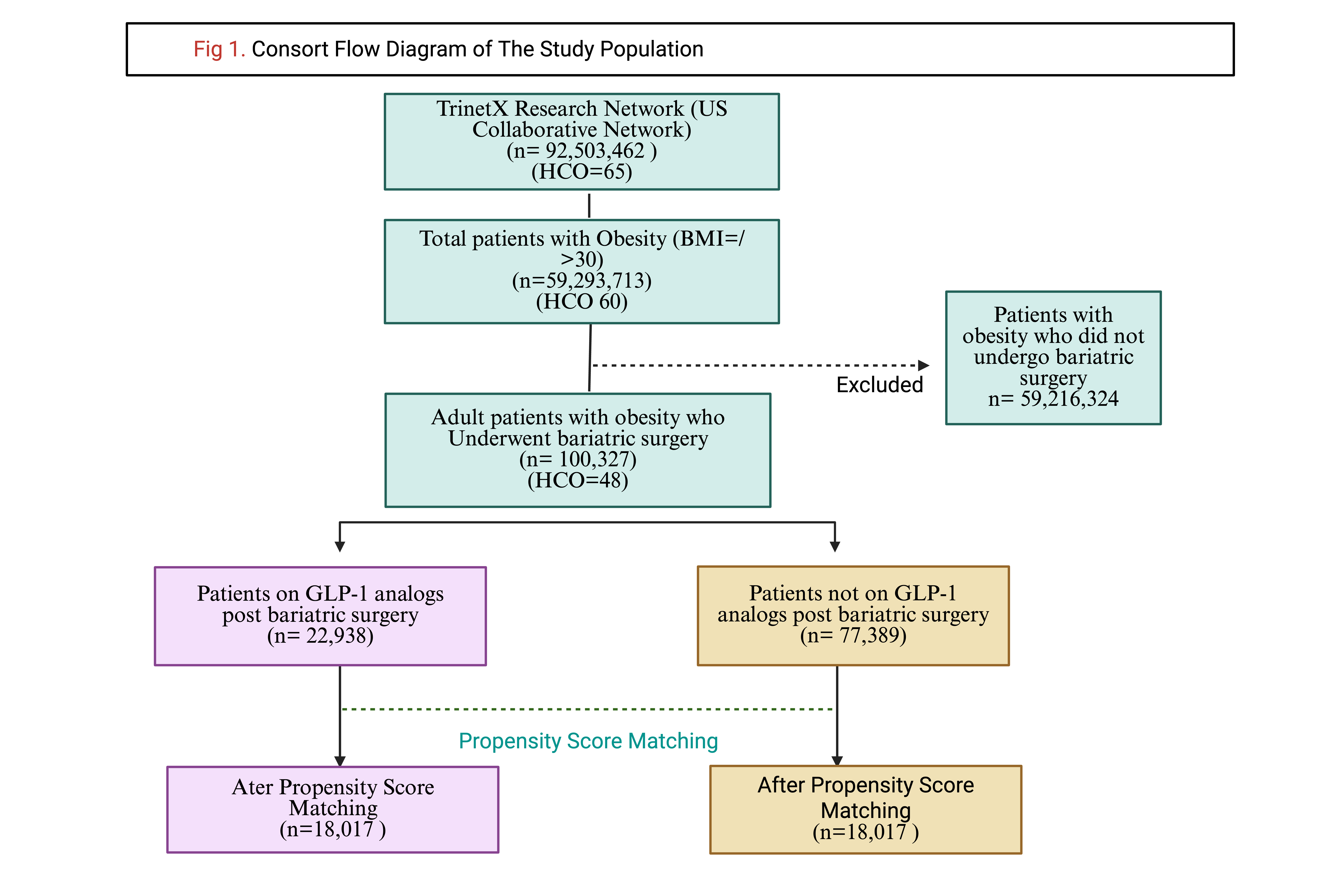
We conducted a retrospective cohort study using the TriNetX US Collaborative Network. Adults (BMI ≥30) who underwent bariatric surgery were divided into two cohorts: those who initiated GLP-1 analogs post-operatively and those who did not. After 1:1 propensity score matching, 18,017 patients were included in each group. The primary outcome was all-cause mortality; secondary outcomes included major adverse cardiovascular events (MACE), atrial fibrillation/flutter, hospital readmission, HbA1c <7% achievement, acute pancreatitis, and gastroparesis. Outcomes were assessed over a 12-month follow-up.

Results:

All-cause mortality was comparable between groups (0.3% vs. 0.3%; HR 0.777, p=0.084). GLP-1 users experienced a slightly higher incidence of MACE (1.7% vs. 1.3%; HR 1.27, p=0.006) and atrial fibrillation/flutter (3.2% vs. 3.1%; HR 1.02, p=0.179), though only the MACE difference reached statistical significance. Notably, GLP-1 use was associated with reduced readmissions (20.1% vs. 25.5%; HR 0.74, p<0.001) and higher rates of glycemic control (HbA1c <7%: 35.1% vs. 32.3%; HR 1.07, p=0.001). There was no significant difference in acute pancreatitis. Gastroparesis was less frequent in GLP-1 users (0.6% vs. 0.8%; HR 0.76, p=0.028).

Conclusion:

In this large real-world cohort, post-operative GLP-1 analog use was associated with improved glycemic control and reduced readmissions, without an increase in all-cause mortality or pancreatitis. Slightly higher rates of MACE warrant further investigation. These findings support the selective use of GLP-1 analogs as adjuncts following bariatric surgery.
  • Khan, Abdul Wali  ( University of Missouri Kansas City , Kansas City , Missouri , United States )
  • Abumuhfouz, Ma'in  ( UMKC , Mission , Kansas , United States )
  • Ishaq, Muhammad  ( Rochester Regional Health , Rochester , New York , United States )
  • Ahmad, Zeeshan  ( Saint peters university hospital , New Brunswick , New Jersey , United States )
  • Asif, Talal  ( Saint Lukes Hospital, Mid America Heart Institute , Kansas City , Missouri , United States )
  • Author Disclosures:
    Abdul Wali Khan: DO NOT have relevant financial relationships | Ma'in Abumuhfouz: DO NOT have relevant financial relationships | Muhammad Ishaq: DO NOT have relevant financial relationships | zeeshan ahmad: DO NOT have relevant financial relationships | TALAL ASIF: DO NOT have relevant financial relationships
Meeting Info:

Scientific Sessions 2025

2025

New Orleans, Louisiana

Session Info:

Optimizing Use of GLP-1 RA for Cardiometabolic Benefit: New Strategies and Applications

Monday, 11/10/2025 , 10:45AM - 12:00PM

Moderated Digital Poster Session

More abstracts from these authors:
Gender Based Disparities in the Utilization and Outcomes of Mechanical Circulatory Support Devices Use Among Patients with Myocardial Infarction: Insights From a Nationwide Data Analysis

Khan Abdul Wali, Ahmad Zeeshan, Ali Zafar, Ullah Sadiq, Ishaq Muhammad, Asif Talal

Trend in the Utilization of Colchicine For Coronary Artery Disease In the United States Over the Past Decade: Insights From Real-World Data

Khan Abdul Wali, Gonzalez Sanchez David, Ishaq Muhammad, Modi Karnav, Perumalla Hima Sanjana, El Mais Huda, Paulino-gonzalez Daniel, Ullah Irfan, Asif Talal

You have to be authorized to contact abstract author. Please, Login
Not Available