
Novel Use of KardiaMobile Device to Assess For Vector Suitability for Subcutaneous Implantable Cardioverter Defibrillator Implantation
Abstract Body (Do not enter title and authors here): Background: The subcutaneous implantable defibrillator (S-ICD) was developed to avoid lead related complications and systemic infections. Screening prior to implantation is critical for appropriate sensing of ventricular arrhythmias and to avoid inappropriate shocks. Current screening protocols require in-person assessment using the Zoom Programmer (Boston Scientific), which may not be readily available in many clinical settings and limits accessibility. . We evaluated if the KardiaMobile 6L (KM), a smartphone linked portable ECG, can be used for S-ICD screening.
Objectives: To evaluate the clinical utility of the KM device to screen patients indicated for S-ICD.
Methods: Patients who met criteria or had already been implanted with an S-ICD or single chamber transvenous ICD were recruited and consented. Paired ECG tracings from the KM and the programmer were collected in primary, secondary, and alternate vectors in both sitting and supine position (Figure 1). ECG tracings from the KM were manually annotated and compared to the programmer.
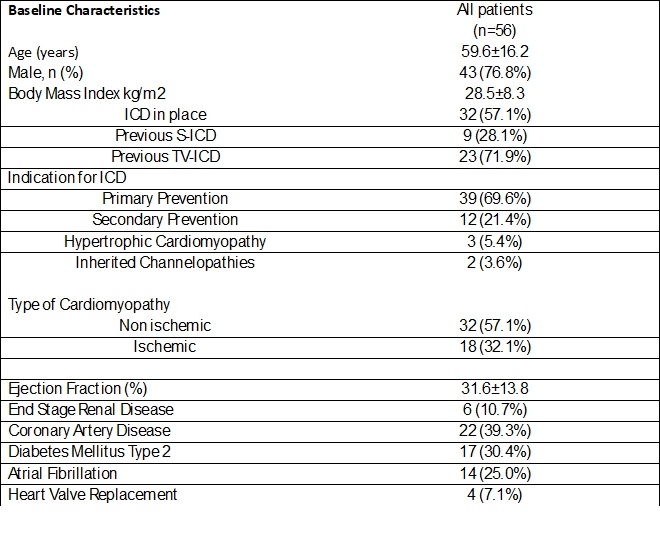
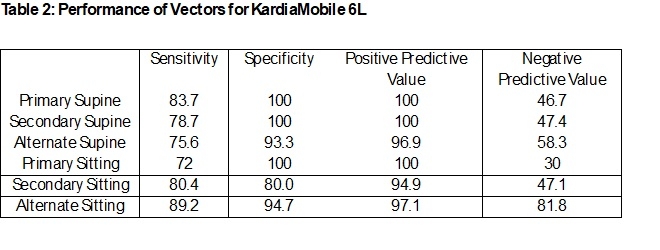
Results: A total of 56 patients (male 76.8%, 56.6±16.2 years) were recruited for the study, which included 336 paired tracings from the programmer and KM (Table 1). A total of 59 (17.5%) of tracings when compared were discordant. When compared to the programmer, KM had a sensitivity of 80% of specificity of 93.9%, with a positive predictive value of 98.2% (Table 2). Alternate standing had the least discordance (n=5), while primary sitting had the highest discordance (n=14).
Conclusion The KardiaMobile 6L provides similar results for screening for S-ICD when compared to the automated programmer. Automated screening and scaling with KM may improve results, and allow for easy and accessible screening for patients and providers.
Ibrahim, Rand
( Emory University
, Atlanta
, Georgia
, United States
)
Bhatia, Neal
( Emory University
, Atlanta
, Georgia
, United States
)
Bahrami Rad, Ali
( Ali Bahrami Rad
, Atlanta
, Georgia
, United States
)
Debakey, Michael
( Emory University School of Medicine
, Atlanta
, Georgia
, United States
)
Lloyd, Michael
( EMORY UNIVERSITY
, Atlanta
, Georgia
, United States
)
El-chami, Mikhael
( EMORY UNIVERSITY
, Atlanta
, Georgia
, United States
)
Westerman, Stacy
( Emory University
, Atlanta
, Georgia
, United States
)
Merchant, Faisal
( Emory University School of Medicine
, Atlanta
, Georgia
, United States
)
Iravanian, Shahriar
( Emory University
, Atlanta
, Georgia
, United States
)
Clifford, Gari
( Emory University
, Atlanta
, Georgia
, United States
)
Author Disclosures:
Rand Ibrahim:DO NOT have relevant financial relationships
| Neal Bhatia:DO NOT have relevant financial relationships
| Ali Bahrami Rad:No Answer
| Michael DeBakey:DO NOT have relevant financial relationships
| Michael Lloyd:DO NOT have relevant financial relationships
| Mikhael El-Chami:DO have relevant financial relationships
;
Consultant:medtronic :Active (exists now)
; Consultant:boston scientific :Active (exists now)
| Stacy Westerman:No Answer
| Faisal Merchant:DO NOT have relevant financial relationships
| Shahriar Iravanian:No Answer
| Gari Clifford:DO have relevant financial relationships
;
Advisor:Alivecor:Active (exists now)
; Executive Role:MindChild Medical :Active (exists now)
; Advisor:Nextsense:Active (exists now)