Logo

American Heart Association

  15
  0


Final ID: MP1605

Fetal Ductus Arteriosus Constriction Associated with Unregulated NSAID and Corticosteroid Use During the Second and Third Trimesters in a Low-Resource Setting

Abstract Body (Do not enter title and authors here): Introduction: Premature closure of the ductus arteriosus (DA) is a rare but serious condition associated with significant fetal morbidity. Use of prostaglandin inhibitors such as non-steroidal anti-inflammatory drugs (NSAIDs) and corticosteroids during pregnancy can precipitate this complication. In low-resource settings, where healthcare regulation and public education are limited, increased accessibility and unregulated use may increase the risk.

Hypothesis: Maternal exposure to NSAIDs and corticosteroids during the second and third trimesters is associated with increased risk of fetal DA constriction in low-resource settings.

Materials and Methods: This retrospective cohort study analyzed 462 fetal echocardiograms (FEs) performed between 2011 and 2021 in a pediatric cardiology clinic in the Dominican Republic. Data collection was IRB-approved and anonymized. FEs were originally conducted during the second or third trimester based on clinical indications. Patients were categorized by exposure to NSAIDs or corticosteroids from electronic medical records. Baseline maternal characteristics and fetal cardiac findings were reviewed. DA waveforms were evaluated as part of standard FEs using peak systolic velocity; values >140 cm/s were considered indicative of DA constriction. Statistical analysis included Chi-square and Fisher’s exact tests, reporting relative risks (RR, 95% CI).

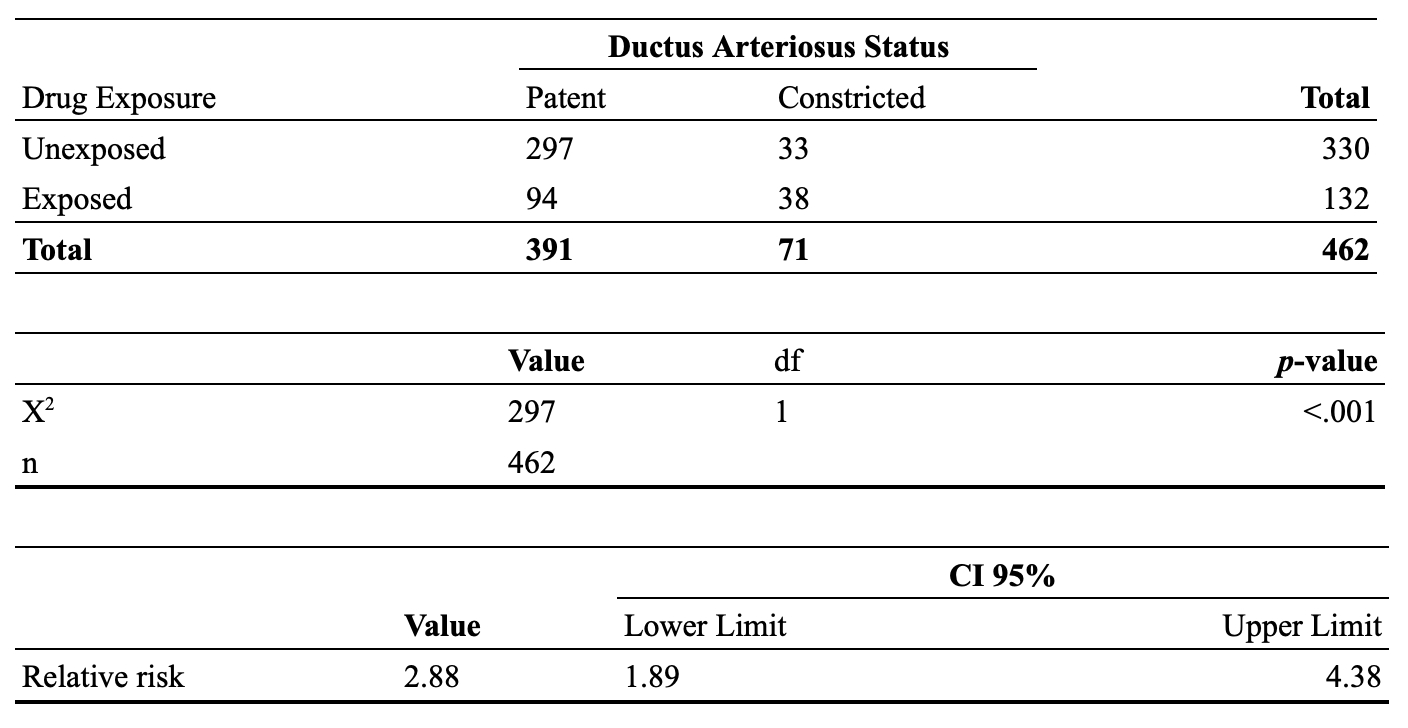
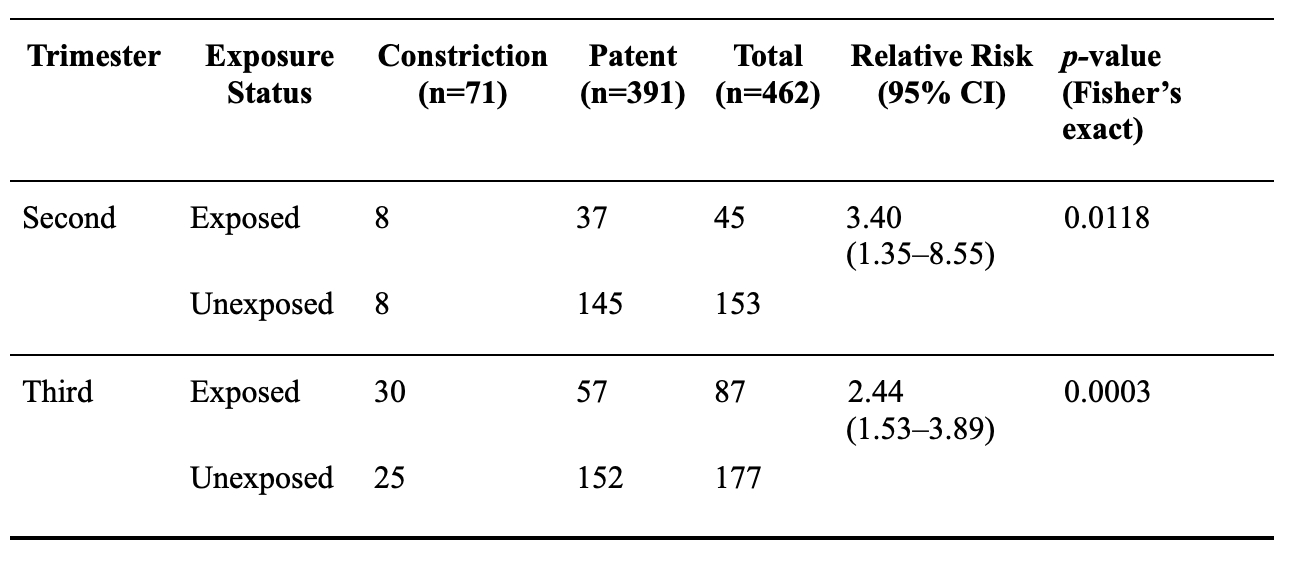
Results: The median maternal age was 31 years (range: 16-46), and the median gestational age at evaluation was 27.5 weeks (range: 15-40). Of the 462 pregnancies, 132 (27%) involved exposure to NSAIDs or corticosteroids. Ductal constriction was observed in 28.8% of exposed versus 10% of unexposed cases (RR 2.88; 95% CI: 1.89-4.38; p<0.001). Stratified analysis revealed increased risk in both the second trimester (RR 3.40; 95% CI: 1.30-8.86; p=0.0118) and third trimester (RR 2.44; 95% CI: 1.57-3.81; p=0.0003). Right ventricular hypertrophy (12.7%; p=0.0004) and tricuspid regurgitation (16.9%; p<0.0001) were significantly more common among fetuses with DA constriction.

Conclusion: Exposure to NSAIDs and corticosteroids in the second and third trimesters was significantly associated with premature ductal constriction and cardiac complications. The high exposure rate highlights a gap in medication safety and the need for stronger regulation. These findings support targeted fetal echocardiographic screening and prenatal counseling in exposed pregnancies, particularly in low-resource settings.
  • Roman, Cristina  ( Universidad Iberoamericana , Santo Domingo DN , Dominican Republic )
  • German Paz, Alejandro Osiris  ( Universidad Iberoamericana , Santo Domingo DN , Dominican Republic )
  • Mueses, Sayira  ( Universidad Iberoamericana , Santo Domingo DN , Dominican Republic )
  • Toribio, Janet  ( Servicios Cardiovasculares Pedíatricos , Santo Domingo , Distrito Nacional , Dominican Republic )
  • Author Disclosures:
    Cristina Roman: DO NOT have relevant financial relationships | Alejandro Osiris German Paz: No Answer | Sayira Mueses: No Answer | janet Toribio: No Answer
Meeting Info:

Scientific Sessions 2025

2025

New Orleans, Louisiana

Session Info:

Fetal and Neonatal Cardiovascular Health: Maternal Influences, Genetics, and Early Life Outcomes

Sunday, 11/09/2025 , 11:50AM - 01:05PM

Moderated Digital Poster Session

More abstracts on this topic:
Mechanical Circulatory Support in Pregnancy

Goodwin Ashley, Wendl Elizabeth, Jones Tara

A Novel H2 Relaxin B-Chain-Only Peptide Variant B7-33 Improves The Pathophysiology Of Placental Ischemia In The Reduced Uterine Perfusion Pressure Rat Model Of Preeclampsia

Pantho Ahmed F, Hossain Mohammed, Uddin Mohammad, Amaral Lorena, Campbell Nathan, Afroze Syeda, Vora Niraj, Kuehl Thomas, Lindheim Steven, Lamarca Babbette, Bathgate Ross

More abstracts from these authors:
You have to be authorized to contact abstract author. Please, Login
Not Available