
Logo

American Heart Association

  18
  0


Final ID: Su3088

Noninvasive Measurement of Coronary Collateral Flow Capacity in Patients with Chronic Total Occlusion: External Counterpulsattion Reduces the Need for High Risk Percutaneous Coronary Intervention

Abstract Body (Do not enter title and authors here): BACKGROUND: Percutaneous coronary intervention (PCI) for chronic total occlusion (CTO) is associated with higher procedure time, contrast use, acute complications and restenosis rates compared with non-CTO targets. Noninvasive external counterpulsation (ECP) improves invasively measured collateral flow index, angina and walking time in patients with obstructive CAD.
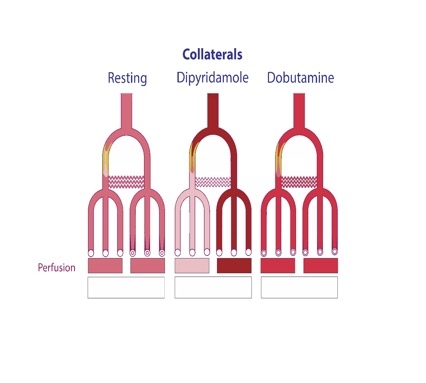
We hypothesized that coronary collateral flow capacity can be measured noninvasively in CTO patients by comparing absolute stress perfusion during vasodilator stress (DIP) which reduces supply side pressure in the collateralized ischemic bed, revealing coronary steal, compared with demand ischemic stress (DBT) which maintains supply side pressure.
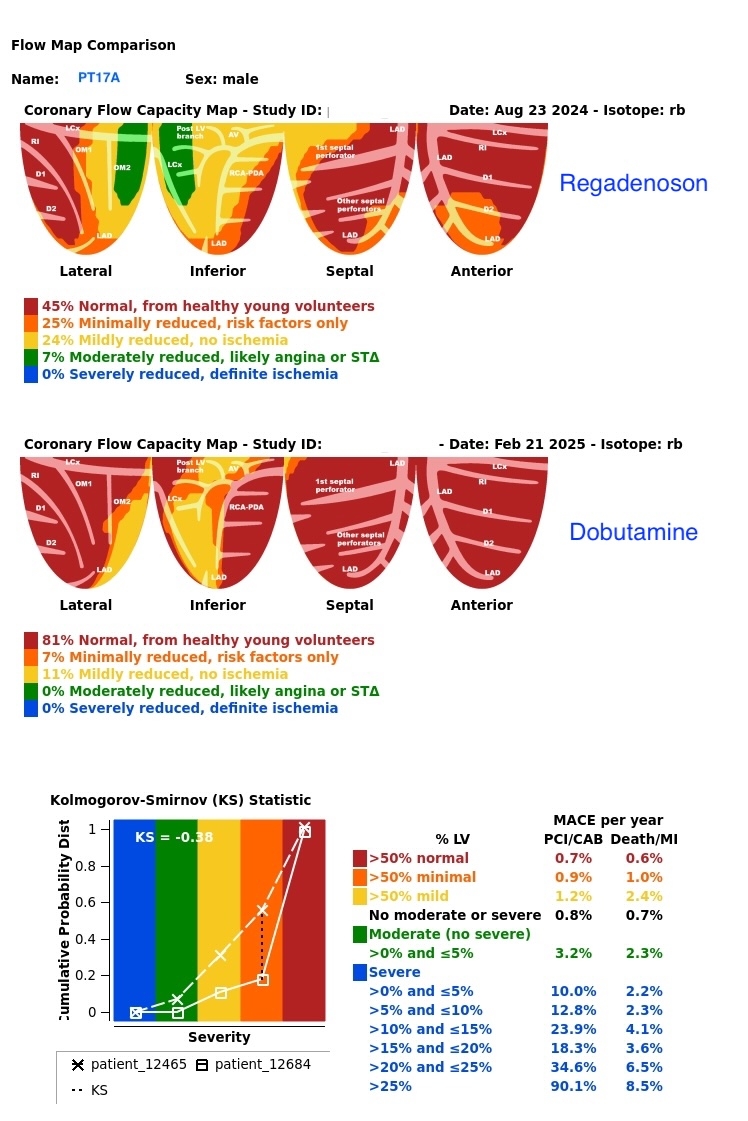
METHODS: Twenty sequential patients found to have CTO at angiography prompted by abnormal quantitative PET myocardial perfusion imaging with vasodilator stress using dipyridamole or regadenoson (QPET-DIP) underwent 35 one-hour sessions of ECP, rather than PCI, followed by demand ischemic stress PET using dobutamine (QPET-DBT). Absolute myocardial perfusion, coronary flow reserve and coronary flow capacity (CFC), were measured using FDA approved HeartSee software. Coronary collateral flow capacity was determined by comparing post-treatment CFC using DBT stress to baseline CFC in the ischemic CTO bed using DIP stress.
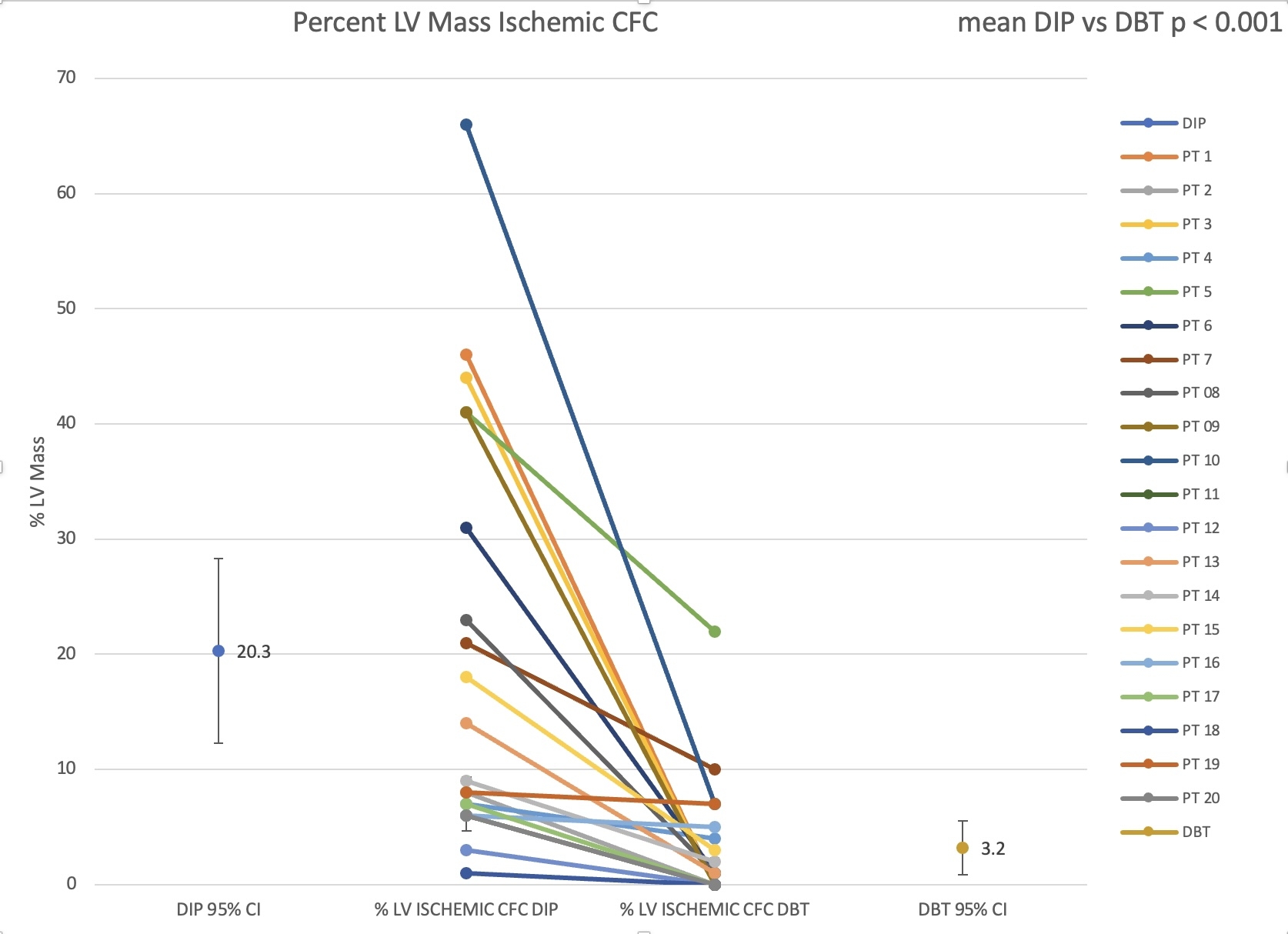
RESULTS: All patients demonstrated a decrease in the size of the ischemic zone at risk when pretreatment QPET-DIP was compared to post ECP QPET-DBT: from 20.3% LV mass to 3.2% (p<0.001). Minimal whole heart and lowest quadrant perfusion also improved from 0.7 to 1.2 ml/min/g (p<0.001) and 1.3 to 2 ml/min/g (p<0.001) respectively, demonstrating significantly improved bulk flow into the ischemic zone, consistent with robust collateralization.
CONCLUSION: Coronary collateral flow capacity can be measured noninvasively with quantitative PET myocardial perfusion imaging. Initial treatment of CTO patients with ECP is associated with rich collateralization and can obviate the need for high-risk PCI.
  • Merhige, Michael  ( State University of New York at Buffalo , Buffalo , New York , United States )
  • Sperrazza, John  ( MICHAEL E MERHIGE MD LLC , Tonawanda , New York , United States )
  • Lavin, Deborah  ( MICHAEL E MERHIGE MD LLC , Tonawanda , New York , United States )
  • Smiedala, Martha  ( MICHAEL E MERHIGE MD LLC , Tonawanda , New York , United States )
  • Belmona, Lina  ( MICHAEL E MERHIGE MD LLC , Tonawanda , New York , United States )
  • Author Disclosures:
    Michael Merhige: DO have relevant financial relationships ; Consultant:Bracco Diagnostics:Active (exists now) | John Sperrazza: DO NOT have relevant financial relationships | Deborah Lavin: No Answer | Martha Smiedala: No Answer | Lina Belmona: No Answer
Meeting Info:

Scientific Sessions 2025

2025

New Orleans, Louisiana

Session Info:

Tools & Techniques for Complex PCI and CTO Revascularization

Sunday, 11/09/2025 , 11:30AM - 12:30PM

Abstract Poster Board Session

More abstracts on this topic:
Age and Admission NIH Stroke Scale but Not Radiologic Collateral Status Predict Modified Rankin Score in Large and Medium Vessel Occlusion Ischemic Strokes

Srinivas Tara, Lakhani Dhairya, Balar Aneri, Xu Risheng, Salim Hamza, Yedavalli Vivek

18F-NaF and 18F-FDG and calcification predict the development of abdominal aortic aneurysms and is attenuated by drug therapy

Nakahara Takehiro, Miyazawa Raita, Iwabuchi Yu, Tonda Kai, Narula Nupoor, Strauss Harry, Narula Jagat, Jinzaki Masahiro

You have to be authorized to contact abstract author. Please, Login
Not Available