
Logo

American Heart Association

  11
  0


Final ID: HCM13

Targeted Therapy Interrupted: Managing Hypertrophic Obstructive Cardiomyopathy in Pregnancy

Abstract Body (Do not enter title and authors here): Goals:
To describe the clinical course of a 27-year-old woman with hypertrophic obstructive cardiomyopathy (HoCM) who developed a severe left ventricular outflow tract (LVOT) obstruction with a stress cardiomyopathy following discontinuation of Mavacamten due to an unplanned pregnancy. This case highlights the challenges of managing HoCM during pregnancy, consequences of treatment interruption, and postpartum decision-making.

Description of the Case:
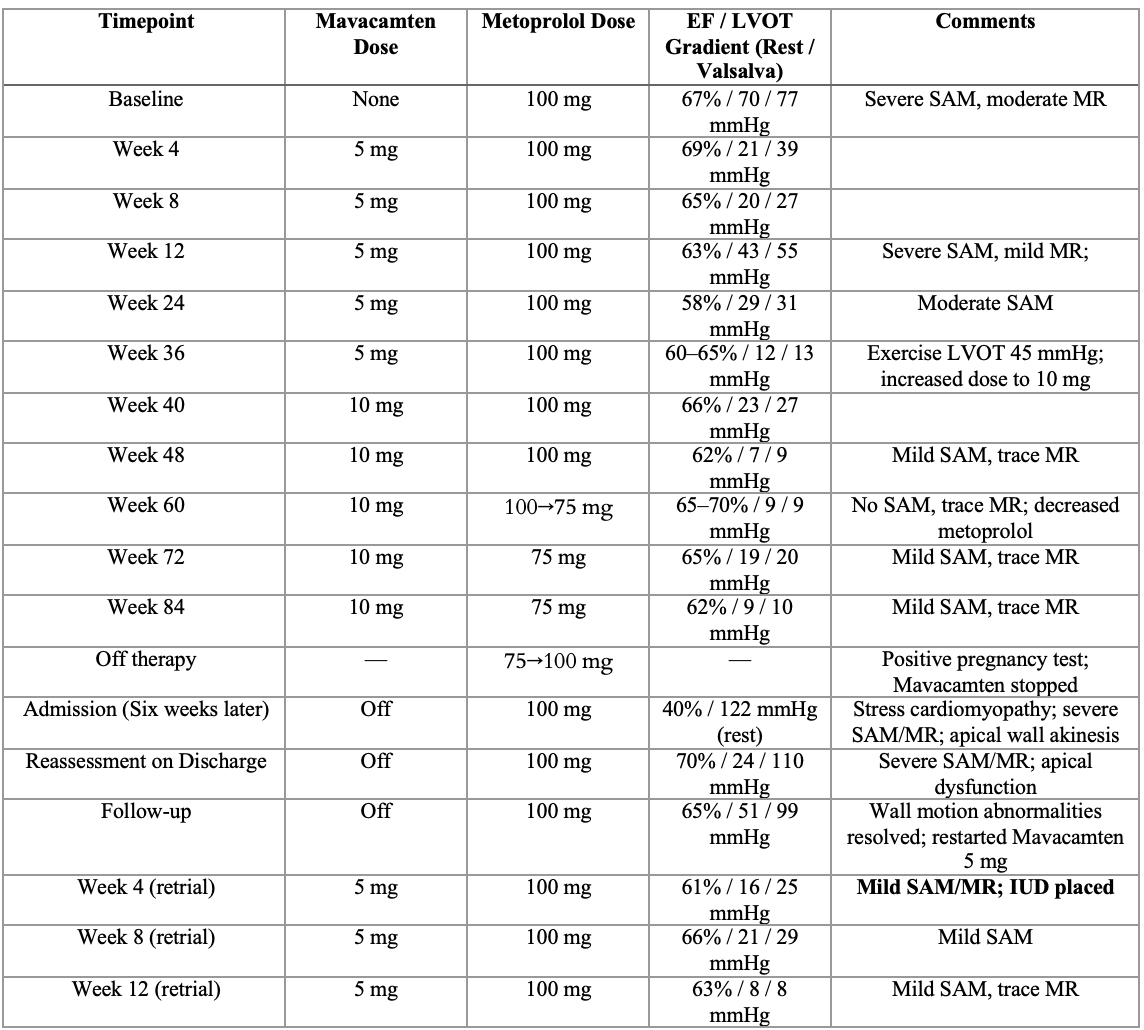
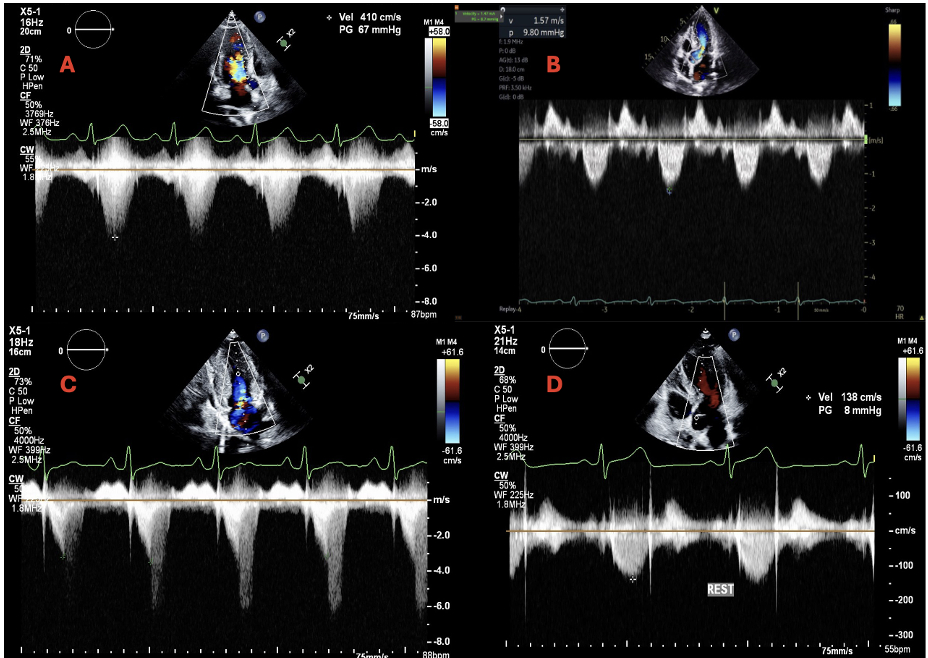
This is a case of a 27-year-old woman with HoCM who was treated with Metoprolol and Mavacamten for 20 months, reducing her LVOT gradient from 70 mmHg to 9 mmHg at rest (Figure 1A and 1B). Despite oral contraceptive use, she had an unplanned pregnancy and immediately discontinued therapy due to teratogenicity concerns.

Six weeks later, she was hospitalized for shortness of breath and lightheadedness and found to have elevated troponins. Transthoracic echocardiography (TTE) showed new mid-septal wall motion abnormalities, reduced EF to 40%, and severe mitral regurgitation with systolic anterior motion of the mitral valve. Gradients were not assessed. Due to concern for acute coronary syndrome, a left heart catheterization was normal, and stress cardiomyopathy was suspected. After receiving 3L IV fluids, she developed flash pulmonary edema and was transferred to our center for worsening hypotension.

On arrival, TTE showed a severe LVOT obstruction (peak gradient 110 mmHg with Valsalva). She was started on IV esmolol and phenylephrine. Over several days, her LVOT gradient improved to 70 mmHg at rest. Pressors were weaned and she was transitioned to oral metoprolol. The pregnancy was electively terminated, and she was discharged home.

One month later, the wall motion abnormalities resolved and her LVOT gradient at rest was 51 mmHg (Figure 1C) and Mavacamten was resumed at 5 mg daily, and a non-hormonal intrauterine device was placed. Three months later, her LVOT gradient improved to 8 mmHg at rest (Figure 1D), and reported no functional limitations.

Discussion:
Despite prior excellent response, abrupt mavacamten discontinuation due to pregnancy led to recurrence of severe obstruction, exacerbated by stress cardiomyopathy (Table 1). Mavacamten may reduce the efficacy of combined hormonal contraceptives, contributing to contraceptive failure. This case underscores the need for preconception counseling and multidisciplinary monitoring for women of childbearing age prior to initiating myosin inhibitors.
  • Bhuiya, Tanzim  ( University of Pennsylvania , Philadelphia , Pennsylvania , United States )
  • Oribabor, Jessica  ( University of Pennsylvania , Philadelphia , Pennsylvania , United States )
  • Saith, Armaan  ( University of Pennsylvania , Philadelphia , Pennsylvania , United States )
  • Genuardi, Michael  ( University of Pennsylvania , Philadelphia , Pennsylvania , United States )
  • Day, Sharlene  ( University of Pennsylvania , Philadelphia , Pennsylvania , United States )
  • Author Disclosures:
    Tanzim Bhuiya: DO NOT have relevant financial relationships | Jessica Oribabor: No Answer | Armaan Saith: DO NOT have relevant financial relationships | Michael Genuardi: DO have relevant financial relationships ; Consultant:Respicardia:Active (exists now) ; Researcher:Abbott:Past (completed) | Sharlene Day: DO have relevant financial relationships ; Consultant:Lexicon Pharmaceuticals:Active (exists now) ; Research Funding (PI or named investigator):BMS:Active (exists now) ; Consultant:Solid Biosciences:Active (exists now) ; Advisor:Cytokinetics:Active (exists now) ; Research Funding (PI or named investigator):Lexicon Pharmaceuticals:Active (exists now)
Meeting Info:

Scientific Sessions 2025

2025

New Orleans, Louisiana

Session Info:

Hypertrophic Cardiomyopathy Medical Society Posters

Friday, 11/07/2025 , 06:30PM - 07:30PM

Abstract Poster Board Session

More abstracts on this topic:
Fetal cardiac physiology but not cerebrovascular resistance predicts neurodevelopmental outcomes in congenital heart disease

Bradford Victoria, Rollins Caitlin, Lipsitz Stuart, Herrera Pujols Kaysi, Hart Nicholas, Waring Kyla, Sadhwani Anjali, Tworetzky Wayne, Newburger Jane, Friedman Kevin

β1-adrenergic autoantibodies (β1-AA) augment macropinocytosis in CD4+ T cells, leading to the expansion of CD4+CD28 T cell subsets in heart failure.

Sun Fei, Yao Junyan, Li Bingjie, Zhang Suli, Liu Huirong

More abstracts from these authors:
You have to be authorized to contact abstract author. Please, Login
Not Available