
Fibroblast Progenitor Cells Contribute to Vasculogenesis During Regenerative Wound Healing
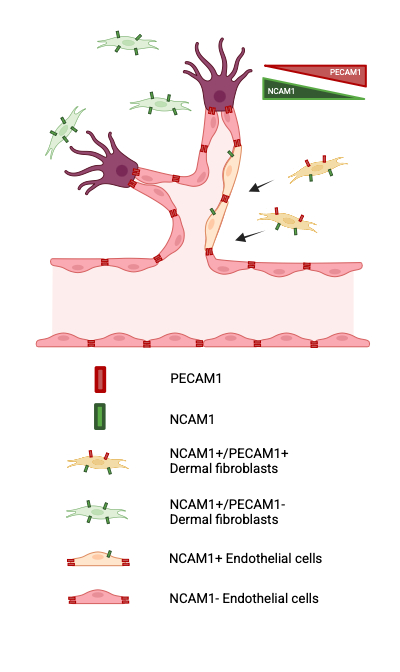
Abstract Body (Do not enter title and authors here): Background The goal of tissue regeneration is to restore structure and function. In adult regenerative wound healing, dermal fibroblasts exhibit multipotency and can be reprogrammed into lineages such as hair follicle cells and adipocytes, etc. Neural cell adhesion molecule 1 (NCAM1), a membrane-bound adhesion protein expressed in dermal fibroblasts, plays a key role in cell-cell and cell-matrix interactions and has been implicated in fate transitions during tissue remodeling. NCAM1 is absent in normal endothelium but is aberrantly expressed in tumor-derived endothelial cells, where it promotes capillary morphogenesis. These observations suggest that NCAM1+ fibroblasts may represent a progenitor-like state more capable of endothelial conversion than NCAM1- cells. While angiogenesis is the main vascularization process in adult wounds, vasculogenesis from progenitors like fibroblasts may also contribute. Fibroblast-to-endothelial reprogramming has been demonstrated in vitro using defined reprogramming factors, but its in vivo evidence remains to be investigated. We hypothesized that NCAM1+ dermal fibroblasts give rise to a subset of regenerated endothelial cells. Aims (1) Characterize vasculature formation during regenerative wound healing (2) Identify progenitor populations and reprogramming cues, including transcription factors and adhesion molecules Method Using a wound-induced hair neogenesis (WIHN) mouse model, we performed scRNA sequencing and RNA velocity analyses on post-wounding day 14. Wholemount immunostaining assessed vascular morphology and cell identity. NCAM1-CreERT2×ROSA26 reporter mice for lineage tracing. Results The regenerated wound bed showed two contrasting vasculature patterns: disrupted, discontinuous vessels in the regenerating wound center and organized vasculature in the wound margin. scRNA-seq and velocity analyses indicated PECAM1+ cells may originate from NCAM1+ fibroblast-like cells that also expressed fibroblast-to-endothelial cells reprogramming factors such as FOXO1, TAL1 and SOX17. Wholemount staining revealed individual cells and a fraction of endothelial cells co-expressing PECAM1, PDGFRα, and NCAM1 in the capillary-like vasculature in wound dermis. Conclusion Our findings support vasculogenesis during regenerative wound healing, with NCAM1+ fibroblasts contributing to endothelial cell populations. These results provide new insights into fibroblast-endothelial plasticity and vascular regeneration in adult tissue regeneration.
Huang, Chih-han
( University of Southern California
, Los Angeles
, California
, United States
)
Chuong, Cheng-ming
( University of Southern California
, Los Angeles
, California
, United States
)
Harn, Hans
( University of Southern California
, Los Angeles
, California
, United States
)
Author Disclosures:
Chih-Han Huang:DO NOT have relevant financial relationships
| Cheng-Ming Chuong:No Answer
| Hans Harn:No Answer