Logo

American Heart Association

  15
  0


Final ID: Mo4008

Biogenic RYR2 Loss-of-Function Disrupts Intracellular Calcium Handling and Induces Electrical Remodeling in Re-Engineered Human Cardiomyocytes

Abstract Body (Do not enter title and authors here): Background: Calcium release channel deficiency syndrome (CRCDS) is caused by biogenic or biophysical loss-of-function (LOF) pathogenic variants in the RYR2-encoded ryanodine receptor (RyR2), a key intracellular Ca2+ release channel. Previously, we identified a novel homozygous duplication involving the promoter and exons 1-4 of RYR2, leading to 80% RyR2 protein loss and exertion-related sudden death in the young. Here, we generated a RYR2 knockout (RYR2-KO) induced pluripotent stem cell-derived cardiomyocyte (iPSC-CM) model to explore intracellular and electrophysiological compensatory mechanisms that overcome this extreme loss of RyR2 protein.
Methods: Using CRISPR/Cas9 gene editing, a homozygous c.163delT variant (p.S55Pfs*46) was inserted into a normal iPSC line (isogenic control) to create a homozygous RYR2-KO iPSC line. After re-engineering the lines into ventricular-like cardiomyocytes (iPSC-CMs), intracellular Ca2+ handling was assessed by Fluo-4 AM cell imaging (0.5 Hz stimulation). Electrical remodeling in the L-type Ca2+ current (ICaL) was assessed using the whole-cell patch clamp technique.
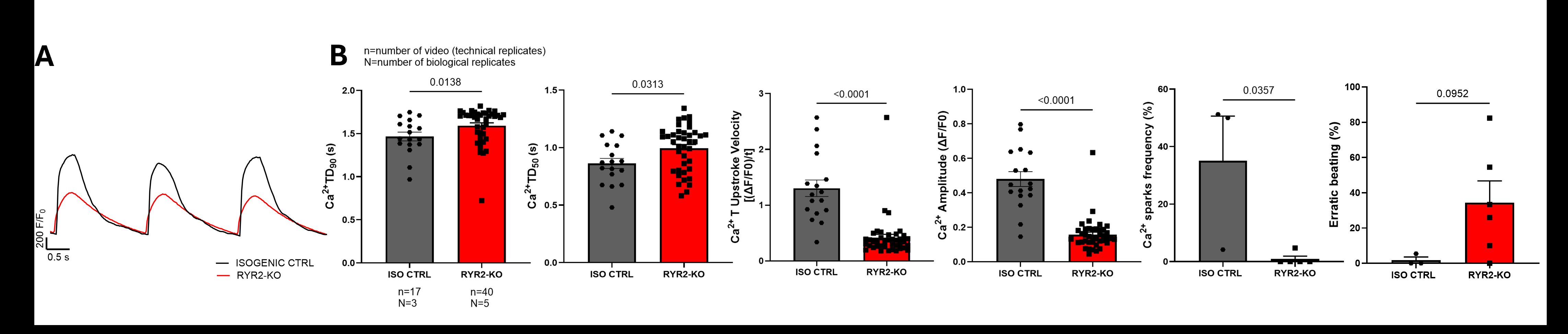
Results: Significant differences were observed in Ca2+ transient parameters between RYR2-KO and isogenic control iPSC-CMs. Biogenic RyR2 loss significantly reduced Ca2+ transient peak amplitude (CTA: 0.16 ± 0.01 ΔF/F0, p<0.0001) and upstroke velocity (CTV: 0.42 ± 0.06 (ΔF/F0)/t, p<0.0001), and prolonged Ca2+ transient duration (CTD90: 1.59 ± 0.03 s, p=0.01) as compared to isogenic control (CTA: 0.48 ± 0.04 ΔF/F0; CTV: 1.30 ± 0.15 (ΔF/F0)/t; CTD90: 1.46 ± 0.05 s). Additionally, RyR2 loss abolished SR Ca2+ leak (0.9 ± 0.9 % versus 35.1 ± 15.5 %, p=0.03). Lastly, a significant reduction in ICaL density was observed in RYR2-KO iPSC-CMs as compared to isogenic control iPSC-CMs (at 0 mV, RYR2-KO: -8.54 ± 1.60 pA/pF, control: -17.45 ± 3.69 pA/pF, p=0.0004). These data indicate that ICaL reduction may contribute to the reduced Ca2+ transient peak.
Conclusions: Complete loss of RyR2 in iPSC-CMs profoundly disrupts intracellular Ca2+ handling, abolishes Ca2+ sparks frequency, and secondarily down-regulates the sarcolemmal L-type Ca2+ channel.
  • Giammarino, Lucilla  ( Mayo Clinic , Rochester , Minnesota , United States )
  • Tester, David  ( MAYO CLINIC COLLEGE OF MEDICINE , Rochester , Minnesota , United States )
  • Ye, Dan  ( Mayo Clinic , Rochester , Minnesota , United States )
  • Giudicessi, John  ( Mayo Clinic , Rochester , Minnesota , United States )
  • Kim, Changsung  ( Mayo Clinic , Rochester , Minnesota , United States )
  • Ackerman, Michael  ( Mayo Clinic , Rochester , Minnesota , United States )
  • Author Disclosures:
    Lucilla Giammarino: DO NOT have relevant financial relationships | David Tester: No Answer | Dan Ye: DO have relevant financial relationships ; Royalties/Patent Beneficiary:Solid Biosciences Inc.:Active (exists now) | John Giudicessi: DO have relevant financial relationships ; Consultant:Avidity Biosciences:Active (exists now) ; Consultant:Nuevocor Therapeutics:Active (exists now) ; Consultant:Citizen Health:Active (exists now) | Changsung Kim: DO have relevant financial relationships ; Royalties/Patent Beneficiary:Solid Biosciences:Active (exists now) | Michael Ackerman: DO have relevant financial relationships ; Consultant:Abbott:Active (exists now) ; Royalties/Patent Beneficiary:UpToDate:Active (exists now) ; Royalties/Patent Beneficiary:Thryv Therapeutics:Active (exists now) ; Royalties/Patent Beneficiary:Solid Biosciences:Active (exists now) ; Royalties/Patent Beneficiary:Prolaio:Active (exists now) ; Royalties/Patent Beneficiary:ARMGO Pharma:Active (exists now) ; Royalties/Patent Beneficiary:AliveCor:Active (exists now) ; Consultant:Tenaya Therapeutics:Active (exists now) ; Consultant:Medtronic:Active (exists now) ; Consultant:Invitae:Past (completed) ; Consultant:Illumina:Active (exists now) ; Consultant:Bristol Myers Squibb:Past (completed) ; Consultant:Boston Scientific:Active (exists now) ; Consultant:BioMarin Pharmaceutical:Past (completed)
Meeting Info:

Scientific Sessions 2025

2025

New Orleans, Louisiana

Session Info:

Remodeling, Mechanobiology & Prognostic Trends in Cardiac Disease

Monday, 11/10/2025 , 10:30AM - 11:30AM

Abstract Poster Board Session

More abstracts on this topic:
A Novel Role for AKAP1 in JNK2 Trafficking to Endoplasmic Reticulum and Ca2+ Triggered Arrhythmic Activities

Kohli Aaryan, Ricchiuti Nikola, Yan Jiajie, Bare Dan, Ai Xun


A Large Animal Model of Persistent Atrial Fibrillation

Mostafizi Pouria, Goldman Steven, Moukabary Talal, Lefkowitz Eli, Ref Jacob, Daugherty Sherry, Grijalva Adrian, Cook Kyle Eric, Chinyere Ike, Lancaster Jordan, Koevary Jen

More abstracts from these authors:
Development of a High-Throughput Drug Screening Platform to Identify Novel Therapeutics for Long QT Syndrome

Smith Annabel, Kim Changsung, Zhou Wei, Ye Dan, Tester David, Giudicessi John, Ackerman Michael

Molecular and Functional Characterization of DENND3 as a Novel Regulator of Ion Channel Trafficking

Gao Shan, Ye Dan, Neves Raquel, Kim Changsung, Tester David, Zhou Wei, Giudicessi John, Ackerman Michael

You have to be authorized to contact abstract author. Please, Login
Not Available