
Logo

American Heart Association

  18
  0


Final ID: Su2037

Heart Rate Variability Metrics from Wearable Devices Predict Symptom Flares in Female Chronic Pelvic Pain Disorders

Abstract Body (Do not enter title and authors here): Background. Female chronic pelvic pain disorders (CPPD) are marked by unpredictable symptom flares, involving both pain and non-pain symptoms that affect the gastrointestinal (GI) and genitourinary (GU) systems. Management is challenging due to limited understanding of pathophysiology and lack of reliable predictors. Heart rate variability (HRV), the measure of small-time differences between heartbeats and an indicator of autonomic nervous system function, has shown promise as a digital biomarker for pain and inflammation.

Research Question. This study evaluates whether real-time wearable and patient-tracked data can predict CPPD symptom flares.

Methods. The final analytic sample comprised of 311,308 HRV measurements, characterized as RMSSD (root mean square of successive differences) and LF/HF (low frequency/high frequency), across 4,166 person-days from 87 females with CPPD in an observational study using an mHealth application (ehive iOS and android) and Fitbit tracker (model Inspire 3). The primary outcome was the “flare week” score, defined as a 7-day period with more days of disease-specific symptom flares than baseline. The daily “flare score” is the product of the number of CPPD-related pain and GI/GU symptoms with their intensity. Cosinor mixed-effects regression was applied to HRV circadian features: midline-estimating statistic of rhythm (MESOR), amplitude and acrophase. Covariates included age, body mass index (BMI), daily steps, sleep efficiency, and menstrual period. Participant ID and person-level amplitude and acrophase were included as random effects.

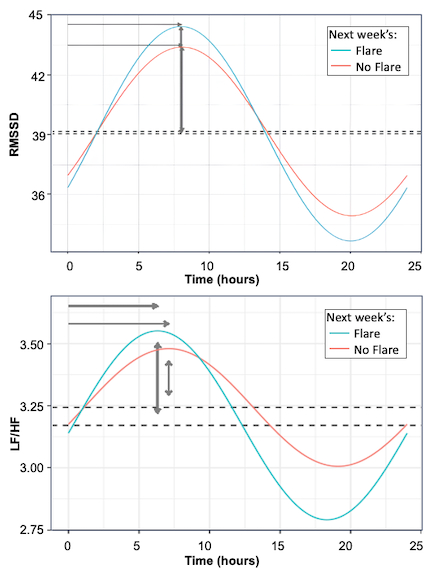
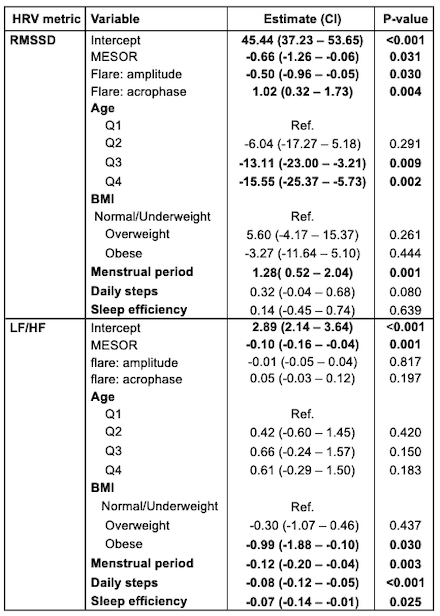
Results. HRV circadian patterns significantly differed in the week prior to a flare week (Figure 1). RMSSD’s MESOR and amplitude decreased in the preceding week (Table 1), while the acrophase increased (all p<0.05). For LF/HF, the MESOR significantly decreased in a week preceding a flare. Menstrual period was positively associated with RMSSD, while menstrual period, daily step count, and sleep efficiency were inversely associated with LF/HF. Significant interactions for both metrics included obesity with amplitude, period with amplitude and steps with acrophase. There was significant variance in the HRV between-participants based on the significant random effects.

Conclusions. We present initial evidence that HRV metrics can predict CPPD symptom fares via non-linear estimation, supporting a promising use of real-time mHealth and wearable data in the context of CPPDs.
  • Cohen, Rebecca  ( Icahn School of Medicine , New York , New York , United States )
  • Suarez-farinas, Mayte  ( Icahn School of Medicine at Mount Sinai , New York , New York , United States )
  • Shahnawaz, Samia  ( Icahn School of Medicine at Mount Sinai , New York , New York , United States )
  • Hirten, Robert  ( Icahn School of Medicine at Mount Sinai , New York , New York , United States )
  • Danieletto, Matteo  ( Icahn School of Medicine at Mount Sinai , New York , New York , United States )
  • Landell, Kyle  ( Icahn School of Medicine at Mount Sinai , New York , New York , United States )
  • Rodrigues, Jovita  ( Icahn School of Medicine at Mount Sinai , New York , New York , United States )
  • Glazer, Kimberly  ( University of Pennsylvania Perelman School of Medicine , Philadelphia , Pennsylvania , United States )
  • Ensari, Ipek  ( Icahn School of Medicine at Mount Sinai , New York , New York , United States )
  • Author Disclosures:
    Rebecca Cohen: DO NOT have relevant financial relationships | Mayte Suarez-Farinas: No Answer | Samia Shahnawaz: No Answer | Robert Hirten: DO NOT have relevant financial relationships | Matteo Danieletto: DO NOT have relevant financial relationships | Kyle Landell: No Answer | Jovita Rodrigues: DO NOT have relevant financial relationships | Kimberly Glazer: No Answer | Ipek Ensari: DO NOT have relevant financial relationships
Meeting Info:

Scientific Sessions 2025

2025

New Orleans, Louisiana

Session Info:

Redefining Cardiovascular Risk and Care: Integrating AI, Imaging, Biomarkers, and Social Contexts

Sunday, 11/09/2025 , 03:15PM - 04:15PM

Abstract Poster Board Session

More abstracts on this topic:
A Woman's Heart: Unveiling CMD as the Cause of Recurrent Syncope

Alvarez Betancourt Alejandro, Balasubramanian Suryakumar, Saladin Gustavo, Makaryus Amgad, Zeltser Roman

Association of Sleep Temperature Patterns with Resting Heart Rate in Regular and Irregular Menstrual Cycles using Wearables: a real-world cross-sectional study

Gupta Kanika, Ippili Sai Prasad, Pirrie Al, Hendi Apurva, Davies Kate, Milnes Rob, Bhattacharya Aditi

You have to be authorized to contact abstract author. Please, Login
Not Available