What Explains Differences in Statin Medication Adherence Among Individuals with Cardiovascular Disease? An Examination of Patient Characteristics, Clinical Relationships, and Area-Level Factors
Abstract Body (Do not enter title and authors here): Background: Statin medication can effectively manage some types of cardiovascular disease (CVD), but not everyone who could benefit from statins is taking them. While adherence to a statin regimen is complex, patients’ experience with the healthcare system can be disparate based on race/ethnicity, which may contribute to barriers to adherence.
Research Question: We examined factors potentially associated with statin receipt and adherence, including characteristics of patients, their neighborhoods, and the patient-physician relationship.
Methods: The study sample included patients with commercial or Medicare Advantage health plan coverage through a large national insurer. All patients were eligible for the HEDIS measure “Statin Therapy for Patients with CVD” in 2020-2023 and had non-missing demographic data, at least one visit to a primary care physician (PCP) or cardiologist in the year before the measurement year, and their attributed physician had complete demographic, educational, and professional data.
We estimated the cross-sectional association between each factor and statin receipt and adherence using multivariate linear regression and physician fixed effect models. Patient factors included age, gender, race/ethnicity, and baseline engagement in care and comorbidities. Patient neighborhood factors included state, urbanicity, Social Vulnerability Index, and PCP and pharmacy shortage area. Physician factors included gender, race/ethnicity, years in practice, and graduation from an international medical school. We also examined the role of patient-physician racial/ethnic concordance.
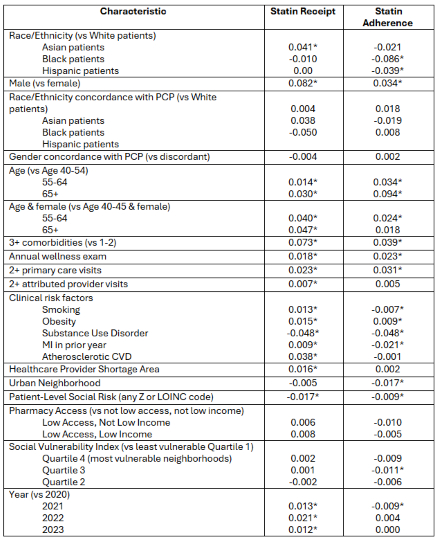
Results: In the sample (N=201,964), the average rate of statin receipt was 80.3% and adherence was 80.7%. The following patient characteristics, shown in Table 1, were most positively associated with statin receipt and adherence in physician fixed effects models: male gender, 3+ comorbidities, age >65 years, and higher engagement in primary care. Differences in statin receipt and adherence between racial/ethnic groups remained after adjusting for other factors, including patient-physician racial/ethnic concordance, which was not statistically significant.
Conclusions: The pattern of results suggests that factors associated with clinical risk and engagement in care are most strongly associated with statin adherence among patients with CVD. Efforts to improve statin adherence should prioritize consistent engagement with and equitable access to primary and preventive care.
Lynch, Stephanie
(
Carelon Research
, Wilmington , Delaware , United States )
Johnson, Martha
(
Carelon Research
, Wilmington , Delaware , United States )
Falconi, April
(
Carelon Research
, Wilmington , Delaware , United States )
Liu, Amy
(
Carelon Research
, Wilmington , Delaware , United States )
Schrager, Nina
(
Carelon Research
, Wilmington , Delaware , United States )
Romine, Jeff
(
Carelon Research
, Wilmington , Delaware , United States )
Johnson, Mallory
(
American Medical Association
, Chicago , Illinois , United States )
Aikens, Blair
(
American Medical Association
, Chicago , Illinois , United States )
Demaio, Fernando
(
American Medical Association
, Chicago , Illinois , United States )
Chi, Winnie
(
Carelon Research
, Wilmington , Delaware , United States )
Author Disclosures:
Stephanie Lynch:DO NOT have relevant financial relationships
| Winnie Chi:No Answer
| Martha Johnson:No Answer
| April Falconi:No Answer
| Amy Liu:DO NOT have relevant financial relationships
| Nina Schrager:DO NOT have relevant financial relationships
| Jeff Romine:No Answer
| Mallory Johnson:DO NOT have relevant financial relationships
| Blair Aikens:No Answer
| Fernando DeMaio:No Answer