Logo

American Heart Association

  21
  0


Final ID: Mo4023

Polygenic Risk Scores Do Not Fully Explain Resilience to CVD in Individuals from Long Lived Families: UK Biobank

Abstract Body (Do not enter title and authors here): Background - Resilience to aging diseases is observed in families with a history of extreme longevity. They may be protected by 3 potential genetic mechanisms: 1) carrying a lower disease risk burden as reflected in polygenic risk scores (PRS), 2) carrying rare disease-resilience genetic variants that are not included in the PRS, or 3) carrying protective genotypes that buffer the effect of common genetic risk factors in PRS. We investigated genetic resilience to CVD by comparing specific PRS in the offspring of parents with extreme longevity (OPEL) to offspring of usual survival (OPUS) in the UK Biobank.
Methods – OPEL (n=9,584) was defined as having at least one parent in the top percentile of survival; father ≥ 95 years, mother ≥ 97 years. OPUS (n=180,042) was defined as both parents with usual survival; father < 84 years and mother < 87 years. PRS of cardiovascular outcomes were available from the UK Biobank. We considered time to cardiovascular events of myocardial infarction, stroke, and Ischemic Stroke (ISS) from the time of enrollment. Cox proportional hazards models were used to assess the effect of PRS and family history on men and women separately, with deprivation index as a covariate.
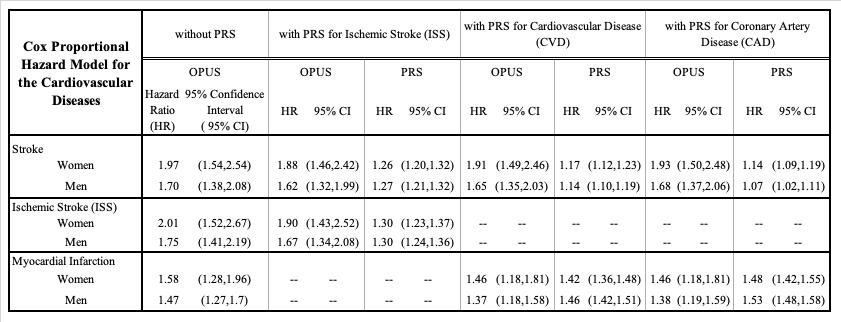
Results – OPUS on average had higher cardiovascular PRS than OPEL. The difference was moderate in size (0.20 to 0.24) but statistically significant. However, PRS did not fully explain the significantly lower cardiovascular disease risk among OPEL. The hazard ratio (HR) of OPUS over OPEL remained highly elevated after we adjusted for PRS in the model (Table). Furthermore, we found no evidence that the effect of PRS was reduced in OPEL.
Conclusions - Exceptional parental longevity is associated with reduced risk of cardiovascular disease in offspring of long-lived parents, independent of known polygenic risk scores. PRS explained only a small fraction of the protective effect observed in OPEL individuals. These findings suggest that rare or undiscovered genetic variants may underlie familial longevity and disease resilience, offering potential targets for future research on healthy aging and disease prevention.
  • Ye, Kenny  ( Albert Einstein College of Medicine , Bronx , New York , United States )
  • Charla, Joseph  ( Albert Einstein College of Medicine , Bronx , New York , United States )
  • Kankaria, Rohan  ( Johns Hopkins University School of Medicine , Baltimore , Maryland , United States )
  • Zhang, Zhendong  ( Albert Einstein College of Medicine , Bronx , New York , United States )
  • Kizer, Jorge  ( San Francisco VA , San Francisco , California , United States )
  • Rodriguez, Carlos  ( Albert Einstein College of Medicine , Bronx , New York , United States )
  • Milman, Sofiya  ( Montefiore Medical Center and Albert Einstein College of Medicine , Bronx , New York , United States )
  • Barzilai, Nir  ( Montefiore Medical Center and Albert Einstein College of Medicine , Bronx , New York , United States )
  • Bortnick, Anna  ( Montefiore Medical Center and Albert Einstein College of Medicine , Bronx , New York , United States )
  • Author Disclosures:
    Kenny Ye: DO NOT have relevant financial relationships | Joseph Charla: DO NOT have relevant financial relationships | Rohan Kankaria: DO NOT have relevant financial relationships | Zhengdong Zhang: No Answer | JORGE KIZER: No Answer | Carlos Rodriguez: DO have relevant financial relationships ; Researcher:Amgen, Inc.:Active (exists now) | Sofiya Milman: DO NOT have relevant financial relationships | Nir Barzilai: No Answer | Anna Bortnick: DO have relevant financial relationships ; Research Funding (PI or named investigator):Arrowhead Pharmaceuticals:Past (completed) ; Other (please indicate in the box next to the company name):Zoll, unrestricted educational funding, honoraria to the institution:Past (completed) ; Other (please indicate in the box next to the company name):Getinge, Meeting travel, honorarium to the institution:Past (completed) ; Other (please indicate in the box next to the company name):ClearView Healthcare LLC, honoraria:Past (completed) ; Research Funding (PI or named investigator):Amgen:Active (exists now) ; Research Funding (PI or named investigator):CSL-Behring:Past (completed)
Meeting Info:

Scientific Sessions 2025

2025

New Orleans, Louisiana

Session Info:

Population-based Genomic Risk Prediction for Cardiovascular Disease 1

Monday, 11/10/2025 , 10:30AM - 11:30AM

Abstract Poster Board Session

More abstracts on this topic:
Adverse Pregnancy Outcomes and Cardiovascular Disease Risk: Insights from the All of Us Research Program

Renedo Daniela, Schwamm Lee, Kamel Hooman, Matouk Charles, Tal Reshef, Sheth Kevin, Falcone Guido, Chaves-rivera Maria Natalia, Rivier Cyprien, Koo Andrew, Clocchiatti-tuozzo Santiago, Huo Shufan, Sujijantarat Nanthiya, Torres Lopez Victor, Hebert Ryan

A Machine Learning-Derived Socio-Environmental Risk Score More Accurately Predicts Cardiovascular Events and Better Addresses Health Inequities than Social Deprivation Index

Chen Zhuo, Nasir Khurram, Al-kindi Sadeer, Rajagopalan Sanjay, Ponnana Sai Rahul, Dazard Jean-eudes, Zhang Tong, Dong Weichuan, Okyere Robert, Sirasapalli Santosh, Deo Salil, Khraishah Haitham

More abstracts from these authors:
The genomics and epigenomics behind cardiovascular aging and disease

Marian Ali, Barzilai Nir, Baccarelli Andrea

Inactive Matrix Gla Protein and Cardiovascular Outcomes: the Multi-Ethnic Study of Atherosclerosis

Berlot Ashley, Bortnick Anna, Fu Xueyan, Shea Kyla, Tracy Russell, Budoff Matthew, Kim Ryung, Naveed Mahim, Booth Sarah, Kizer Jorge

You have to be authorized to contact abstract author. Please, Login
Not Available