Epidemiology and Cardiovascular Implications of Preclinical and Clinical Obesity: Insights from the UK Biobank
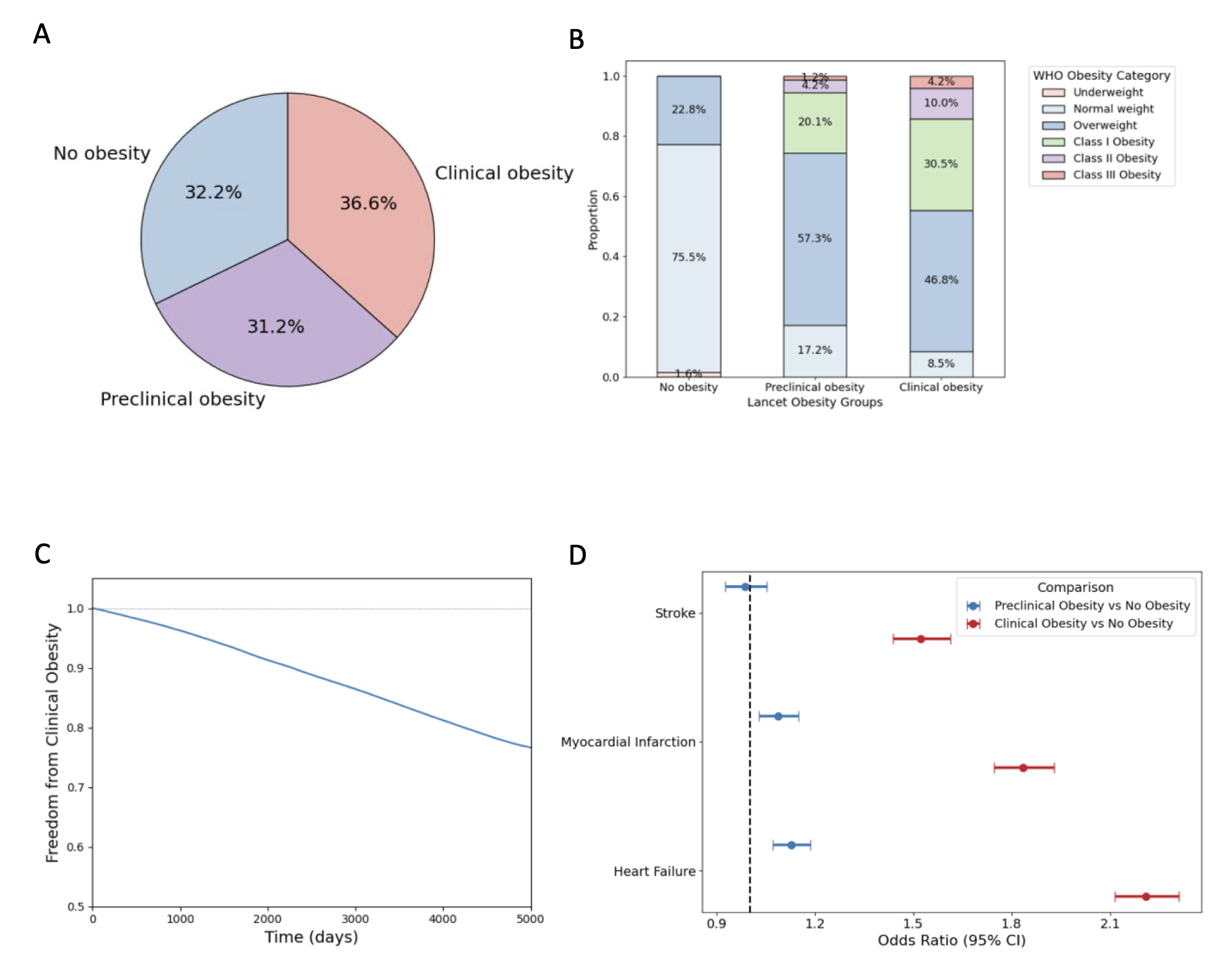
Abstract Body (Do not enter title and authors here): Background: Obesity is a major contributor to cardiovascular disease (CVD). Historically, obesity was defined by body mass index (BMI), but this metric has low sensitivity with body fat and U-shaped association with CVD. To address these concerns, the Lancet Commission issued a new definition of obesity, stratified by preclinical and clinical groups. Objectives We sought to evaluate the epidemiology of preclinical and clinical obesity in the UK Biobank and their associations with incident CVD. Methods We included 502,233 adults in the UK Biobank. Obesity was defined as excess body fat via direct measurement or at least two metrics of excess body fat using BMI, waist circumference, waist to hip ratio, or waist to height ratio. Clinical obesity was defined as adiposity-related dysfunction assessed via ICD10 codes, physical immobility, and abnormal lab values, while preclinical obesity had no deficits. Results The prevalence of preclinical and clinical obesity was 31.2% and 36.6% respectively (Fig. A). Most individuals with preclinical or clinical obesity were classified as WHO overweight (57.3% and 46.8% respectively, Fig. B). Clinical obesity was more prevalent in men (43.6%), elderly (49.4% in 70-80 year olds), South Asians (51.8%), and individuals with lower education (43.3%) or income levels (46.2%); 24.1% of individuals transitioned from preclinical to clinical obesity within 10 years (Fig. C). Individuals with clinical obesity and without baseline CVD had an increased risk of incident stroke (OR 1.5, CI 1.4-1.6), heart failure (OR 2.2, CI 2.1-2.3), and myocardial infarction (OR 1.8, CI 1.7-1.9) within the 13 year follow up, significantly greater than those with preclinical or no obesity after adjusting for age, sex, ethnicity, education, income, and smoking (Fig. D). Conclusions In the UK Biobank, preclinical and clinical obesity were common, but the risk for incident CVD was substantially increased for those with clinical obesity. Identifying such individuals may help in intensifying further therapeutic management.
Zahid, Sohail
(
Johns Hopkins School of Medicine
, Baltimore , Maryland , United States )
Yao, Zhiqi
(
Johns Hopkins School of Medicine
, Baltimore , Maryland , United States )
Peng, Allison
(
Johns Hopkins School of Medicine
, Baltimore , Maryland , United States )
Razavi, Alexander
(
Emory University
, Atlanta , Georgia , United States )
Blumenthal, Roger
(
Johns Hopkins School of Medicine
, Baltimore , Maryland , United States )
Blaha, Michael
(
Johns Hopkins School of Medicine
, Baltimore , Maryland , United States )
Author Disclosures:
Sohail Zahid:DO NOT have relevant financial relationships
| Zhiqi Yao:DO NOT have relevant financial relationships
| Allison Peng:DO NOT have relevant financial relationships
| Alexander Razavi:DO NOT have relevant financial relationships
| Roger Blumenthal:DO NOT have relevant financial relationships
| Michael Blaha:DO have relevant financial relationships
;
Research Funding (PI or named investigator):Novo Nordisk:Active (exists now)
; Consultant:Eli Lilly:Past (completed)
; Consultant:Boehringer Ingelheim:Past (completed)
; Consultant:Astra Zeneca:Past (completed)
; Consultant:New Amsterdam:Active (exists now)
; Consultant:Agepha:Active (exists now)
; Consultant:Merck:Active (exists now)
; Consultant:Idorsia:Past (completed)
; Consultant:Genentech:Past (completed)
; Consultant:Bayer:Active (exists now)
; Consultant:Novo Nordisk:Active (exists now)
; Research Funding (PI or named investigator):Bayer:Active (exists now)