Association of Residential Green Space, Blue Space, and Natural Environment with the Incident Heart Failure and Cardiac Morpho-Functional Phenotypes: a UK Biobank-based Prospective Cohort and Imaging Study
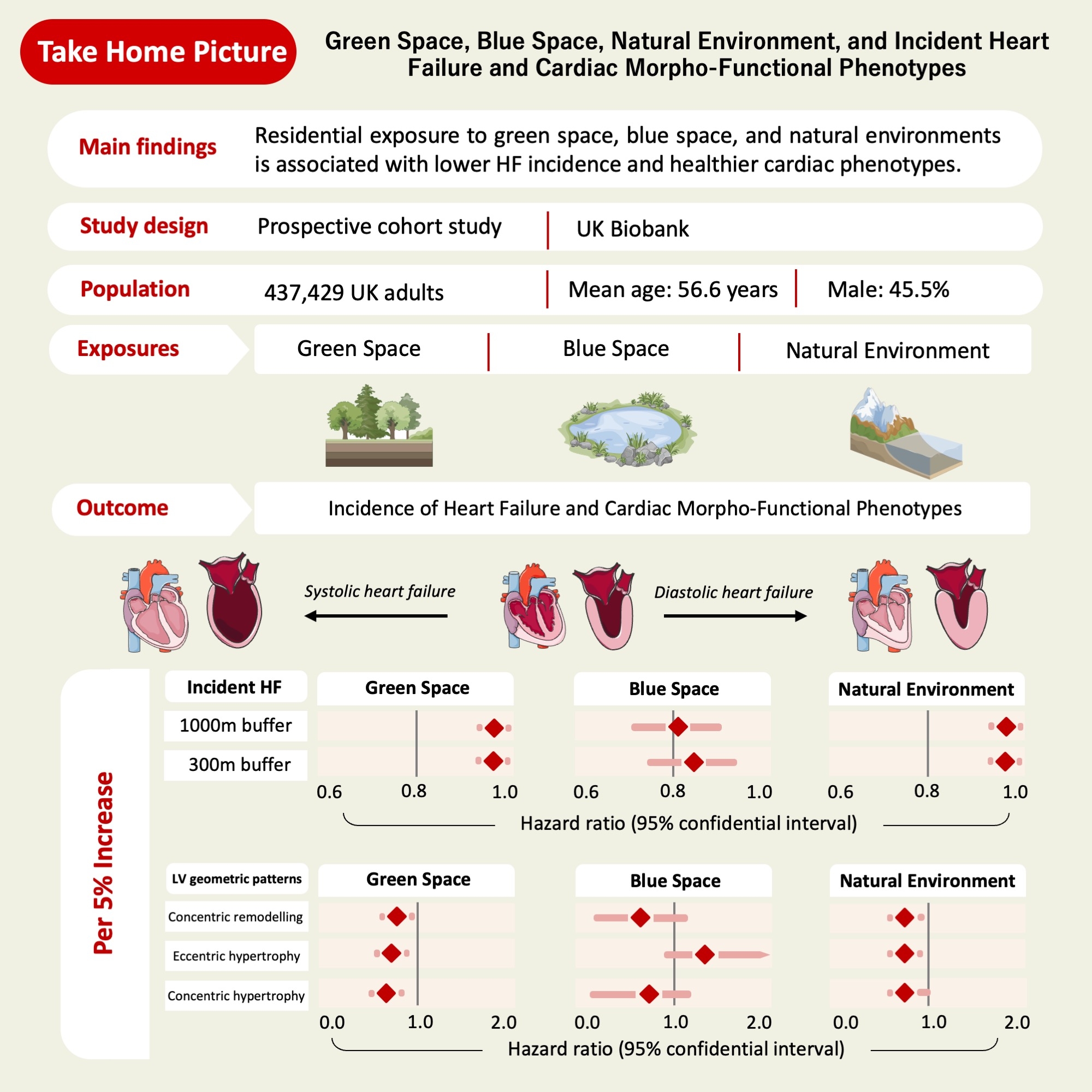
Abstract Body (Do not enter title and authors here): Background Environmental exposures are increasingly recognized as modifiable risk factors for heart failure (HF), yet the roles of residential green space, blue space, and natural environments in cardiac structural/functional remodeling and HF development remain underexplored. Objectives We aimed to prospectively evaluate associations between residential green space, blue space, and natural environment exposure with incident HF and cardiac morpho-functional phenotypes. Methods We analyzed 437,429 UK Biobank participants free of baseline HF. Residential green space, blue space, and natural environment were quantified as land coverage percentages within 300-meter and 1000-meter buffers. Incident HF was ascertained via linked health records. Cox proportional regression models adjusted for sociodemographic, lifestyle, clinical, polygenic risk score, and air pollution covariates assessed HF risk. Cardiac magnetic resonance (CMR) imaging data from the UK Biobank data was analyzed for associations with ventricular/atrial structure and function. Results During the follow-up, 16,564 incident HF cases were identified. Within a 1000-meter buffer, higher exposure to green space (HR 0.83, 95%CI 0.78–0.89), blue space (HR 0.74, 95%CI 0.70–0.78), and natural environment (HR 0.81, 95%CI 0.76–0.86) (for 3rd vs 1st tertile) was consistently associated with a reduced risk of HF. Similar trends were observed for the 300-meter buffer, with comparable protective associations for green space, blue space, and natural environment. In CMR analyses, higher green space exposure correlated with reduced odds of concentric remodeling (OR 0.43, 95%CI 0.24–0.80), eccentric hypertrophy (OR, 0.42 95CI, 0.23–0.77), and concentric hypertrophy (OR 0.33, 95%CI 0.11–0.98) within 1000-meter buffers. For blue space (within the 1000-meter buffer), higher exposure showed a reduced odds of concentric remodeling (OR 0.35, 95% CI 0.20–0.61). Natural environment exposure within a 1000-meter buffer demonstrated attenuation of adverse remodeling comparable to green space effects. Conclusions Residential exposure to green space, blue space, and natural environments is associated with lower HF incidence and healthier cardiac phenotypes, independent of genetic predisposition and air pollution. Green space demonstrates the most robust cardioprotective effects.
Song, Yanjun
(
Fuwai Hospital
, Beijing , China )
Lin, Zhangyu
(
Fuwai Hospital
, Beijing , China )
Zheng, Zhihao
(
Fuwai Hospital
, Beijing , China )
Chen, Xinyue
(
Fuwai Hospital
, Beijing , China )
Bian, Xiaohui
(
Fuwai Hospital
, Beijing , China )
Author Disclosures:
Yanjun Song:DO NOT have relevant financial relationships
| Zhangyu Lin:DO NOT have relevant financial relationships
| Zhihao Zheng:DO NOT have relevant financial relationships
| Xinyue Chen:DO NOT have relevant financial relationships
| Xiaohui Bian:DO NOT have relevant financial relationships