Comparative Effectiveness of SGLT2 Inhibitors with and without GLP-1 Receptor Agonists in Patients with Heart Failure and Type 2 Diabetes Mellitus
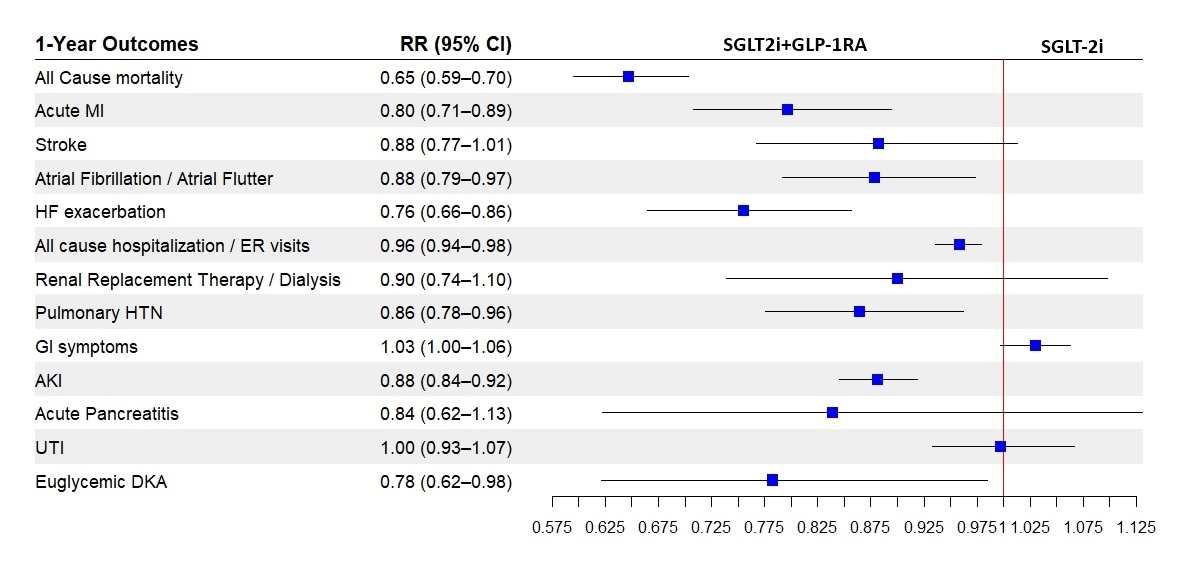
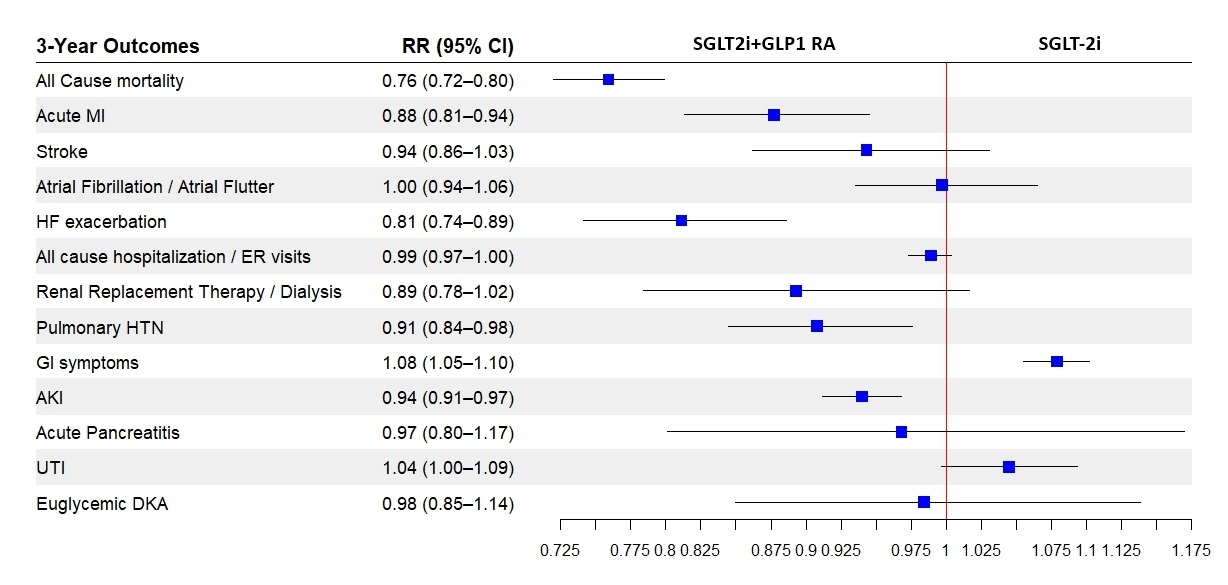
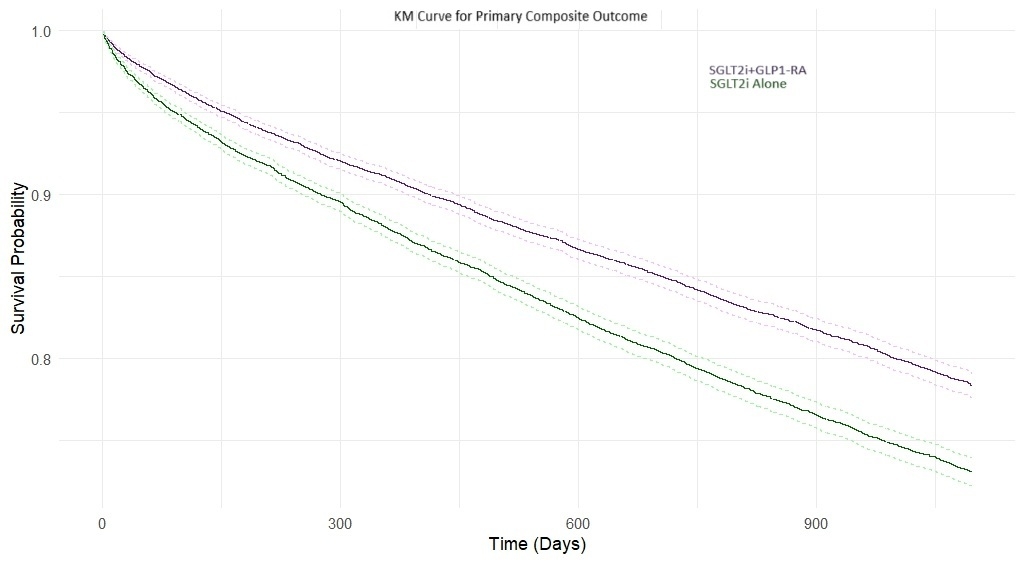
Abstract Body (Do not enter title and authors here): Background:SGLT2i and GLP-1RA Independently Improve CV outcomes in pts with T2DM.Their combined effect in real-world pts with coexisting HF and T2DM remains underexplored.Methods:We conducted a propensity-matched cohort study using the TriNetX global federated health research network.We identified adults (≥18 years) with HF and T2DM who initiated either SGLT2i with GLP1-RA (Cohort A) or SGLT2i alone (Cohort B) across 102 healthcare organizations.Among 58,525 adults, 22,322 pts received SGLT2i with GLP-1RA, and 36,203 pts were on SGLT2i alone between Jan 2015 and May 2022.After propensity score matching 18,141 pts were included in each cohort.The primary outcome was a composite of all-cause mortality,acute myocardial infarction(AMI),or stroke at 1 year and 3 years.Secondary outcomes included individual event rates,hospitalizations,HFexacerbations,and safety events.Results:At 1 year,combination therapy with SGLT2i and GLP-1RA was associated with a significantly lower risk of the primary composite outcome than SGLT2i alone.Specifically, the combination group showed reduced all-cause mortality(RR: 0.647; 95% CI: 0.595–0.703; p<0.001),AMI (RR: 0.796; 95% CI: 0.708–0.894; p<0.001).Among secondary outcomes,HF exacerbations(RR: 0.755; 95% CI: 0.665–0.857; p<0.001)and AKI(RR: 0.881; 95% CI: 0.845–0.919; p<0.001)were also significantly lower in the combination group.These clinical benefits remained consistent over a 3-year follow-up,with ongoing reductions in all-cause mortality and AMI observed in the combination group.No significant increase in stroke risk was observed.The 1-year RR was 0.882(95% CI: 0.767–1.013; p=0.075),and the 3-year RR was 0.943(95% CI: 0.862–1.031; p=0.198).Similarly, adverse events—including atrial fibrillation/atrial flutter, need for renal replacement therapy or dialysis, pulmonary HTN, acute pancreatitis, UTI, and euglycemic DKA—did not show significant differences.All-cause hospitalization or emergency room visits were significantly reduced at 1 year in the combination therapy(RR: 0.958; 95% CI: 0.936–0.979; p<0.001),though this difference was no longer significant at 3 years(RR: 0.989; 95% CI: 0.973–1.004; p=0.157).Conclusion:In a large real-world cohort of patients with HF and T2DM, combined SGLT2i and GLP1-RA therapy was associated with significantly improved CV outcomes and survival over 1 and 3 years,with no increase in major adverse safety events.These findings support the consideration of dual therapy in this high-risk population.
Jahan, Sultana
(
Valley Health System
, Las Vegas , Nevada , United States )
Hamza, Muhammad
(
Guthrie Medical Group
, Ithaca , New York , United States )
Mir, Junaid
(
university of missouri columbia
, Columbia , Missouri , United States )
Baqi, Abdul
(
Mercy St. Vincent Medical Center
, Toledo , Ohio , United States )
Qadeer, Abdul
(
University of Texas Medical Branch
, Galveston , Texas , United States )
Mercado, Adrian
(
Valley Health System
, Las Vegas , Nevada , United States )
Tanveer, Aisha
(
Valley Health System
, Las Vegas , Nevada , United States )
Dani, Sourbha
(
LAHEY HOSPITAL MEDICAL CENTER
, Burlington , Massachusetts , United States )
Author Disclosures:
Sultana Jahan:DO NOT have relevant financial relationships
| Muhammad Hamza:No Answer
| Junaid Mir:DO NOT have relevant financial relationships
| Abdul Baqi:No Answer
| Abdul Qadeer:DO NOT have relevant financial relationships
| Adrian Mercado:DO have relevant financial relationships
;
Consultant:INARI Medical:Active (exists now)
; Consultant:Abbott:Active (exists now)
; Consultant:Shockwave medical:Active (exists now)
| Aisha Tanveer:No Answer
| Sourbha Dani:DO NOT have relevant financial relationships