
Logo

American Heart Association

  14
  0


Final ID: MP2455

Immersive Healing: Approach to Easing Anxiety in Pediatric Cardiology Outpatient Procedures through Virtual Reality Distracting Techniques

Abstract Body (Do not enter title and authors here): Background: Virtual reality (VR) coping has recently flourished into a popular distractor in pediatric medical environments. This study aims to assess the effectiveness of VR versus standard care for reducing anxiety during routine outpatient ECGs. A secondary objective was to examine if the use of VR results in higher patient, parent, and ECG technician satisfaction when undergoing these procedures.
Methods: Patients being clinically evaluated in a pediatric cardiology clinic with an ECG were prospectively enrolled after informed consent and randomized to VR and non-VR (standard care) groups. Patients completed pre- and post-ECG surveys using the validated Children’s Anxiety Meter-State (CAM-S) and the Children’s Fear Scale (CFS). In addition, patient, parent, and technician satisfaction were evaluated via post-procedure experience surveys. ECGs were reviewed by a pediatric cardiologist for presence of motion artifact and compared with electronic medical records for diagnostic accuracy. Differences between groups (VR vs non-VR) were measured using Student t-tests, while within group (pre vs post) differences were measured using repeated measures (Proc Mixed). The study was reviewed and approved by Stanford University IRB (#74232). All analyses were conducted using SAS OnDemand for Academics (Cary, NC).
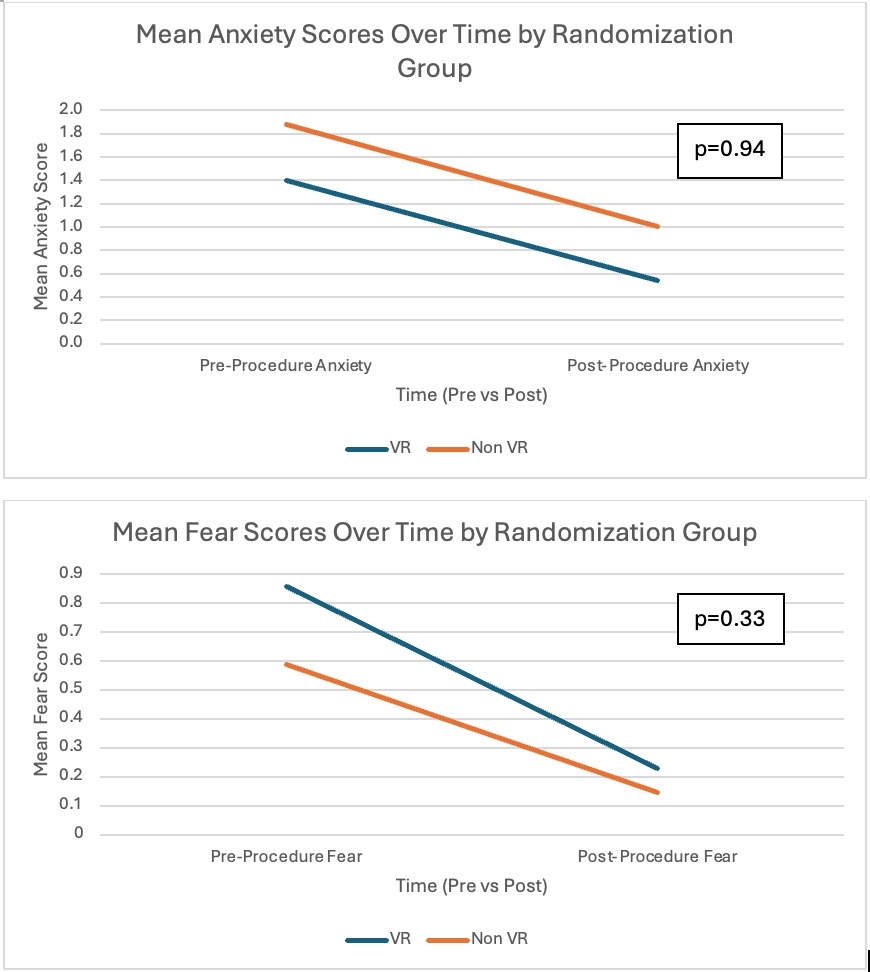
Results: Among 70 randomized patients, 1 was unable to finish the procedure, leaving 35 in the VR group and 34 in the non-VR group. No difference in technician time was observed between the groups (p = 0.32). Both groups showed significant reductions in post-ECG anxiety and fear scores (p < 0.01 for both). However, no significant difference was seen between the VR and Non-VR groups for the decrease in anxiety (p=0.94) or fear (p=0.33). The majority of patients, parents, and technicians reported VR as a helpful distraction tool, with 91-95% of patients and parents feeling more relaxed and 79% of technicians finding VR improved efficiency. Additionally, 87-100% of respondents felt VR technology was engaging for the child and useful for other patients.
Conclusion: While VR and Non-VR decrease anxiety and fear at similar rates, surveys indicate that children find VR to be a beneficial tool and the technology eases parents’ fears when watching their child undergo a new procedure. The use of VR also appears to aid in technician efficiency, suggesting the addition of this distractor has merit as a valuable tool in additional outpatient settings and patient groups.
  • Kohlsaat, Katherine  ( Stanford School of Medicine , Palo Alto , California , United States )
  • Punn, Rajesh  ( Stanford University , Palo Alto , United States Minor Outlying Islands )
  • Jameson, Susan  ( Stanford University , Pleasanton , California , United States )
  • Menendez, Maria  ( Stanford University , Palo Alto , United States Minor Outlying Islands )
  • Ceresnak, Scott  ( Stanford University , Palo Alto , California , United States )
  • Mederios, Paige  ( Stanford University , Palo Alto , United States Minor Outlying Islands )
  • Barnett, Mitchell  ( Stanford University , Palo Alto , United States Minor Outlying Islands )
  • Author Disclosures:
    Katherine Kohlsaat: DO NOT have relevant financial relationships | Rajesh Punn: No Answer | Susan Jameson: DO NOT have relevant financial relationships | Maria Menendez: DO NOT have relevant financial relationships | Scott Ceresnak: No Answer | Paige Mederios: DO NOT have relevant financial relationships | Mitchell Barnett: DO NOT have relevant financial relationships
Meeting Info:

Scientific Sessions 2025

2025

New Orleans, Louisiana

Session Info:
More abstracts on this topic:
Adverse Childhood Experiences are Associated with Poor Sleep Among Racial and Ethnic Minoritized Patients with Recent Myocardial Infarction

Bartelloni Alexis, De Brito Stefany, Hausvater Anais, Smilowitz Nathaniel, Reynolds Harmony, Spruill Tanya

Characteristics of Blue Zones and Their Association with Longevity: Analysis in the Women’s Health Initiative

Reding Kerryn, Malek Angela, Hale Lauren, Lane Dorothy, Haring Bernhard, Nudy Matthew, Johnson Karen, Garcia Lorena, Manson Joann, Lamonte Michael, Lee Hyunhae, Hovey Kathleen, Andrews Chris, Vasbinder Alexi, Szewczyk Warren, Tsai Chi-shan, Kroenke Candyce, Mozhui Khyobeni

More abstracts from these authors:
Evaluation of the syncopal athlete

Etheridge Susan, Ceresnak Scott, Kannankeril Prince

You have to be authorized to contact abstract author. Please, Login
Not Available