
Logo

American Heart Association

  17
  0


Final ID: MP1547

Retrospective Analysis of the Impact of Ischemic Time and Race/Ethnicity on Survival and Mortality after Heart Transplantation

Abstract Body (Do not enter title and authors here): Background
Cold ischemic time influences post-transplant outcomes in heart transplantation. Despite medical advances, racial disparities persist in cardiac transplantation mortality. The relationship between ischemic time and recipient race/ethnicity remains poorly understood but may significantly impact survival outcomes.
Methods
We conducted a retrospective cohort study using the United Network for Organ Sharing (UNOS) database, analyzing 40,812 adult heart transplant recipients from 2000 to 2023. Cold ischemic time was defined as the interval from donor aortic cross-clamping to recipient reperfusion, with prolonged ischemic time as ≥4 hours. Multivariate analysis assessed the interaction between recipient race/ethnicity and ischemic time on post-transplant outcomes and mortality. Statistical significance was set at p < 0.05.
Results
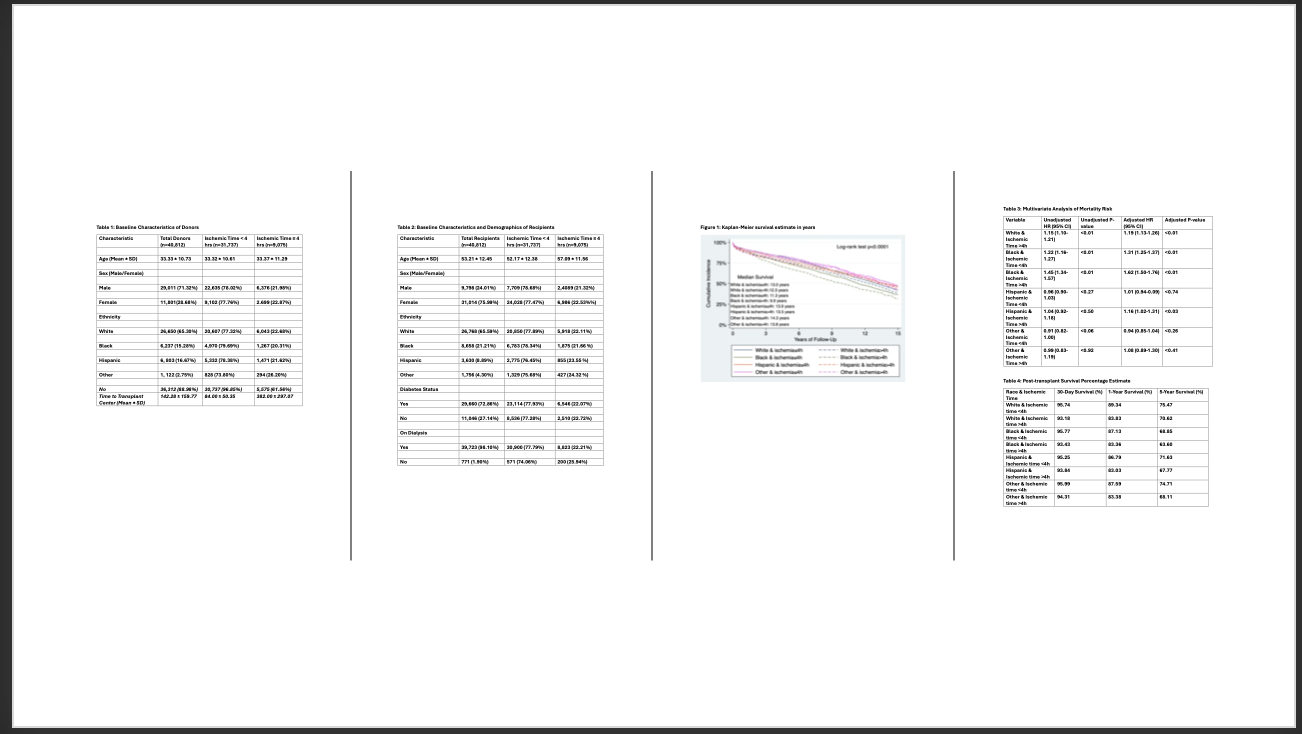
Among the cohort of 40,812 analyzed, 22.2% experienced prolonged ischemic times. Baseline characteristics are shown in Tables 1 and 2. Black recipients (21.2% of total) showed the highest mortality risk when experiencing prolonged ischemic times (adjusted HR 1.62, 95% CI 1.50-1.76, p<0.01) compared to White recipients with prolonged ischemic times (HR 1.19, 95% CI 1.13-1.26, p<0.01) as described in table 3. Even with normal ischemic times, Black recipients demonstrated elevated mortality risk (adjusted HR 1.31, 95% CI 1.25-1.37, p<0.01). Five-year survival rates revealed significant disparities: Black recipients with prolonged ischemic times showed the lowest Survival (63.6%) compared to White recipients with normal ischemic times (75.5%), representing nearly a 12% absolute survival difference, as shown in Table 4 and Figure 1.
Conclusion
Black heart transplant recipients face disproportionate mortality risk that is further amplified by prolonged ischemic times. This interaction between race and ischemic time suggests the need for tailored allocation strategies that consider these disparities. Implementation of targeted interventions to adjust ischemic times, particularly enhancing post-transplant care for high-risk populations, and the development of improved organ preservation techniques may help mitigate these disparities and improve equitable outcomes in heart transplantation.
  • Akinfenwa, Stephen  ( UConn School of Medicine , Farmington , Connecticut , United States )
  • Zoni, Cesar  ( Federación Argentina de Cardiología , Argentina , Argentina )
  • Dean, Matthew  ( Virginia Commonwealth University , Richmond , Virginia , United States )
  • Ravi, Yazhini  ( UConn School of Medicine , Farmington , Connecticut , United States )
  • Author Disclosures:
    Stephen Akinfenwa: DO NOT have relevant financial relationships | Cesar Zoni: DO NOT have relevant financial relationships | Matthew Dean: DO NOT have relevant financial relationships | Yazhini Ravi: No Answer
Meeting Info:

Scientific Sessions 2025

2025

New Orleans, Louisiana

Session Info:

Crisis, Complexity, and the Cardiovascular Continuum: Risk, Response, and Real-World Trends

Sunday, 11/09/2025 , 11:50AM - 01:05PM

Moderated Digital Poster Session

More abstracts on this topic:
Artificial Intelligence-Enhanced Electrocardiographic Phenotyping Unveils Novel Lethal Cardiovascular & Sudden Death Risk Signatures in Traditionally Low Risk Populations

Barker Joseph, Syan Jasjit, Jenkins Alex, Ribeiro Antonio, Annis Jeffrey, Camelo Lidyane, Oliveira Clara, Paixao Gabriela, Brant Luisa, Ribeiro Antonio, Ge Junbo, Fathieh Sina, Kramer Daniel, Waks Jonathan, Brittain Evan, Peters Nicholas, Figtree Gemma, Khattak Gul Rukh, Sau Arunashis, Ng Fu Siong, Pastika Libor, Birdi Aidan, Zeidaabadi Boroumand, Patlatzoglou Konstantinos, Liang Yixiu, Aggour Hesham, El-medany Ahmed

Sex Differences in Latent Profiles of Hypertension-Mediated Organ Damage: A UK Biobank Analysis

Angarita-fonseca Adriana, Sharma Abhinav, Berry Colin, Kaur Amanpreet, Mavrakanas Thomas, Behlouli Hassan, Rajah Natasha, Pilote Louise

You have to be authorized to contact abstract author. Please, Login
Not Available