Real World Experience of Intravenous Iron Repletion in Children with Heart Failure
Abstract Body (Do not enter title and authors here): Introduction: Iron deficiency (ID) is common in HF and is associated with adverse CV outcomes. There is a paucity of literature on efficacy of intravenous iron replacement (FeIV) in children with HF.
Methods: Single-center observational analysis of 244 children (≤ 21 years old) with HF or post-heart transplant (HTX) who received IV iron sucrose (IS, 46%) from 2010-2018 or IV ferric carboxymaltose (FCM, 54%) from 2019-2024. Anemia was defined by World Health Organization age-specific hemoglobin cutoffs; ID was defined as iron saturation (TSAT) <20% or ferritin <100 ng/mL. Primary outcome was change in iron profile and hematological indices. Secondary outcome was change in LVEF and BNP. Exploratory outcome included baseline risk factors for anemia and composite event of HTX listing, need for MCS, or death by latest follow-up.
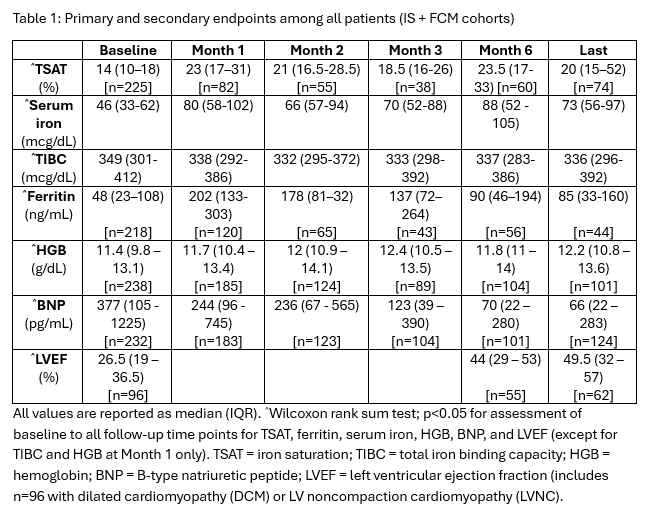
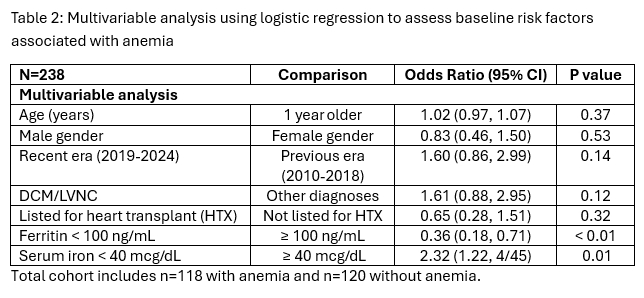
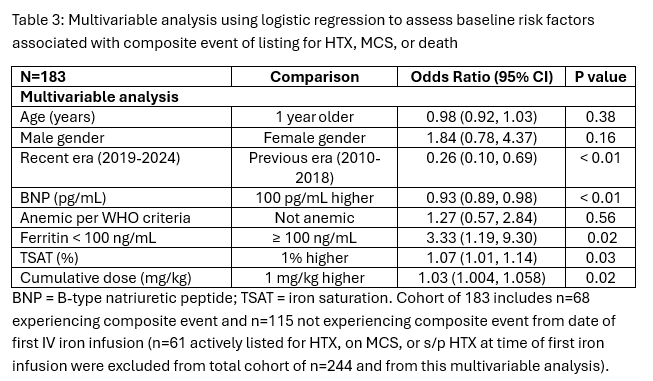
Results: Median age at first FeIV infusion was 3.6 years (IQR 0.8-13.2); 43% were female. Diagnoses included CDM (49%), congenital heart disease (43%), and s/p HTX (8%). Total of 812 FeIV infusions were administered (67% IS; 33% FCM). Median number of infusions per patient was 4 (IQR 3–6) for IS and 1 (IQR 1–2) for FCM (p<0.01). Despite fewer infusions, the median cumulative dose was higher with FCM (19.9 vs 13.1 mg/kg; p<0.01). At baseline, 82% had TSAT <20%, 70% had ferritin <100 ng/mL, 38% had serum iron <40 mcg/dL, and 50% were anemic. Only 56% had TSAT <20% with ferritin <100 ng/mL. Mean follow-up was 255 days (SD±144). Significant increases in TSAT, ferritin, serum iron, hemoglobin, and LVEF, and decreases in BNP, were observed at most follow-up points (Table 1) (all p<0.05). Following FeIV, 81% achieved TSAT ≥20% and 80% ferritin ≥100 ng/mL. Composite event occurred in 28% at median 28 days (IQR 8-102) following first FeIV infusion; time to event occurred significantly earlier in IS vs FCM cohorts (18 vs 32 days, respectively, p=0.04). Multivariable analysis identified ferritin <100 ng/mL was independently associated with decreased risk of anemia and serum iron <40 mcg/dL as increased risk (Table 2). Older era (2010-2018), lower cumulative FeIV dose, ferritin <100 ng/mL, lower TSAT, and higher BNP were all independently associated with higher risk of composite event (Table 3).
Conclusion: FeIV effectively corrects ID in children with HF and may be linked with improvements in clinical outcomes. Further studies are needed to confirm safety and clinical benefits of FeIV in pediatric HF.
Newland, David
(
Seattle Children's Hospital
, Seattle , Washington , United States )
Ali, Reda
(
Seattle Children's Hospital
, Seattle , Washington , United States )
Albers, Erin
(
Seattle Children's Hospital
, Seattle , Washington , United States )
Hartje-dunn, Christina
(
Seattle Children's Hospital
, Seattle , Washington , United States )
Hong, Borah
(
Seattle Children's Hospital
, Seattle , Washington , United States )
Kemna, Mariska
(
Seattle Children's Hospital
, Seattle , Washington , United States )
Liu, Jiawen
(
Seattle Children's Hospital
, Seattle , Washington , United States )
Srour, Nina
(
Seattle Children's Hospital
, Seattle , Washington , United States )
Wisotzkey, Bethany
(
Seattle Children's Hospital
, Seattle , Washington , United States )
Law, Yuk
(
Seattle Children's Hospital
, Seattle , Washington , United States )
Author Disclosures:
David Newland:DO NOT have relevant financial relationships
| Yuk Law:DO NOT have relevant financial relationships
| Reda Ali:No Answer
| Erin Albers:DO NOT have relevant financial relationships
| Christina Hartje-Dunn:DO NOT have relevant financial relationships
| Borah Hong:DO NOT have relevant financial relationships
| Mariska Kemna:DO NOT have relevant financial relationships
| Jiawen Liu:No Answer
| Nina Srour:No Answer
| Bethany Wisotzkey:No Answer