Can a Deep Learning-Based Model Effectively Differentiate Cardiac Congestion and Interstitial Lung Disease in Patients With Acute Dyspnea Using Chest Radiography?
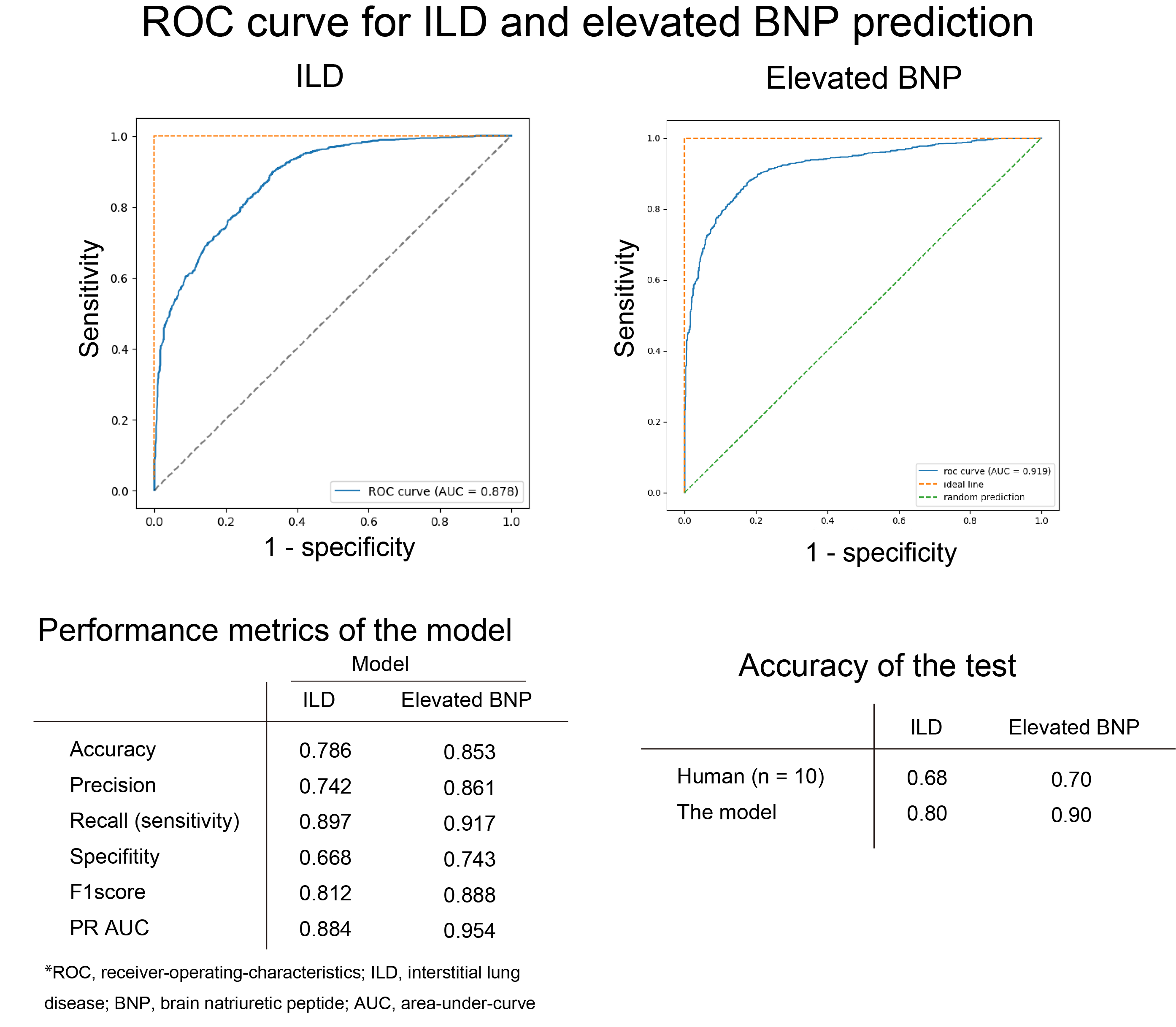
Abstract Body (Do not enter title and authors here): Background: Differentiating the underlying cause of dyspnea in patients presenting to the emergency department is sometimes a clinical challenge. It is often difficult to distinguish cardiogenic pulmonary edema from interstitial lung disease (ILD) on chest radiographs. Aims: We assessed the hypothesis that deep learning models could differentiate chest radiographs of ILD from those of cardiogenic pulmonary edema. Methods: Patients presenting with dyspnea who underwent chest radiography in posteroanterior, anteroposterior, standing, sitting, or supine positions were included (ILD dataset); lateral views were excluded. Patients who had both chest radiography and brain natriuretic peptide (BNP) tested on the same day were included (BNP dataset). Deep neural network models were pretrained on the CXR8 dataset and then fine-tuned using the ILD and BNP datasets to predict ILD and elevated BNP levels, respectively. Model performance was evaluated on an external dataset. Tests were conducted on humans, including doctors, who predicted ILD and elevated BNP from chest radiograms extracted from the test data set, and their performance was compared to the model. Results: A total of 112,120 chest radiographs from the CXR8 dataset, 3,755 radiographs from 250 patients in the ILD dataset, and 8,390 radiographs from 1,334 patients in the BNP dataset were used for model development. The area under the receiver operating characteristic curve (AUC) for predicting ILD and elevated BNP were 0.878 and 0.919, respectively. The precision-recall AUCs were 0.884 and 0.954, and the F1 scores were 0.812 and 0.888, respectively. In the human test, the examiners’ (n = 10) accuracy in predicting ILD and elevated BNP was 0.68 and 0.70, respectively, compared to the model’s accuracy of 0.80 and 0.90. Conclusions: The AI models demonstrated the ability to predict ILD and elevated BNP levels from chest radiographs. Such models may provide valuable diagnostic support to physicians in emergency settings for differentiating heart failure from lung disease.
Kagawa, Eisuke
(
Hiroshima City Asa Hospital
, Hiroshima , Japan )
Hidaka, Takayuki
(
Hiroshima City Asa Hospital
, Hiroshima , Japan )
Kunita, Eiji
(
Hiroshima City Asa Hospital
, Hiroshima , Japan )
Yamane, Aya
(
Hiroshima City Asa Hospital
, Hiroshima , Japan )
Matsui, Shogo
(
Hiroshima City Asa Hospital
, Hiroshima , Japan )
Kobayashi, Yusuke
(
Hiroshima City Asa Hospital
, Hiroshima , Japan )
Uotani, Yukimi
(
Hiroshima City Asa Hospital
, Hiroshima , Japan )
Teramoto, Tomoki
(
Hiroshima City Asa Hospital
, Hiroshima , Japan )
Yoshii, Kanade
(
Hiroshima City Asa Hospital
, Hiroshima , Japan )
Kato, Masaya
(
Hiroshima City Asa Hospital
, Hiroshima , Japan )
Author Disclosures:
Eisuke Kagawa:DO NOT have relevant financial relationships
| Masaya Kato:DO NOT have relevant financial relationships
| Takayuki Hidaka:No Answer
| Eiji Kunita:No Answer
| AYA YAMANE:No Answer
| Shogo Matsui:No Answer
| Yusuke Kobayashi:No Answer
| Yukimi Uotani:DO NOT have relevant financial relationships
| tomoki teramoto:DO NOT have relevant financial relationships
| Kanade Yoshii:No Answer