Logo

American Heart Association

  23
  0


Final ID: Su4079

Efficacy of Anti-inflammatory Therapies for Pericarditis: A Systematic Review and Network Meta-analysis

Abstract Body (Do not enter title and authors here): Background
One of the most troublesome complications of acute pericarditis is recurrence. Non-steroidal anti-inflammatory drugs (NSAIDs) and colchicine form the cornerstone treatment, with the addition of steroids in cases of incomplete response. Recent evidence also suggests a role for interleukin-1 (IL-1) antagonists in challenging cases of recurrence. However, with an increasing number of potential therapies, our study aims to examine the relative efficacy of these anti-inflammatory treatments for recurrent pericarditis risk reduction.
Methods
We searched Medline, Embase, and the Cochrane Central Register of Controlled Trials in October 2023. We included randomized controlled trials (RCTs) and prospective cohort studies of patients with pericarditis treated with a drug with anti-inflammatory properties compared with those treated with a control. The main outcome evaluated was pericarditis recurrence.
Results
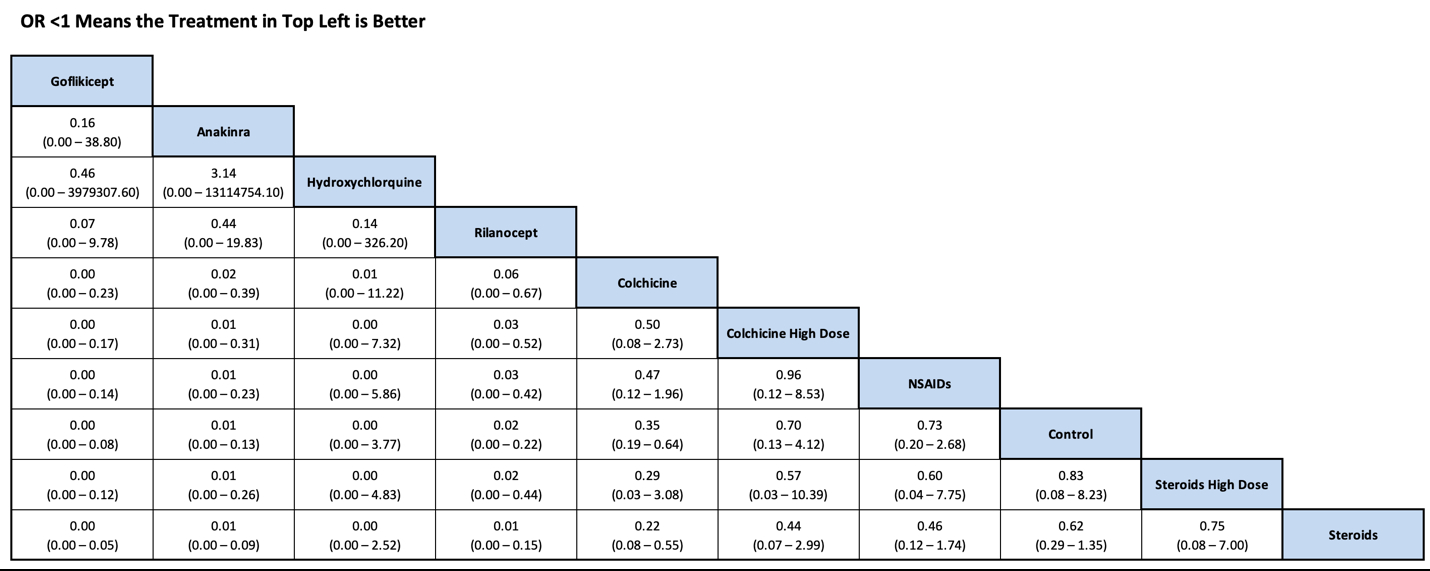
A total of 6,831 studies were screened, of which 25 articles were included (14 RCTs and 11 cohort studies) for a total number of patients of 3,561. The mean age across studies was 54.82 years for adults and 9.04 years for children (females = 40.55%). The average follow-up duration was 20.03 months. Bayesian network meta-analysis was performed to calculate risk estimates using a random effects model (Figure 1). Goflikicept, a fusion protein that neutralizes IL-1, showed a significant reduction in recurrent pericarditis rates (OR: 0.00, 95% Credible Limits [Crl]: 0.00-0.08). Similarly, anakinra (OR: 0.01, 95% Crl: 0.00-0.13), rilonacept (OR: 0.02, 95% Crl: 0.00-0.22) and colchicine (OR: 0.35, 95% Crl: 0.19-0.64) were associated with a significant reduction in recurrent pericarditis events. High dose colchicine (OR: 0.70, 95% Crl: 0.13-4.12) was not superior to regular dose colchicine (1 mg vs 0.6 mg twice daily, respectively). Interestingly, there was not enough data to make a meaningful comparison between steroids and control.
Conclusion
In our analysis, goflikicept, rilonacept, and anakinra were most effective at reducing recurrent pericarditis rates. However, the evidence is based on a small number of studies. Our analysis also corroborated evidence regarding the efficacy of colchicine in reducing pericarditis recurrence. For a comprehensive analysis of the benefits and harms of anti-inflammatory therapies, larger comparative studies or network meta-analyses of patient-level data are required.
  • Ragheb, Mirna  ( University of Ottawa, Heart Inst. , Ottawa , Ontario , Canada )
  • Mardigyan, Vartan  ( McGill University Health Centre , Montreal , Quebec , Canada )
  • Chetrit, Michael  ( McGill University Health Centre , Montreal , Quebec , Canada )
  • Kafil, Tahir  ( Mayo Clinic , Rochester , Minnesota , United States )
  • Wells, George  ( University of Ottawa, Heart Inst. , Ottawa , Ontario , Canada )
  • Boczar, Kevin  ( University of Ottawa, Heart Inst. , Ottawa , Ontario , Canada )
  • Pantieras, Falia  ( University of Ottawa, Heart Inst. , Ottawa , Ontario , Canada )
  • Pearson, Alexander  ( University of Ottawa, Heart Inst. , Ottawa , Ontario , Canada )
  • Patel, Milin  ( University of Ottawa, Heart Inst. , Ottawa , Ontario , Canada )
  • Lisondra, James  ( University of Ottawa, Heart Inst. , Ottawa , Ontario , Canada )
  • Visintini, Sarah  ( University of Ottawa, Heart Inst. , Ottawa , Ontario , Canada )
  • Abumustafa, Yousef  ( University of Ottawa, Heart Inst. , Ottawa , Ontario , Canada )
  • Ani, Omar  ( University of Pennsylvania , Philadelphia , Pennsylvania , United States )
  • Hakimjavadi, Ramtin  ( University of Ottawa, Heart Inst. , Ottawa , Ontario , Canada )
  • Author Disclosures:
    Mirna Ragheb: DO NOT have relevant financial relationships | Vartan Mardigyan: No Answer | Michael Chetrit: No Answer | Tahir Kafil: DO NOT have relevant financial relationships | George Wells: DO have relevant financial relationships ; Researcher:University of Ottawa Heart Institute:Active (exists now) | Kevin Boczar: No Answer | Falia Pantieras: No Answer | Alexander Pearson: DO NOT have relevant financial relationships | Milin Patel: DO NOT have relevant financial relationships | James Lisondra: DO NOT have relevant financial relationships | Sarah Visintini: No Answer | Yousef Abumustafa: DO NOT have relevant financial relationships | Omar Ani: No Answer | Ramtin Hakimjavadi: DO NOT have relevant financial relationships
Meeting Info:

Scientific Sessions 2025

2025

New Orleans, Louisiana

Session Info:

Cross-System Drivers of Cardiac Disease: Immune, Metabolic, and Genetic Mechanisms

Sunday, 11/09/2025 , 03:15PM - 04:15PM

Abstract Poster Board Session

More abstracts on this topic:
A Mast Cell-Specific Receptor Mediates Post-Stroke Brain Inflammation Via a Dural-Brain Axis

Kothari Ruchita, Caplan Justin, Gonzalez L. Fernando, Jackson Christopher, Bettegowda Chetan, Huang Judy, Koehler Raymond, Tamargo Rafael, Xu Risheng, Dong Xinzhong, Abdulrahim Mostafa, Oh Hyun Jong, Capuzzi Daniel, Nair Sumil, Zhang Yaowu, Limjunyawong Nathachit, Saini Sarbjit, Kim Jennifer

A Trickling Hourglass: A Case of Purulent Pericarditis and Liver Abscess Caused by Parvimonas micra

Chaudhary Noman Ahmed, Ali Ahmed

More abstracts from these authors:
Double Trouble Exploring Mental Health Issues in Patients with Spontaneous Coronary Artery Dissection (SCAD) and Fibromuscular Dysplasia (FMD)

Maukel Lisa-marie, Reed J, Liu Shuangbo, Sun Louise, Robert Helen, Lappa Nadia, Tulloch Heather, Coutinho Thais, Mulvagh Sharon, Madan Mina, Pacheco Christine, Bouchard Karen, So Derek, Saw Jacqueline, Wells George

Sympathetic Denervation as a Substrate for Persistent Atrial Fibrillation Assessed Using 11C-Hydroxyephedrine PET Imaging

Dai Yuchen, Wells George, Beanlands Rob, Birnie David, Dekemp Robert, Nery Pablo, Tavoosi Anahita, Nair Girish, Redpath Calum, Golian Mehrdad, Thornhill Rebecca, Pena-fernandez Elena, Hansom Simon, Sadek Mouhannad

You have to be authorized to contact abstract author. Please, Login
Not Available