Glucose Homeostasis Measured By Continuous Glucose Monitor Is Associated With Cognitive Function In The Multi-Ethnic Study of Atherosclerosis
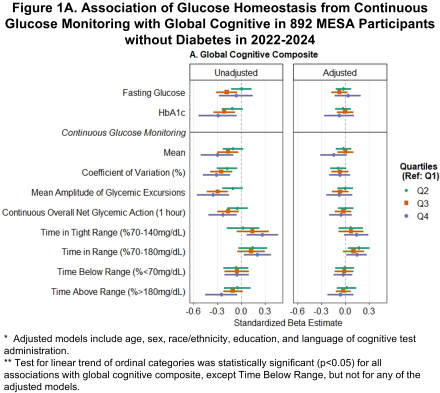
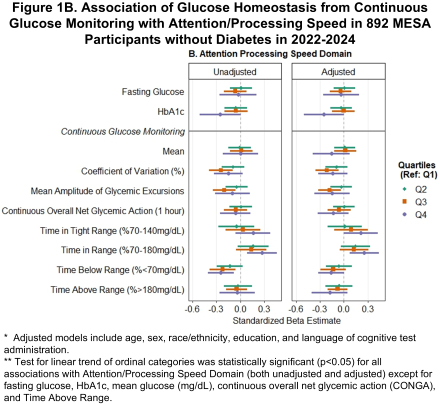
Abstract Body (Do not enter title and authors here): Background: Cardiometabolic disorders are a major contributor to cognitive decline and Alzheimer’s disease and related dementias; yet, gaps remain in our understanding of glucose homeostasis and cognitive function. Continuous glucose monitoring (CGM) offers new opportunities to understand these relationships beyond what is possible from fasting glucose and HbA1c. Hypothesis: CGM abnormalities will be associated with worse cognitive function. Methods: CGM was measured in Multi-Ethnic Study of Atherosclerosis (MESA) participants concurrently with cognitive testing in 2022-2024. We report unadjusted and adjusted standardized estimates from linear regression of CGM metrics as quartiles (including mean, variability measures, and time in range variables) with global cognitive function (Composite = mean of z-scores for Cognitive Abilities Screening Instrument (CASI), Digit Symbol Coding (DSC, attention/processing speed), Digit Span (DS, forwards and backwards recall of working memory)) and cognitive domain scores (from the Uniform Data Set (UDS) neuropsychological battery version 3: memory immediate and delayed, attention/processing speed, executive function, visuospatial, language). Results: A total of 892 participants without diabetes (mean age of 76 years; 57% female; 47% white; 24% African American; 19% Hispanic; 10% Asian) were included. Fasting glucose, HbA1c, and CGM variables were significantly associated with unadjusted global cognitive function and processing speed (Figure 1A); yet, substantial attenuation was seen with adjustment. Results for memory delayed domain were similar to those for global cognitive composite score except for clinical measurements, with similar but weaker results for memory immediate recall domain (data not shown). In contrast, estimates for coefficient of variation, mean amplitude of glycemic excursions, Time Below Range, Time Above Range, and Time In Tight Range with attention/processing speed domain were significant in both unadjusted and adjusted models (Figure 1B). Results for other domains were weaker and not significant (data not shown). Conclusion: This first cross-sectional look from MESA suggests a high level of heterogeneity in the associations between different CGM metrics and indicators of cognitive function; however, the stronger estimates for attention/processing speed, often the earliest indicator of cognitive decline, suggest that CGM metrics may offer insight into the pathways from dysglycemia to cognitive risk.
Mongraw-chaffin, Morgana
(
MedStar Health Research Institute
, Winston Salem , North Carolina , United States )
Chen, Shyh-huei
(
Wake Forest School of Medicine
, Winston Salem , North Carolina , United States )
Chen, Haiying
(
Wake Forest School of Medicine
, Winston Salem , North Carolina , United States )
Mcclain, Donald
(
Wake Forest School of Medicine
, Winston Salem , North Carolina , United States )
Schaich, Christopher
(
Wake Forest University
, Winston-Salem , North Carolina , United States )
Tanley, Jordan
(
Wake Forest School of Medicine
, Winston Salem , North Carolina , United States )
Hughes, Timothy
(
Wake Forest School of Medicine
, Winston Salem , North Carolina , United States )
Hayden, Kathleen
(
Wake Forest School of Medicine
, Winston-Salem , United States Minor Outlying Islands )
Author Disclosures:
Morgana Mongraw-Chaffin:DO NOT have relevant financial relationships
| Shyh-Huei Chen:No Answer
| Haiying Chen:DO NOT have relevant financial relationships
| Donald McClain:DO NOT have relevant financial relationships
| Christopher Schaich:DO NOT have relevant financial relationships
| Jordan Tanley:DO NOT have relevant financial relationships
| Timothy Hughes:DO NOT have relevant financial relationships
| Kathleen Hayden:No Answer