
Logo

American Heart Association

  26
  0


Final ID: Mo3132

Endovascular Treatment Versus Best Medical Therapy for Acute Ischemic Stroke Due to Medium or Distal Vessel Occlusions: A Meta-Analysis of Randomized Controlled Trials

Abstract Body (Do not enter title and authors here): Background:
The role of endovascular treatment (EVT) in acute ischemic stroke due to medium or distal vessel occlusions remains uncertain, with limited randomized evidence guiding clinical decision-making. This meta-analysis evaluates the efficacy and safety of EVT compared to best medical therapy (BMT) in this patient population.

Methods:
We systematically searched PubMed, Embase, and Cochrane Library for randomized controlled trials comparing EVT with BMT for acute ischemic stroke due to medium or distal vessel occlusions. Primary outcomes included all-cause mortality and favorable functional outcome defined by modified Rankin Scale (mRS) scores. Secondary outcomes included excellent functional outcome (mRS 0–1 at 90 days) and symptomatic intracranial hemorrhage (sICH). Pooled risk ratios (RRs) and 95% confidence intervals (CIs) were calculated using a random-effects model.

Results:
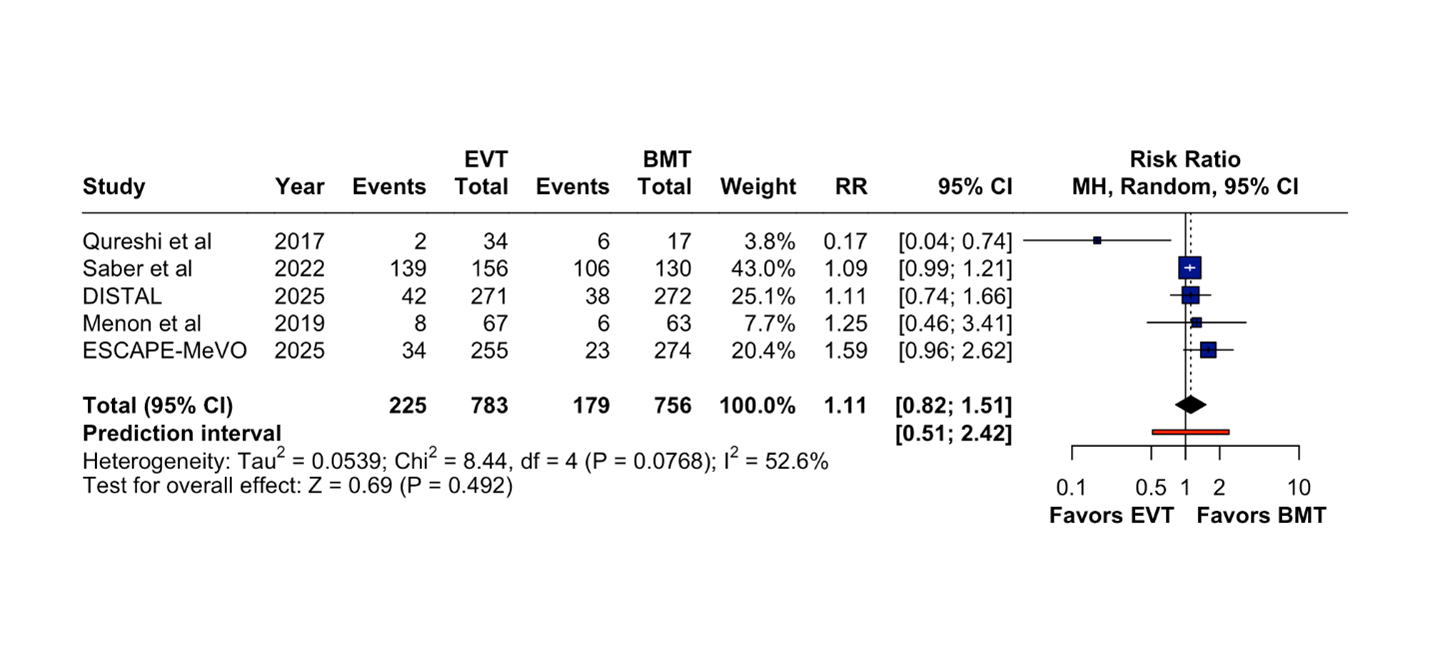
Five randomized controlled trials were included with 1,539 patients (783 EVT, 756 BMT). The mean age of the included studies was 73.4 years, while 56.6 % of the included studies were males. EVT was not associated with a significant reduction in all-cause mortality compared to BMT (RR = 1.11; 95% CI: 0.82–1.51; P = 0.492; I2 = 52.6%; Figure 1). Excellent functional outcome (mRS 0–1) was similar between groups (RR = 1.02; 95% CI: 0.90–1.16; P = 0.716; I2 = 39.6%). Likewise, favorable functional outcome (mRS 0–2) did not significantly differ (RR = 1.03; 95% CI: 0.90–1.18; P = 0.645; I2 = 50.0%). There was no significant difference in the incidence of sICH (RR = 1.30; 95% CI: 0.13–12.89; P = 0.822), although this analysis showed considerable heterogeneity (I2 = 96.1%).

Conclusion:
In patients with stroke due to medium or distal vessel occlusions, EVT did not significantly improve mortality or functional outcomes compared to BMT. The risk of sICH was not significantly increased, though safety data were limited by heterogeneity. Further large-scale trials are needed to clarify the clinical benefits of EVT in this subgroup.
  • Obi, Ogechukwu  ( New York Institute of Technology College of Osteopathic Medicine , Old Westbury , New York , United States )
  • Nweze, Uchenna  ( Kaiser Permanente Fontana Medical Center , Fontana , California , United States )
  • Unegbe, Chinenye  ( University of Sunderland , London , United Kingdom )
  • Asonye, Patricia  ( UIC Retzky College of Pharmacy , Chicago , Illinois , United States )
  • Lajczak, Pawel  ( Medical University of Silesia , Zabrze , Poland )
  • Author Disclosures:
    OGECHUKWU OBI: DO NOT have relevant financial relationships | Uchenna Nweze: DO NOT have relevant financial relationships | Chinenye Unegbe: No Answer | Patricia Asonye: No Answer | Pawel Lajczak: DO NOT have relevant financial relationships
Meeting Info:

Scientific Sessions 2025

2025

New Orleans, Louisiana

Session Info:

Cerebrovascular Disease: Aortic, Branch Vessel, and Carotid Issues

Monday, 11/10/2025 , 10:30AM - 11:30AM

Abstract Poster Board Session

More abstracts on this topic:
Evaluating Tenecteplase Versus Alteplase in Acute Ischemic Stroke Management: Real-World Insights for Clinical Decision-Making

Hong Lucia, Bannoud Makhlouf, Ibelaidene Maya, Woo Daniel, Novak Daniel

Catheter-Directed Intervention for High-Risk Acute Pulmonary Embolism in Patients with Cancer: Findings from the U.S. Nationwide Readmissions Database

Kumar Manoj, Ali Shafaqat, Nso Nso, Jamshed Aneeza, Murthi Mukunthan, Kumar Nomesh, Ricciardi Mark, Arman Qamar, Gomez Valencia Javier

You have to be authorized to contact abstract author. Please, Login
Not Available