
Logo

American Heart Association

  26
  0


Final ID: Su3143

Examination of ICU-Acquired Weakness in Patients with Acute Aortic Dissection

Abstract Body (Do not enter title and authors here): Background:
Post-intensive care syndrome (PICS) encompasses cognitive, psychiatric, and physical impairments that may persist following ICU and hospital discharge. Despite its clinical importance, PICS has been insufficiently studied in the context of cardiovascular disease. This study aimed to evaluate the extent of ICU-acquired weakness (ICU-AW), a physical manifestation of PICS, in patients with type B acute aortic dissection (AAD).
Methods:
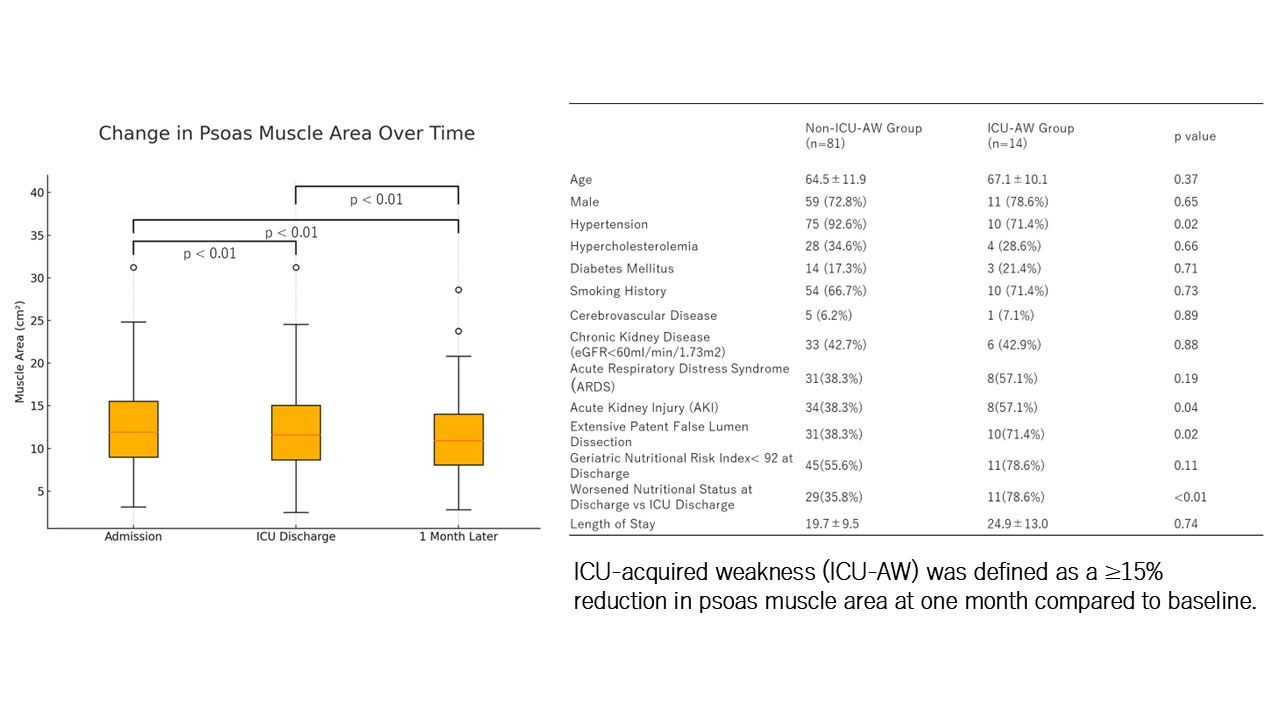
We retrospectively analyzed 95 patients admitted with type B AAD who received conservative treatment in the ICU. Computed tomography (CT) was performed at admission, approximately one week later, and one month after symptom onset. The cross-sectional area of the psoas muscle at the mid-level of the third lumbar vertebra (L3) was manually measured at each time point. Muscle mass loss was calculated, and nutritional status was assessed using the Geriatric Nutritional Risk Index (GNRI). ICU-AW was defined as a ≥15% reduction in psoas muscle area at one month compared to baseline. Extensive patent false lumen was defined as dissection extending below the diaphragm. Acute kidney injury (AKI) was defined as a ≥0.3 mg/dL or ≥1.5-fold increase in serum creatinine during hospitalization.
Results:
The average psoas muscle area decreased from 12.5 cm2at admission to 11.3 cm2at one month, representing a mean reduction of 9.6% (p < 0.01). ICU-AW was identified in 14 patients (14.7%).
The incidence of extensive patent false lumen was significantly higher in the ICU-AW group compared to the non-ICU-AW group (71.4% vs. 38.3%, p = 0.02). AKI was more frequently observed in the ICU-AW group (71.4% vs. 42.0%, p = 0.04). Furthermore, a decline in GNRI between ICU discharge and hospital discharge was more common in the ICU-AW group (78.6% vs. 35.8%, p < 0.01). (see table 1)
Conclusions:
Patients with type B acute aortic dissection often develop ICU-acquired muscle weakness, which persists beyond the acute phase. ICU-AW was significantly associated with greater disease severity, nutritional decline, and renal dysfunction, highlighting the need for comprehensive monitoring and rehabilitation strategies in this population.
  • Nemoto, Naohiko  ( Ota Memorial Hospital , Ota , Japan )
  • Kameda, Yuika  ( Ota Memorial Hospital , Gunma , Japan )
  • Anzai, Hitoshi  ( Ota Memorial Hospital , Ota , Japan )
  • Takenaka, Hiroki  ( Ota Memorial Hospital , Ota , Japan )
  • Author Disclosures:
    Naohiko Nemoto: DO NOT have relevant financial relationships | Yuika Kameda: DO NOT have relevant financial relationships | Hitoshi Anzai: No Answer | HIROKI TAKENAKA: No Answer
Meeting Info:

Scientific Sessions 2025

2025

New Orleans, Louisiana

Session Info:

Aortic Disease

Sunday, 11/09/2025 , 03:15PM - 04:15PM

Abstract Poster Board Session

You have to be authorized to contact abstract author. Please, Login
Not Available