Lower Very Short-Term Blood Pressure Variability Is Associated with Atrial Fibrillation Recurrence after Catheter Ablation
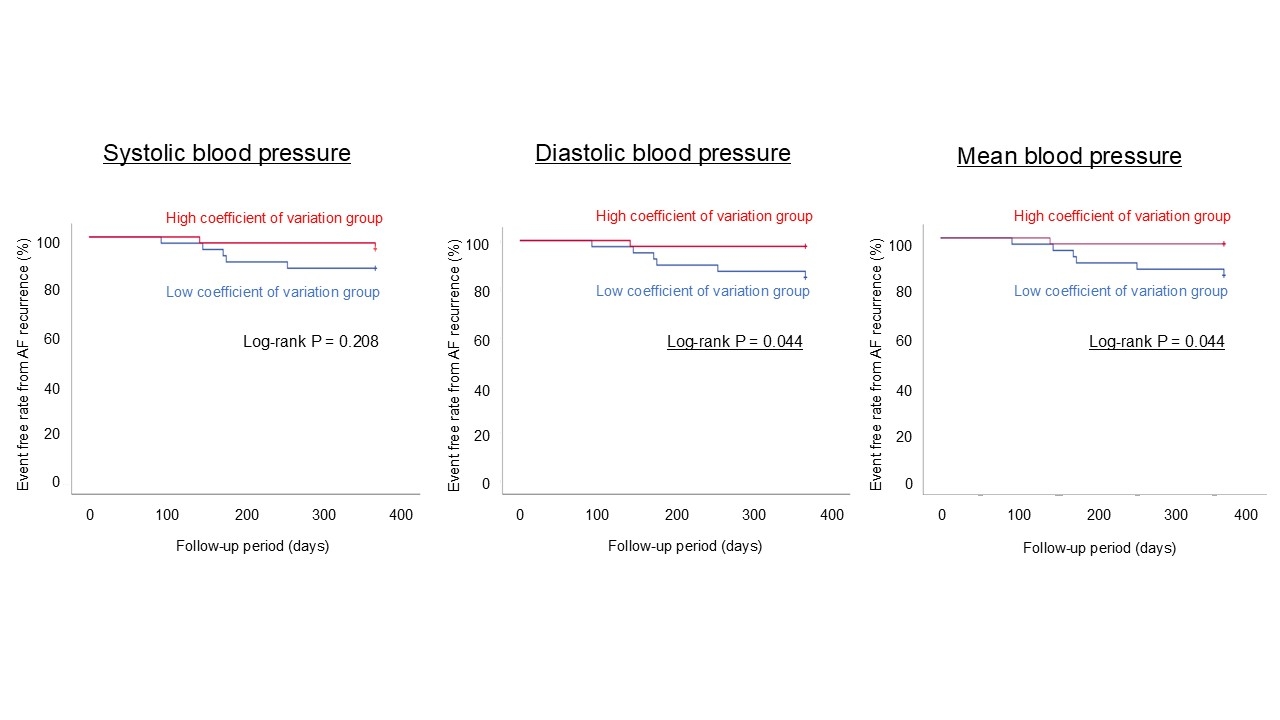
Abstract Body (Do not enter title and authors here): Background Very short-term blood pressure variability (BPV), derived from pulse transit time monitoring, is recently recognized as an independent cardiovascular risk marker. However, its association with atrial fibrillation (AF) recurrence after catheter ablation remains unclear. Hypothesis We hypothesized that very short-term BPV, measured prior to catheter ablation, would predict AF recurrence during follow-up. Methods We enrolled 80 consecutive patients (mean age: 65.0 years; 79% male) undergoing first-time catheter ablation for AF. On the night before the procedure, continuous overnight blood pressure monitoring was performed during sinus rhythm using a pulse transit time-based device. Pulse transit time was defined as the interval from the R-wave on the electrocardiogram to the upstroke of the pulse wave detected by fingertip photoplethysmography. Beat-to-beat systolic, diastolic, and mean blood pressure values were reconstructed, and very short-term BPV was quantified using the coefficient of variation for each parameter. AF recurrence, defined as any atrial tachyarrhythmia lasting ≥30 seconds after a 3-month blanking period, was prospectively assessed over a 12-month follow-up period. Results During follow-up, 7 patients (8.8%) experienced AF recurrence. Patients were divided into two groups based on the median value of each BPV parameter. Kaplan–Meier analysis demonstrated significantly higher recurrence rates in the lower coefficient of variation groups for diastolic and mean blood pressure, whereas no significant difference was observed for systolic blood pressure (Figure). In univariate Cox proportional hazards analysis including clinical characteristics (age, sex, and comorbidities), echocardiographic findings (e.g. left ventricular ejection fraction and left atrial size), laboratory data (e.g. brain natriuretic peptide, hemoglobin, and glomerular filtration rate), and very short-term BPV parameters, only the coefficients of variation for diastolic (per 1% increase: hazard ratio 0.350, 95% confidence interval 0.146-0.838, P = 0.018) and mean blood pressure (per 1% increase: hazard ratio 0.358, 95% confidence interval 0.133-0.964, P = 0.042) were significantly associated with AF recurrence. Conclusion Lower very short-term blood pressure variability, particularly as reflected by reduced variability in diastolic and mean blood pressure, was significantly associated with a higher risk of AF recurrence following catheter ablation.
Murota, Sadahiro
(
FUKUSHIMA MEDICAL UNIV
, Fukushima , Japan )
Nodera, Minoru
(
FUKUSHIMA MEDICAL UNIV
, Fukushima , Japan )
Ohashi, Naoto
(
FUKUSHIMA MEDICAL UNIV
, Fukushima , Japan )
Ogawara, Ryo
(
FUKUSHIMA MEDICAL UNIV
, Fukushima , Japan )
Sato, Yu
(
FUKUSHIMA MEDICAL UNIV
, Fukushima , Japan )
Yokokawa, Tetsuro
(
FUKUSHIMA MEDICAL UNIV
, Fukushima , Japan )
Misaka, Tomofumi
(
FUKUSHIMA MEDICAL UNIV
, Fukushima , Japan )
Yamada, Shinya
(
FUKUSHIMA MEDICAL UNIV
, Fukushima , Japan )
Kaneshiro, Takashi
(
FUKUSHIMA MEDICAL UNIV
, Fukushima , Japan )
Yoshihisa, Akiomi
(
FUKUSHIMA MEDICAL UNIV
, Fukushima , Japan )
Takeishi, Yasuchika
(
FUKUSHIMA MEDICAL UNIV
, Fukushima , Japan )
Author Disclosures:
Sadahiro Murota:DO NOT have relevant financial relationships
| Akiomi Yoshihisa:DO NOT have relevant financial relationships
| Yasuchika Takeishi:DO NOT have relevant financial relationships
| Minoru Nodera:DO NOT have relevant financial relationships
| Naoto Ohashi:DO NOT have relevant financial relationships
| Ryo Ogawara:DO NOT have relevant financial relationships
| Yu Sato:DO NOT have relevant financial relationships
| Tetsuro Yokokawa:DO NOT have relevant financial relationships
| Tomofumi Misaka:DO NOT have relevant financial relationships
| Shinya Yamada:DO NOT have relevant financial relationships
| Takashi Kaneshiro:DO NOT have relevant financial relationships